
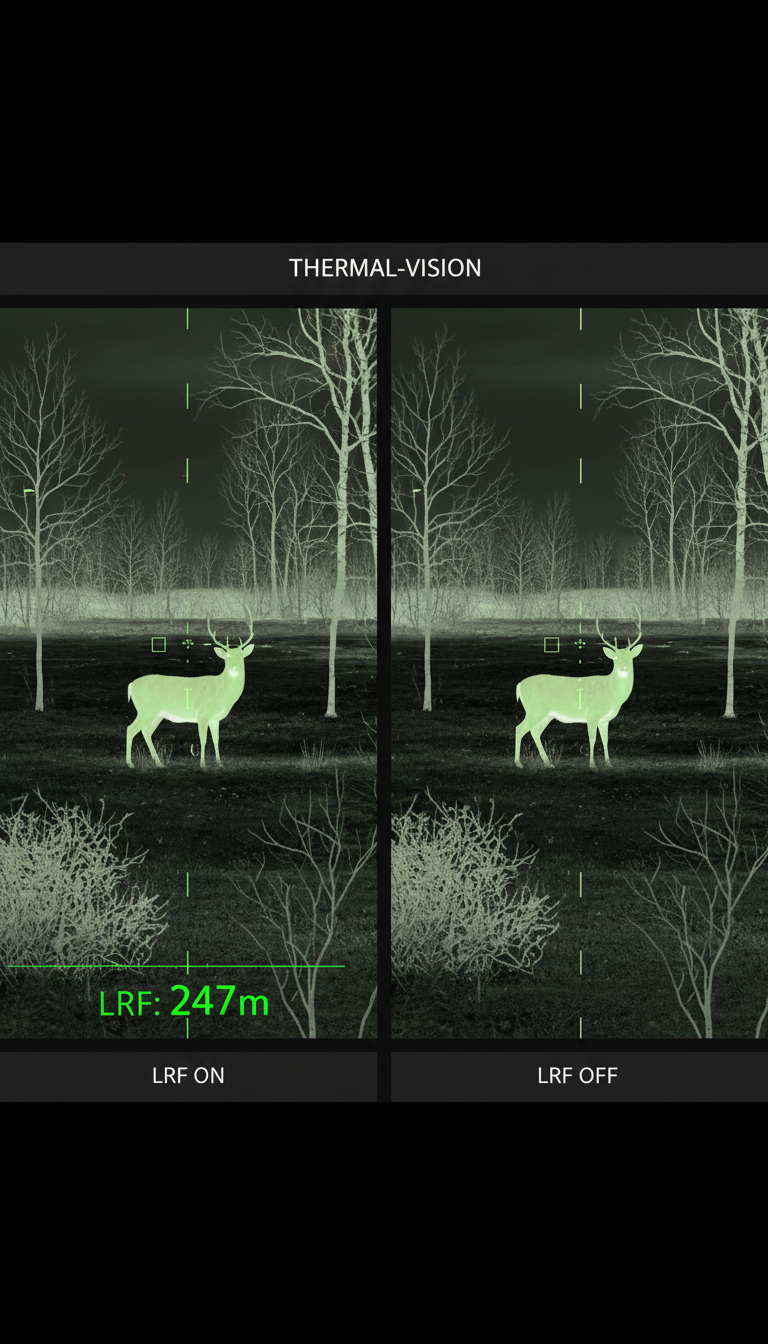
If you’re shopping for a thermal scope, you’ve probably noticed some models include LRF and some don’t — and the price jump can be significant.
So the real question is simple: will LRF actually help you hunt better, faster, and more confidently at night?
This guide breaks it down in plain English, with practical “when it matters” scenarios and a shortlist of LRF thermal options to consider.
What is LRF?
LRF = Laser Range Finder
On a thermal scope, LRF gives you an instant distance reading to your target (usually in metres). That distance matters because your point of impact changes with range — and at night, it’s much easier to misjudge how far away an animal really is.
Why distance is harder to judge through thermal
Thermal is amazing for detection and identification, but it can make distance feel deceptive because:
- You lose many daytime depth cues (colour, shadows, fine detail)
- Terrain can look “flatter” than it really is
- Animals can appear closer or farther depending on humidity, background heat, and contrast
- Opportunities are often quick — you don’t always have time to range landmarks first
That’s why LRF can be more than a nice-to-have: it removes the guesswork.
When LRF is 100% worth it
LRF is a strong “yes” if you regularly hunt in situations like these:
- Open paddocks / crop edges / firebreaks where targets can appear at any distance
- Mixed-distance hunting (one minute it’s 60–80m, next minute it’s 150–200m)
- You want to reduce misses or poor hits caused by holdover guesswork
- You often shoot when it’s fast-paced (multiple animals, moving targets, short windows)
Rule of thumb: If you’ve ever thought “I’m not sure if that’s 120m or 180m”, LRF will earn its keep.
The hidden benefit: faster “yes/no” decisions
Most people think LRF is only for long shots.
In reality, one of the biggest advantages is decision speed:
- In range? Take the shot confidently.
- Not in range? Don’t force it.
That quick clarity can prevent rushed shots and second-guessing — especially when you’re tired, it’s late, or the animal won’t stand still.
When you might not need LRF
LRF may be less important if your hunting is mostly:
- Short-range and predictable (tight scrub, bait sites, defined shooting lanes)
- In areas where you can pre-range landmarks and your distances don’t change much
Even then, plenty of hunters still choose LRF for convenience — but it’s most valuable when distances vary
Quick checklist: Is LRF right for you?
If you tick two or more, LRF is likely worth it:
- I hunt open country where distances change constantly
- I take shots past 150m (or I want the option)
- I don’t want to guess holdover at night
- I often have quick opportunities and limited time to set up
- I want the simplest, most confident thermal workflow
Share:
Detection vs. Identification Range in Thermal Scopes | GoingDark Australia
Picking the Perfect Colour Palette