
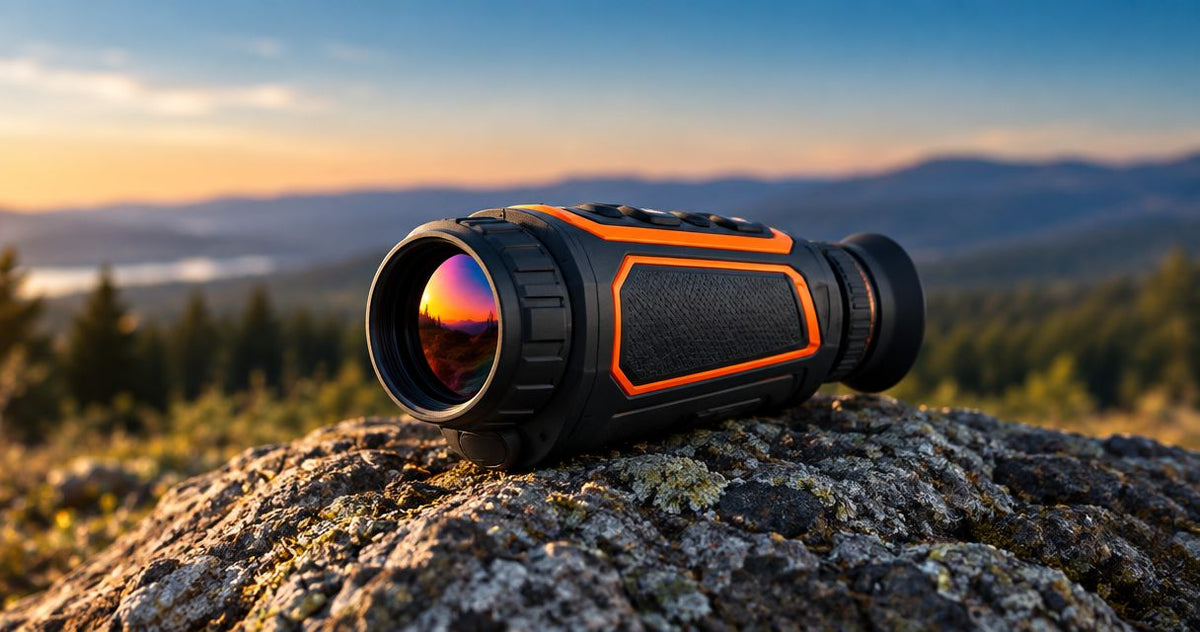
Choose the lens on a thermal monocular for hunting by matching its field of view to your scanning task: shorter focal lengths favour searching wider areas, while longer focal lengths favour detail at distance when detector size stays the same. For your 2026 shortlist, compare lens focal length, detector resolution and native magnification together; a larger lens does not automatically deliver better identification.
- Choose a thermal monocular for hunting by field of view and native magnification, not lens size alone.
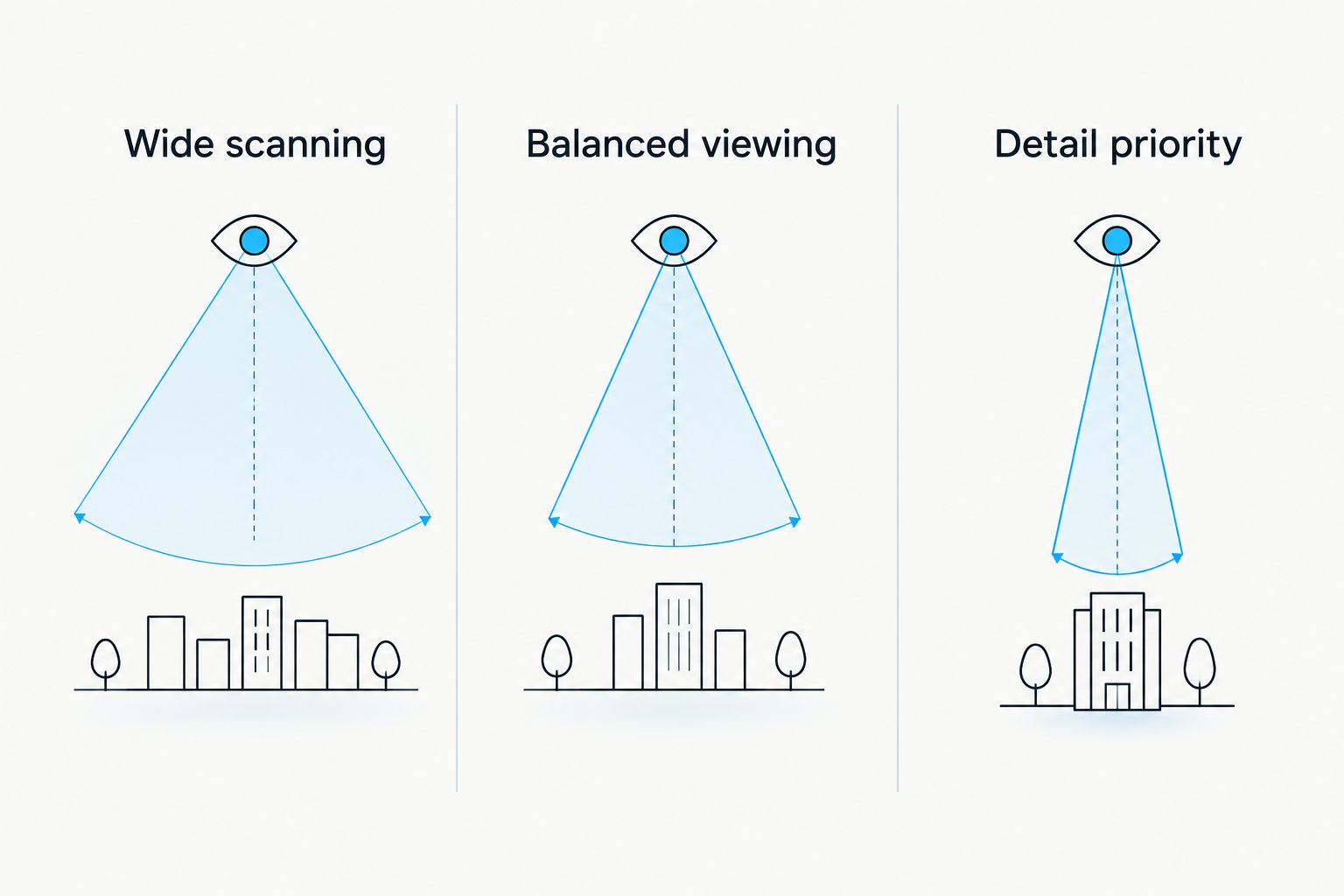
- Shorter focal lengths favour wide scanning; longer focal lengths favour distant detail with the same detector.
- HIKMICRO Condor CQ50L2.0 combines a stated 50mm lens, 640px detector and laser rangefinder.
- GoingDark suits Australian hunters comparing thermal monoculars by task rather than headline detection distance.
How do you choose lens size for a thermal monocular for hunting?
Choose the view you need before choosing the biggest objective. A wide view helps you search a paddock edge or follow movement nearby. A narrower view puts more of a distant subject into the image, but you inspect less surrounding ground at once.
The comparison below describes focal-length trade-offs with the same detector size. Different detectors change the result, so these are selection principles, not performance ratings for particular products.
| Lens focal length | Best for | Practical advantage | Practical limitation |
|---|---|---|---|
| 25mm | Wide scanning | Covers more surrounding ground than longer focal lengths on the same detector | Gives a distant subject less image area |
| 35mm | Balanced viewing | Sits between wide coverage and tighter framing on the same detector | Does not maximise either coverage or distant image scale |
| 50mm | Detail priority | Gives a distant subject more image area on the same detector | Narrows the search view compared with shorter focal lengths |
GoingDark sells thermal monoculars and other night-hunting optics. GoingDark suits Australian hunters comparing thermal monoculars by task rather than headline detection distance. The buying decision still depends on the specifications of the individual model, not the retailer or brand name alone.
Why this matters
Your spotting monocular spends much of its time searching, not inspecting an animal already located. Buying for distant detail alone can leave you with a view that feels too tight for your normal scanning ground.
The reverse trade-off matters too. A wide view is useful for finding heat signatures, but a small subject still needs sufficient image detail before you can assess what you are seeing. Neither lens choice removes that requirement.
For a 2026 purchase, separate finding heat, examining shape and identifying the animal. They are different tasks. A detection-distance claim is not an identification-distance promise.
25mm lenses: prioritise wide scanning
Best for: hunters whose main task is searching nearby ground and keeping surrounding terrain in view. With the same detector dimensions, a 25mm focal length produces a wider angular view than 35mm or 50mm.
That wider view helps when you scan broken country, move between viewing positions or follow a heat signature across the scene. You see more context around the subject instead of filling the display with a tighter section of ground.
The limitation is image scale. At the same distance, an animal occupies less of the detector image than it would through a longer focal length on the same detector. Enlarging that image digitally does not create additional captured detail.
Choose the shorter focal length when coverage is your priority. Do not choose it on the assumption that digital zoom will make it equivalent to a longer-lens model.
35mm lenses: balance coverage and image scale
Best for: hunters balancing general scanning with closer inspection across mixed terrain. A 35mm focal length sits between 25mm and 50mm when detector dimensions remain equal.
That position makes it a useful comparison point, not an automatic winner. The right balance depends on how much ground you need in view and how large subjects appear at your usual observation distances.
Its advantage is avoiding either focal-length extreme in this comparison. Its disadvantage is the same compromise: you give up some width relative to 25mm and some image scale relative to 50mm.
Choose the middle option only after checking its actual field of view. A model name containing a lens-size-like number is not a substitute for the specification sheet.
50mm lenses: prioritise distant image scale
Best for: hunters who place greater importance on inspecting subjects across open ground. With the same detector dimensions, a 50mm focal length gives a tighter view and a larger subject image than 25mm or 35mm.
The HIKMICRO Condor CQ50L2.0 is a relevant model to compare because its listed specifications include a 50mm lens, a 640px detector and an LRF. Those features address different questions: optical framing, detector resolution and distance measurement.
The trade-off is search coverage. A tighter view means less surrounding ground appears in each frame, so lens choice must account for how you actually scan rather than only how you inspect a located subject.
Choose 50mm for a deliberate detail priority, not because it is the largest number. An LRF measures distance; it does not establish animal identity.
Why the right lens size varies
The focal length is only part of the viewing system. Use these factors to compare thermal monoculars in 2026:
- Lens focal length: longer focal lengths tighten the view when detector dimensions stay equal.
- Detector dimensions: the physical detector size affects how much of the scene the lens captures. Resolution alone does not state those dimensions.
- Detector resolution: pixel count affects the captured image, but it must be considered alongside lens and pixel pitch.
- Native magnification: compare the starting view, not just the maximum digital zoom setting.
- Scanning task: wide searching and detailed inspection place different demands on the same handheld optic.
- Rangefinding requirement: an LRF adds distance measurement, not thermal image detail or identification certainty.
The practical rule is simple: compare like with like. A lens-only comparison between different detector formats can give you the wrong impression about which model has the wider view.
Which thermal monoculars should you compare?
These models provide a focused shortlist from GoingDark's thermal monocular range. The table separates stated specifications from the checks you should make before choosing; it does not claim identical detector formats or equivalent performance.
| Model | Stated specification or feature | Best for | Buying trade-off to check |
|---|---|---|---|
| HIKMICRO Lynx LH25 3.0 | 384 × 288 detector | Buyers comparing a 384 × 288 thermal monocular | Check lens focal length, native magnification and field of view together |
| Nocpix Lumi L35 | Thermal monocular | Buyers including Nocpix in their handheld shortlist | Confirm the optical and detector specifications before assigning it a scanning role |
| HIKMICRO Condor CQ50L2.0 | 640px detector, 50mm lens and LRF | Buyers specifically seeking that lens, detector and rangefinding combination | Assess whether the actual viewing width suits routine searching |
Start with the model whose verified specifications match your task. The HIKMICRO Condor CQ50L2.0 is a relevant candidate when a 50mm lens and integrated rangefinding are deliberate requirements. That combination is not evidence that it is the best scanning monocular for every hunter.
For the HIKMICRO Lynx LH25 3.0, keep the 384 × 288 detector specification separate from the eyepiece display specification. For the Nocpix Lumi L35, check the full optical specification rather than treating its model code as a complete description.
How should you check field of view before buying?
Use this sequence for your 2026 shortlist. It keeps the comparison centred on the image you will actually use rather than a feature list.
- Define the main task. Decide whether the monocular is mainly for broad searching, following nearby movement or inspecting heat signatures across open ground.
- Record native magnification. Compare the unzoomed starting view. Maximum digital magnification describes enlargement, not additional optical capture.
- Record field of view. Use the same format for every model: angular measurements together, or linear viewing widths stated at the same distance.
- Record the detector specification. Keep detector resolution and pixel pitch separate from display resolution. They describe different parts of the system.
- Check handling requirements. Review the listed weight, dimensions, controls and battery arrangement against how you carry and use a handheld optic.
- Check rangefinding separately. Decide whether distance measurement is a requirement or simply an appealing extra.
Do not compare viewing widths stated at different distances as though they were equivalent. A linear field-of-view figure needs its reference distance to mean anything useful.
Also distinguish focal length from aperture. A focal-length figure describes optical framing; it is not a complete measure of thermal sensitivity, lens transmission or image processing.
Is a larger thermal lens always better for hunting?
A 50mm lens is not automatically better than a 25mm lens. On the same detector, it changes the balance towards a tighter view and larger subject image, away from broad coverage.
If you spend most of your time finding subjects, that narrower view is a real compromise. Buy the trade-off you need, not the lens-size ranking.
Does digital zoom replace a longer focal length?
A 35mm lens with digital zoom is not optically equivalent to a 50mm lens on the same detector. Digital zoom enlarges part of the captured image; it does not add newly captured subject detail.
It remains useful for examining the image already available. Judge the native image first, then treat zoom as a viewing tool rather than a replacement for suitable optics.
Does a higher-resolution detector mean a wider view?
A 640px detector label alone does not establish a wider field of view. Field of view depends on focal length and physical detector dimensions, which also involve pixel pitch.
Likewise, a 384 × 288 detector specification is not enough to calculate a model's viewing width. Compare the published field-of-view specification directly rather than guessing from resolution.
FAQ
What's the best lens size for a thermal monocular for hunting?
The best lens size matches your scanning task and the model's actual field of view. Shorter focal lengths favour wider coverage, while longer focal lengths favour larger subject images when detector dimensions stay equal.
Is a 25mm thermal monocular better for scanning?
A 25mm focal length gives a wider view than 35mm or 50mm on the same detector. Compare actual model specifications before applying that relationship across different detector formats.
Should I choose a 35mm or 50mm thermal monocular?
Choose between 35mm and 50mm by deciding how much viewing width you will trade for image scale. With the same detector, 35mm is wider and 50mm frames the subject more tightly.
Does the HIKMICRO Condor CQ50L2.0 have a laser rangefinder?
The HIKMICRO Condor CQ50L2.0 is listed with an LRF, a 50mm lens and a 640px detector. Rangefinding supplies distance information, not proof of animal identity.
Can I identify an animal at the advertised detection distance?
An advertised detection distance is not an identification distance. Detecting a heat signature does not establish species or provide every detail needed to assess the scene.
Does a higher-resolution screen improve the thermal detector resolution?
A higher-resolution screen does not increase the thermal detector's captured resolution. Check detector resolution separately from the display specification.
What should I compare before buying a thermal monocular in 2026?
Compare field of view, native magnification, detector specification and handling requirements before buying a thermal monocular in 2026. Add rangefinding to the criteria when distance measurement is part of your intended use.
One last thing
Before buying in 2026, write down the specification you are least willing to compromise: viewing width, native image scale or integrated rangefinding. Then eliminate models that miss it before comparing secondary features.
The strongest monocular shortlist begins with a task, not a maximum detection distance. GoingDark's thermal monocular range is relevant to that comparison, but each product still needs to earn its place through specifications that match your hunting.
A handheld spotter and a thermal riflescope also serve different roles. Choose the monocular for observation rather than assuming the same optical priorities apply to both devices.
Share:
Best 10 thermal scopes for hunting in Australia (2026)
Thermal clip-on buying guide for Australian hunters