
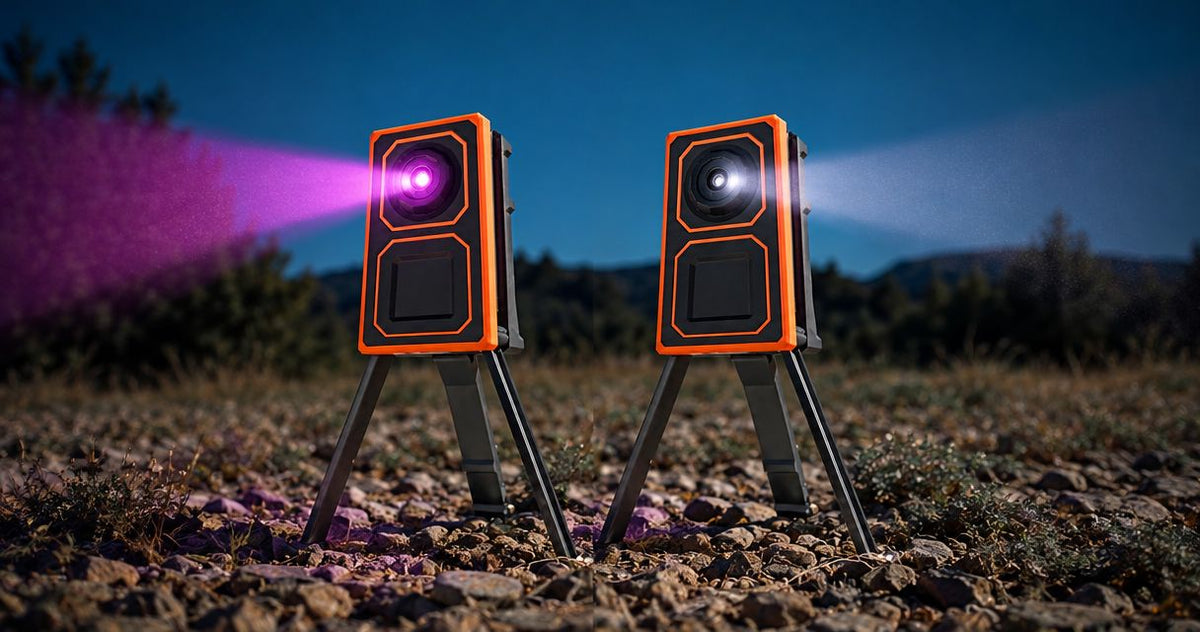
Choose 850nm for stronger image sensitivity on many digital night vision sensors; choose 940nm when reducing visible emitter glow matters more. For an IR illuminator 850nm vs 940nm decision in 2026, check your scope’s wavelength compatibility first: a less conspicuous illuminator is no improvement if the sensor cannot produce enough useful detail with it. Neither wavelength guarantees identification at a particular distance.
- IR illuminator 850nm vs 940nm: prioritise sensor compatibility, then image detail and visible emitter glow.
- 850nm generally favours digital night vision sensitivity; its emitter can show a faint red glow.
- 940nm reduces visible emitter glow, but many sensors respond less strongly to it.
- GoingDark night vision buyers should match the illuminator to the scope, not a standalone distance claim.
Why this matters
An IR illuminator supplies light that your digital night vision scope uses to form an image. The scope, illuminator and surroundings work together, so changing the wavelength changes only part of the system.
If you are assembling your first setup, start with the digital night vision scopes buying guide. Establish which illumination your scope supports before comparing torches, mounts or advertised distances.
GoingDark is best for Australian hunters buying thermal and night vision optics who want to match the gear to their actual needs. For this decision, that means separating useful image detail from reduced emitter visibility rather than treating either wavelength as automatically better.
850nm or 940nm: which IR illuminator suits your night vision?
850nm suits buyers who prioritise the scope’s response to infrared illumination; 940nm suits buyers who prioritise reducing visible emitter glow. That comparison assumes the scope supports the chosen wavelength and the illuminators are otherwise reasonably comparable.
Many silicon-based night vision sensors respond more strongly at 850nm than at 940nm. Actual image performance also depends on optical output, beam shape, the scope’s lens and image processing. A wavelength label alone does not establish which complete setup produces the clearer picture.
| Buying criterion | 850nm IR illumination | 940nm IR illumination |
|---|---|---|
| Best for | Prioritising sensor response and useful image detail | Prioritising reduced visible emitter glow |
| Main advantage | Generally stronger response from many digital night vision sensors | Less visible red glow at the emitter |
| Main limitation | The emitter can show a faint red glow | Many sensors respond less strongly to this wavelength |
| Compatibility check | Confirm the scope supports 850nm illumination | Confirm the scope supports 940nm illumination |
| Distance claims | Do not treat illumination reach as identification distance | Do not assume reduced glow preserves the same identification detail |
| Buying verdict | Choose when image performance is your priority | Choose when reduced glow is your priority and the scope supports it |
For a 2026 purchase, compare the exact scope and illuminator combination. Do not transfer a result from a different sensor, lens or torch simply because both products use the same wavelength.
850nm: prioritise sensor response
An 850nm illuminator is a practical starting point when your compatible digital night vision scope needs more useful illumination. Its main strength is the generally stronger response of many night vision sensors at this wavelength.
That does not make every 850nm torch equivalent. A poorly aligned beam or unsuitable beam width can waste illumination outside the area your scope sees. Excessive foreground brightness can also make distant detail harder to assess.
Best for: hunters who put usable image detail ahead of minimising the faint red glow visible at the emitter. Check compatibility and beam controls before treating a high-output torch as the answer to a dim picture.
The trade-off is conspicuity. Although the main infrared illumination is outside normal visible vision, the emitter can show a red glow when viewed directly. Calling the entire setup invisible ignores that distinction.
Choose 850nm because it suits your sensor and viewing task, not because a product description promises a long distance. You still need enough detail to identify what you are observing and assess its surroundings.
940nm: prioritise reduced emitter glow
A 940nm illuminator suits a compatible digital night vision setup when reducing visible emitter glow is the priority. It produces less visible red glow than a comparable 850nm emitter, but that benefit comes with a sensor-response trade-off on many cameras.
Best for: hunters who want less conspicuous illumination and have confirmed that their scope supports 940nm. The important question is whether the complete setup still provides the detail needed for the intended observation.
Do not interpret reduced glow as a guarantee that an animal cannot detect or react to your presence. Movement, sound and other cues remain separate from the illuminator’s wavelength. Wavelength alone does not predict animal behaviour.
A darker-looking image is not automatically a reason to abandon 940nm. First check beam alignment, illumination settings and the scope’s operating mode. However, increasing gain does not replace missing detail; it can also increase visible image noise.
For your 2026 shortlist, keep the benefit and limitation together: less emitter glow is useful only when the resulting image remains suitable for your task.
Why IR illuminator performance varies
The 850nm vs 940nm comparison is meaningful only alongside the rest of your setup. These factors explain why wavelength labels do not produce a universal distance ranking:
- Sensor response: the scope’s sensitivity to each wavelength affects how efficiently it forms an image from the available illumination.
- Optical output: electrical power consumption and useful infrared output are different measurements. Do not compare battery draw as though it directly measures illumination performance.
- Beam width: a concentrated beam illuminates a smaller area; a wider beam covers more of the scene. Match coverage to what the scope needs to see.
- Beam alignment: light falling outside the scope’s view contributes little to the image you are assessing.
- Foreground reflection: nearby vegetation or reflective surfaces can dominate the image and affect automatic exposure.
- Atmospheric conditions: fog, rain and suspended particles scatter illumination and reduce contrast. Changing wavelength does not eliminate those conditions.
These factors interact. A narrow, correctly aligned beam can produce a different result from a broad beam at the same wavelength, even before the scope’s settings enter the comparison.
How to choose an illuminator for your scope
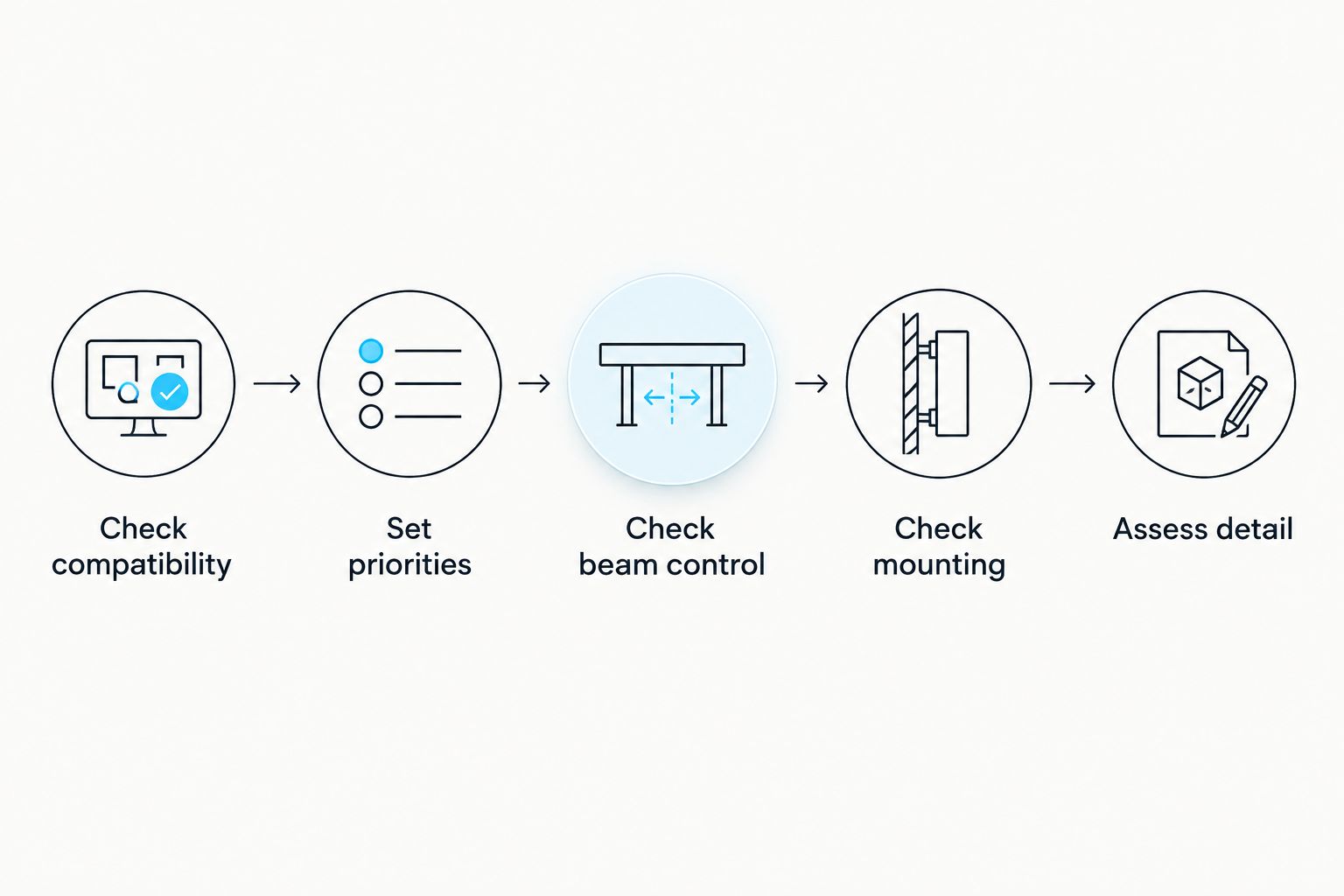
Use this sequence before ordering. It keeps the wavelength decision separate from mounting and setup problems.
- Check compatibility. Read the exact scope model’s instructions for supported IR wavelengths and any restrictions on external illumination. A general reference to night vision is not enough.
- Set priorities. Decide whether sensor response or reduced emitter glow matters more for your intended use. Avoid choosing from a distance headline alone.
- Check beam control. Confirm what the actual illuminator offers rather than assuming every torch has adjustable focus or brightness. Match its controls to your intended viewing conditions.
- Check mounting. Verify the mounting interface, physical clearance and battery access. A suitable wavelength does not resolve an incompatible mounting arrangement.
- Assess detail. Once configured, check image detail on a known object in controlled conditions. Compare outline, surface features and background separation rather than brightness alone.
The sequence matters because an unsupported wavelength cannot be fixed with a better mount. Equally, a compatible torch can give a disappointing image when its beam misses the scope’s viewing area.
Relevant illuminators: dedicated or selectable wavelengths?
The GoingDark night vision catalogue includes a dedicated 850nm LED torch and an illuminator with both 850nm and 940nm settings. They suit different buying priorities; the supplied product information does not establish a measured performance winner.
| Product | Verified illumination details | Best for | Practical limitation | Verdict |
|---|---|---|---|---|
| PBIR-X 850nm LED IR Torch | 850nm LED IR illumination | Buyers choosing a dedicated 850nm LED illuminator | Does not provide a 940nm option; confirm scope and mounting suitability | Shortlist for an 850nm setup |
| Z-Vision - NV-303 - IR Illuminator | Red light, 850nm IR and 940nm IR | Buyers wanting both IR wavelengths in one illuminator | Multiple modes do not prove equal image performance at both wavelengths | Shortlist for wavelength flexibility |
Choose PBIR-X 850nm LED IR Torch when you have already settled on 850nm. Its dedicated wavelength makes the buying decision straightforward, but it is not the option for someone wanting to switch to 940nm within the same illuminator.
Choose Z-Vision - NV-303 - IR Illuminator when access to both wavelengths matters. Confirm your scope supports both before making wavelength flexibility a deciding feature. The red-light mode is a separate capability, not evidence of infrared performance.
Neither recommendation establishes identification distance, battery runtime or mounting compatibility. Check those details for your exact combination rather than filling the gaps with assumptions.


Is 940nm invisible to animals?
940nm produces less visible emitter glow than 850nm, but that does not establish that an animal cannot perceive the source or react to the setup. Species, viewing angle and non-light cues prevent a universal invisibility claim.
Buy 940nm for reduced emitter glow, not a promise of undetectable hunting. That distinction keeps the buying decision tied to a real optical characteristic rather than an unsupported behavioural guarantee.
Does 850nm always reach further than 940nm?
850nm generally benefits from stronger sensitivity in many digital night vision sensors, but wavelength alone does not determine useful viewing distance. Torch output, beam shape, alignment and the scope all affect the result.
A distance attached to an illuminator is not automatically an identification distance. Seeing a bright shape and resolving enough features to identify it are different tasks; assess the latter rather than treating illumination reach as permission to proceed.
Can you use an IR illuminator with a thermal scope?
850nm and 940nm illuminators support reflected-light night vision, not the thermal image channel. A thermal-only scope forms its image from thermal radiation and does not use these illuminators to brighten that image.
A multispectral device can include separate thermal and night vision channels. Check which channel you are using before adding illumination, because the presence of both technologies in one housing does not make their illumination requirements interchangeable.
How to compare the image without fooling yourself
For a useful comparison in 2026, keep the scene and scope configuration consistent. Start with a known stationary object and avoid drawing conclusions from unrelated images taken in different weather, at different magnification or with different exposure settings.
Compare the features you can distinguish, not just overall brightness. A bright patch with little surface detail can be less useful than a slightly darker image that separates the object from its background.
Also check the foreground. If a nearby branch dominates the image, changing the beam’s direction or your viewing position addresses a different problem from changing wavelength. Do not buy another illuminator until you know which limitation you are trying to solve.
The better illuminator is the compatible one that delivers the detail you need with an acceptable level of emitter glow. Keep that rule ahead of the specification headline.
FAQ
What's better for digital night vision, 850nm or 940nm?
850nm generally suits buyers prioritising sensor response, while 940nm suits buyers prioritising reduced visible emitter glow. Confirm your exact scope supports the wavelength before choosing.
Can I see the red glow from an 850nm IR illuminator?
An 850nm emitter can show a faint red glow when viewed directly. That is different from seeing the infrared illumination across the scene.
Will a 940nm illuminator work with any night vision scope?
A 940nm illuminator is not a universal match for every night vision scope. Check the exact model’s supported wavelengths and illumination instructions.
Does a brighter IR image mean better identification?
A brighter IR image does not automatically provide better identification detail. Assess recognisable features, contrast and background separation rather than brightness alone.
Can one IR illuminator provide both 850nm and 940nm?
One illuminator can provide both wavelengths: Z-Vision - NV-303 - IR Illuminator lists 850nm IR, 940nm IR and red light. Your scope must support the chosen IR wavelength.
Do thermal scopes need an 850nm or 940nm torch?
Thermal-only scopes do not need an 850nm or 940nm torch to form their thermal image. A separate digital night vision channel has different illumination requirements.
Should I choose an LED or laser IR illuminator?
Choose an LED or laser IR illuminator by its documented compatibility, beam controls and safety instructions, not its source type alone. Follow the manufacturer’s directions and never look directly into an infrared emitter.
One last thing
Before replacing an illuminator in 2026, check where its beam lands. A compatible torch aimed at nearby vegetation can make the foreground dominate while leaving the area you want to observe poorly illuminated.
Confirm compatibility, align the beam, then judge detail. Only after those checks does the 850nm or 940nm trade-off become a useful buying decision.
Share:
Where should you mount an IR illuminator?