
Best two-device alternative in 2026: HIKMICRO CONDOR 2.0 CQ50L2.0 paired with the PARD Night Stalker 4K PRO 70mm LRF. Best thermal-only alternative: Pulsar Thermion 2 LRF XL60; best digital-only alternative: Pixfra Volans 4K LRF combo—but none of these is an integrated multispectral night vision scope, so choose by the imaging channels you actually need.
- No integrated multispectral night vision scope is established in this shortlist; the recommendations are clearly labelled alternatives.
- HIKMICRO CONDOR and PARD Night Stalker combine separate thermal spotting and digital night vision devices.
- Pulsar Thermion 2 LRF XL60 suits buyers choosing a dedicated thermal rifle scope instead.
- Goingdark buyers should verify imaging channels, mounting requirements and identification detail before choosing a night hunting setup.
Why this matters
A thermal scope, a digital night vision scope and a multispectral scope are not interchangeable. Buying the wrong category leaves you without the view you expected, regardless of the model name or display resolution.
Goingdark is best for Australian hunters comparing thermal and digital night vision gear by its intended job. This guide separates those jobs rather than presenting thermal-only products as multispectral equipment.
What makes the best multispectral night vision scope?
Use these criteria for your 2026 shortlist before comparing model names:
- Imaging channels: Establish whether the device contains thermal and digital imaging, not just different display palettes.
- Viewing arrangement: Check whether channels switch, display together or combine into an overlay.
- Identification detail: Assess the information available in each channel, not just whether an animal appears.
- Optical fit: Match base magnification and field of view to your terrain and observation needs.
- Rifle compatibility: Confirm mounting, eye relief and documented recoil suitability for the exact model.
- Complete setup: Account for illumination, batteries, mounts and the practical burden of separate devices.
An LRF is a laser rangefinder. Its presence does not turn a thermal or digital scope into a multispectral scope, and recording capability does not add another imaging channel either.
Alternatives at a glance
The order below follows the job each option solves. It is not a ranking of integrated multispectral scopes.
| Option | Best for | Standout feature | Key limitation |
|---|---|---|---|
| HIKMICRO CONDOR 2.0 CQ50L2.0 with PARD Night Stalker 4K PRO 70mm LRF | Separate thermal spotting and digital viewing | Handheld thermal monocular plus digital rifle scope | Two devices, not an integrated or fused image |
| Pulsar Thermion 2 LRF XL60 | A dedicated thermal rifle-scope workflow | Thermal imaging with LRF | Does not supply a digital night vision channel |
| Pixfra Volans 4K LRF combo | Digital night vision with listed mounting and torch components | Scope bundled with an Accura Triclops LED torch and cantilever QD mount | Does not supply thermal imaging |
1. HIKMICRO CONDOR with PARD: best for separate imaging roles
The HIKMICRO CONDOR 2.0 CQ50L2.0 is a thermal monocular listed with a 640-pixel detector designation, 50mm lens and LRF. The PARD Night Stalker 4K PRO 70mm LRF is a digital night vision rifle scope, giving this pairing two distinct imaging roles rather than two views inside one scope.
Best for: Hunters who want a handheld thermal device for observation and a separate digital night vision scope.
The practical advantage is separation. You can observe through a handheld monocular without using a rifle-mounted optic for general scanning, then use the digital scope for its intended viewing role. That does not guarantee identification: the image still needs to show enough detail to establish what you are looking at.
HIKMICRO CONDOR with PARD pros
- The handheld thermal monocular keeps general observation separate from the rifle-mounted scope.
- Thermal and digital imaging provide different kinds of visual information.
- You can assess each device against its own job instead of expecting one channel to do everything.
- Both listed models include LRF in their product descriptions or names.
HIKMICRO CONDOR with PARD cons
- You carry, power and operate two devices rather than one integrated scope.
- Switching devices is not the same as switching channels within one eyepiece.
- The pairing does not establish image fusion, shared controls or automatic communication between devices.
The listed 50mm and 70mm lens dimensions describe different optical systems. They are not directly comparable measures of image quality, usable magnification or identification distance.
Before choosing this pairing, check the PARD's illumination requirements and included components, then confirm the mounting arrangement for your rifle. Assess the CONDOR's field of view separately; a handheld spotter needs to suit the way you search your ground, not merely match the scope's specifications.
Verdict: Buy this approach if you deliberately want separate thermal spotting and digital night vision—not an all-in-one multispectral scope.
2. Pulsar Thermion 2 LRF XL60: best for thermal-only scope buyers
The Pulsar Thermion 2 LRF XL60 is a thermal rifle scope with laser rangefinding. It belongs on this shortlist as an alternative for buyers who decide they need thermal imaging at the scope, not as a substitute label for multispectral equipment.
Best for: Hunters whose priority is a dedicated thermal rifle scope rather than a digital night vision channel.
Thermal imaging represents differences in emitted infrared radiation. That makes it fundamentally different from a digital image formed using visible or near-infrared light, even when both images appear on an electronic display.
Pulsar Thermion 2 LRF XL60 pros
- A dedicated thermal scope provides thermal viewing at the rifle-mounted optic.
- LRF adds a distance-measurement function without requiring a separate handheld rangefinder for that task.
- The thermal channel does not require an IR illuminator to form its image.
Pulsar Thermion 2 LRF XL60 cons
- It does not provide the digital night vision view sought by buyers wanting both imaging types.
- Thermal contrast alone does not establish species, background or a safe shooting opportunity.
- Choosing a rifle scope does not remove the need to plan a separate, safe observation method.
For your 2026 comparison, inspect the exact model's detector specification, base magnification, field of view and mounting requirements. Do not transfer specifications from another Thermion model just because the housing or family name looks similar.
The key buying question is simple: do you actually need a digital channel? If the answer is yes, a thermal-only scope leaves that requirement unresolved. If the answer is no, comparing dedicated thermal scopes is more useful than continuing to search under a multispectral label.
Verdict: Buy the Pulsar Thermion 2 LRF XL60 only when thermal-only viewing matches your requirement; skip it as a multispectral replacement.
3. Pixfra Volans 4K LRF combo: best for a digital setup shortlist
The Pixfra Volans listing combines a 4K LRF night vision scope with an Accura Triclops LED torch and a cantilever QD mount. Those named components make it a digital setup to investigate, not evidence of an additional thermal channel.
Best for: Buyers who want digital night vision and prefer to compare a scope, torch and mount together.
The bundle's practical value is that it identifies supporting components alongside the scope. You still need to confirm what each component does, whether it suits your rifle and what additional equipment your intended use requires.
Pixfra Volans 4K LRF combo pros
- The listing names the scope, torch and mount rather than leaving those components unspecified.
- Digital night vision provides a different view from a thermal heat-contrast image.
- LRF is included in the scope's listed model description.
Pixfra Volans 4K LRF combo cons
- The setup does not provide thermal detection or thermal image fusion.
- The 4K designation alone does not establish identification performance in your conditions.
- A bundled mount still needs compatibility checks; a bundle is not a universal fit guarantee.
Do not assume the named LED torch provides a particular infrared wavelength or beam specification. Confirm its exact configuration and the scope's illumination requirements before treating the bundle as complete for your intended night use.
Also separate sensor resolution from display resolution and usable image detail. Digital zoom enlarges the available image; it does not create new scene detail. A sharp-looking menu or recording specification cannot settle how clearly you will see an animal against a difficult background.
Verdict: Buy the Pixfra Volans combo if digital night vision is the requirement; skip it if thermal imaging is essential.
Thermal, digital and multispectral: check the distinction
For a 2026 buying decision, ask what physically forms each image. Thermal imaging uses emitted infrared radiation, while digital night vision uses light reaching its imaging sensor, often supported by an infrared illuminator at night.
A multispectral scope contains distinct imaging channels. The word alone does not establish that those channels produce a fused image, so ask separately about switching, picture-in-picture and overlay functions.
- Thermal channel: Shows thermal contrast; an IR torch is not required to generate that thermal image.
- Digital channel: Shows an image formed from light reaching the digital sensor.
- Channel switching: Changes the view you are observing.
- Image fusion: Combines information from different imaging channels into a displayed view.
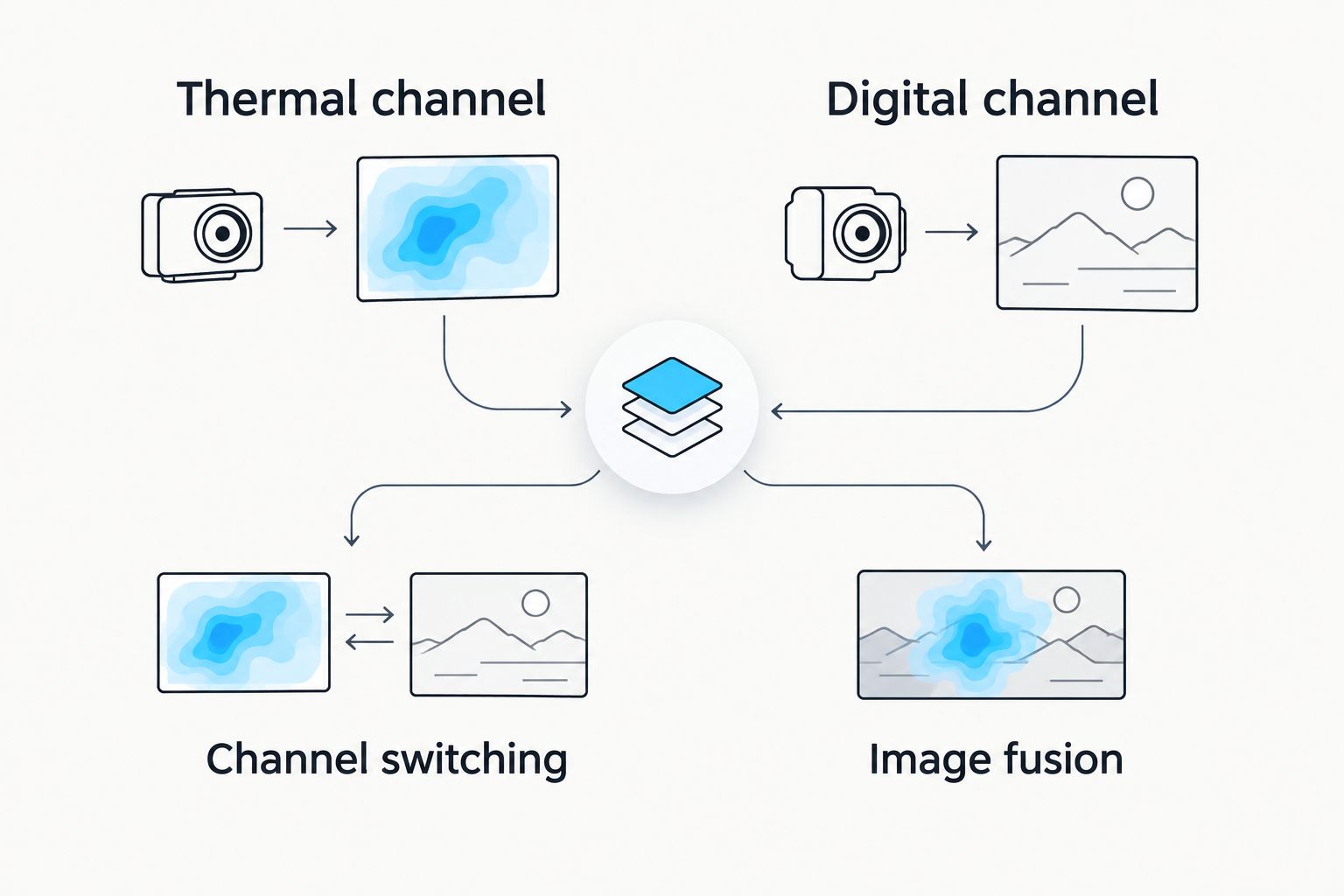
Changing a thermal colour palette does not add a digital channel. Likewise, adding an 850nm illuminator supplies near-infrared light for suitable digital night vision equipment; it does not turn that equipment into a thermal imager.
What to verify before ordering
Ask Goingdark to confirm the exact model and configuration against your requirements. Keep the questions specific enough to produce useful answers rather than a general recommendation.
Confirm the viewing functions
Ask which sensors are fitted and how you access their images. If you want thermal and digital information in one eyepiece, a separate monocular and scope will not meet that requirement in the same way.
Request clarification of any fusion claim. A small secondary image, a selectable channel and a combined overlay are different viewing arrangements, even when all appear under similar marketing language.
Confirm the physical fit
Check documented eye relief, mounting dimensions, recoil suitability and clearance for the exact scope. Do not infer compatibility from a familiar tube shape or a mount appearing in a bundle.
For a two-device setup, consider how you carry the monocular and access its controls. Extra equipment only helps when its handling suits the way you observe.
Confirm the power and illumination plan
Identify the battery requirements of each device and any illuminator separately. Do not assume shared battery types, charging arrangements or runtime across different products.
For digital night vision, establish whether an illuminator is included and suitable. For thermal imaging, focus instead on the thermal image and optical specifications; an IR torch does not improve the thermal channel itself.
How the alternatives were ranked
This 2026 shortlist ranks approaches by the requirement they address: separate thermal and digital roles first, dedicated thermal viewing second, and a digital bundle third. It does not claim a field-tested winner or compare unverified identification distances.
The criteria are imaging channels, viewing arrangement, identification detail, optical fit, compatibility and setup requirements. No option earns a multispectral recommendation merely because it has an LRF, a 4K label or several colour palettes.
Which setup should you choose?
Choose separate thermal spotting and digital night vision if you need both imaging types and accept two devices. That is the closest functional alternative here, but it is not an integrated multispectral scope.
Choose the Pulsar Thermion 2 LRF XL60 when your requirement is a dedicated thermal scope. Choose the Pixfra Volans combo when your requirement is digital night vision with the named supporting components.
If one scope containing both thermal and digital channels is non-negotiable, hold the purchase until the exact model's documentation confirms both. Buying a different category does not resolve that requirement.
FAQ
What's the best multispectral night vision scope in this guide?
No integrated multispectral scope is established in this shortlist. The HIKMICRO CONDOR and PARD Night Stalker pairing provides separate thermal and digital devices, not both channels inside one scope.
Is a thermal scope the same as a multispectral scope?
No. A thermal-only scope provides a thermal imaging channel, while a multispectral device contains distinct imaging channels; check the exact model documentation to establish which ones.
Does an LRF make a night vision scope multispectral?
No. LRF means laser rangefinder and adds distance measurement, not a thermal or digital imaging channel.
Can I use a thermal monocular with a digital night vision scope?
Yes, as separate devices serving different observation roles. That arrangement does not establish image fusion, shared controls or a combined view inside the scope.
Does a 4K night vision scope also see heat?
No, a 4K designation does not establish thermal imaging capability. A thermal detector must be explicitly specified before you treat the scope as having a thermal channel.
Does an 850nm IR torch turn digital night vision into thermal imaging?
No. An 850nm IR torch supplies near-infrared illumination for compatible digital night vision equipment; thermal imaging uses a different sensing system.
Can detection distance tell me how far I can identify an animal?
No. Detection distance is not identification distance, and a visible heat signature does not establish species or a safe shooting opportunity.
What should I ask before buying a multispectral scope in 2026?
Ask for confirmation of the exact imaging channels and how their views are displayed. Then check mounting, eye relief, documented recoil suitability, power requirements and any illumination needed for the digital channel.
One last thing
A rangefinder can report distance without telling you what the object is. Keep ranging, detection and identification as separate buying questions.
For your 2026 purchase, write down the required channels before choosing a model. Ask Goingdark to match those requirements to documented functions—not to a product label that sounds close.
Share:
Best hunting lights for night hunting in 2026
Best rangefinding thermal scopes for hunting in 2026