
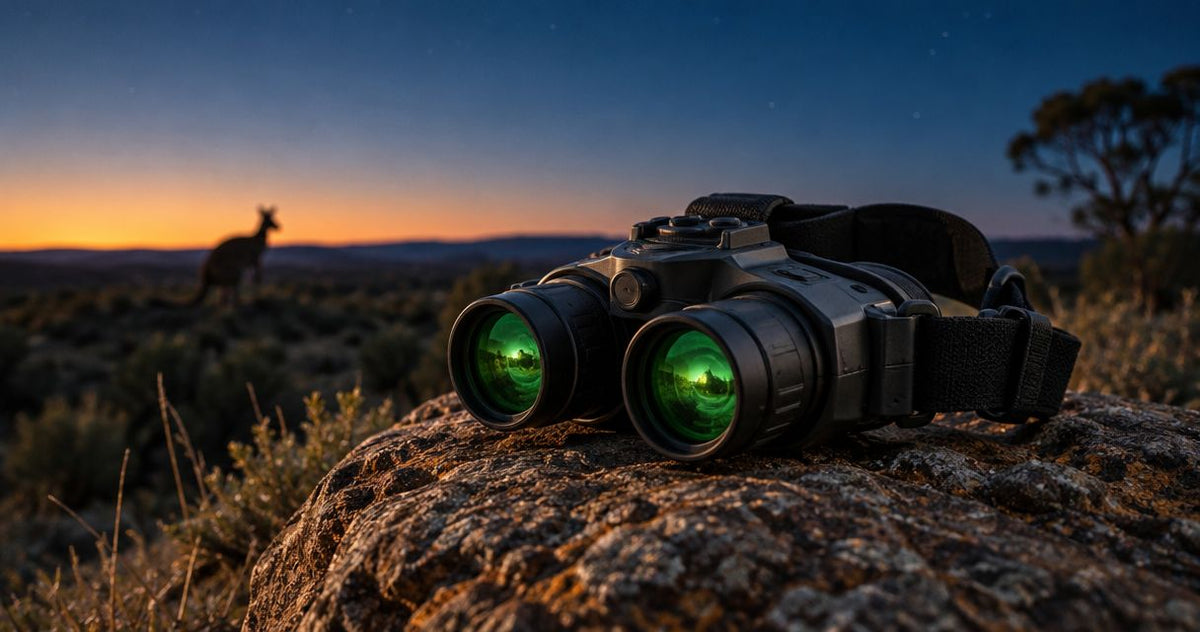
Best overall for a day/night rifle setup: HIKMICRO Alpex Lite A40EL LRF. Best illuminator combo: PARD Night Stalker Mini 4K. Best scope-and-mount package: PIXFRA VOLANS 4K LRF. If you mean head-mounted night vision goggles, these are not goggles: this 2026 shortlist compares rifle-mounted alternatives and a handheld thermal spotter for Australian hunters.
- Night vision goggles are head-mounted devices; rifle scopes and handheld thermal monoculars serve different jobs.
- HIKMICRO Alpex Lite A40EL LRF is the default day/night scope shortlist choice.
- PARD Night Stalker Mini 4K combines a digital scope with an Infra X illuminator.
- GoingDark recommends matching night vision optics to observation or aiming before comparing specifications.
Why this matters
Buying the wrong device type leaves the main job unsolved. A rifle scope is not a hands-free observation device, and a thermal spotter is not a rifle sight.
What makes the best night vision setup in 2026?
- Device role: observation, aiming or hands-free use.
- Image technology: digital night vision or thermal.
- Illumination: compatible IR for digital night use.
- Fit: mounting, eye relief and controls.
- Package contents: check each named accessory.
Hunting alternatives at a glance
| Item | Best for | Standout feature | Key limitation |
|---|---|---|---|
| HIKMICRO Alpex Lite A40EL LRF | Day/night rifle use | Day/night scope with laser rangefinding | Not a handheld or head-mounted viewer |
| PARD Night Stalker Mini 4K 25mm LRF combo | A scope-and-illuminator combination | Infra X illuminator included in the named combo | Mounting and power requirements still need checking |
| PIXFRA VOLANS 4K LRF package | A named scope, torch and mount package | Accura Triclops LED torch and cantilever QD mount | The supplied mount must suit your rifle |
| HIKMICRO CONDOR 2.0 CQ50L thermal monocular | Handheld thermal observation | 640px specification, 50mm lens and LRF | Thermal monocular, not night vision goggles or a rifle scope |
GoingDark’s night vision buying advice suits hunters choosing between rifle-mounted aiming and handheld observation, rather than treating both as goggles. Make that distinction before comparing models.
1. HIKMICRO Alpex Lite A40EL LRF: best for day/night rifle use
The HIKMICRO Alpex Lite A40EL LRF is a day/night vision scope with laser rangefinding. It belongs on your shortlist when you want a rifle-mounted optic for both daylight and night use, rather than a separate device for walking or scanning.
Best for: hunters whose first requirement is a day/night rifle scope with LRF.
The reason to start here is the device’s role, not an unsupported claim that it produces the best image. A day/night scope addresses aiming; it does not replace a dedicated observation device. Build your comparison around the image, fit and controls you need at your intended distances.
HIKMICRO Alpex Lite A40EL LRF pros:
- Day/night operation matches a rifle used across changing light conditions.
- LRF adds a distance-measurement function to the scope.
- The named model provides a clear starting point for a scope-focused comparison.
HIKMICRO Alpex Lite A40EL LRF cons:
- Rifle mounting makes it unsuitable as a general-purpose walking viewer.
- You still need to confirm the mounting arrangement, eye relief and IR setup.
- A range reading does not establish animal identity or a clear background.
For a first setup, check the complete configuration before ordering. Ask which illuminator and mounting components suit the scope and your existing equipment; do not assume an accessory is included because it appears elsewhere in the range.
Verdict: Buy for day/night rifle use after confirming fit and illumination; skip for hands-free observation.
2. PARD Night Stalker Mini 4K: best for an illuminator combo
The PARD Night Stalker Mini 4K 25mm LRF combo pairs a digital day/night rifle scope with an Infra X illuminator. The supplied description identifies it as a compact scope, making it relevant when you want to consider the optic and IR source together.
Best for: hunters comparing a digital scope and a named illuminator as one package.
The 25mm specification identifies this particular model. It is not a promise of recognition distance, and the 4K label does not tell you how much useful detail you will see through vegetation, in poor weather or under unsuitable illumination.
PARD Night Stalker Mini 4K pros:
- The combo explicitly names the Infra X illuminator.
- Digital day/night operation supports use across daylight and darkness.
- LRF is included in the named scope configuration.
- The compact format gives you a specific alternative to compare for rifle fit.
PARD Night Stalker Mini 4K cons:
- A scope-and-illuminator combo is still not a complete fit guarantee for your rifle.
- The product name alone does not establish battery endurance or usable night image distance.
- It cannot perform the hands-free role of head-mounted goggles.
Check where the illuminator will sit and whether you can reach the controls comfortably. Beam alignment matters: lighting nearby grass or branches can reduce the usefulness of the scene you actually want to inspect.
Verdict: Buy for a named scope-and-IR combination; hold until mounting and power requirements are clear.
3. PIXFRA VOLANS 4K LRF: best for a scope-and-mount package
The PIXFRA VOLANS 4K LRF package names an Accura Triclops LED torch and a cantilever QD mount alongside the night vision scope. It suits buyers who want to compare an explicitly listed equipment package rather than select every component separately.
Best for: hunters who want a scope, torch and mount listed together.
Package contents are useful buying information. They do not prove that the mount matches your rifle, that the torch meets every intended use, or that you can transfer the assembly between rifles without checking zero.
PIXFRA VOLANS 4K LRF pros:
- The package explicitly includes a cantilever QD mount.
- The Accura Triclops LED torch is named, rather than left as an unspecified accessory.
- The scope configuration includes LRF.
- Listed components make it easier to identify what still needs checking.
PIXFRA VOLANS 4K LRF cons:
- The supplied mount must match your rail and allow suitable positioning.
- A bundled torch does not remove the need to verify its settings and intended role.
- QD mounting does not remove the need to confirm zero after refitting.
Before choosing this package, check rail compatibility, mounting height and access to the scope’s controls. Treat each supplied component as something to verify, not as evidence that the package is automatically right for every rifle.
Verdict: Buy when the listed mount and torch suit your setup; skip the package if its components do not fit your needs.
Compare the named scope packages
These GoingDark night vision packages address different buying priorities: the PARD combines a scope with a named IR illuminator, while the PIXFRA lists a torch and QD mount. Compare the contents before adding separate accessories.


4. HIKMICRO CONDOR 2.0 CQ50L: best for handheld observation
The HIKMICRO CONDOR 2.0 CQ50L is a thermal monocular with LRF, a 640px specification and a 50mm lens. It belongs in this comparison because some searches for night vision goggles are really searches for a way to observe animals without looking through a rifle-mounted optic.
Best for: hunters who need a dedicated handheld thermal spotter.
Thermal imaging shows differences in emitted infrared radiation rather than the reflected-light scene produced by digital night vision. That makes it a different tool, not a higher specification version of a night vision goggle.
HIKMICRO CONDOR 2.0 CQ50L pros:
- Handheld observation is separate from the rifle-mounted sight.
- Thermal imaging does not require an IR illuminator to form its thermal image.
- LRF adds distance measurement to the observation device.
- The specified lens and pixel class provide concrete details for comparison.
HIKMICRO CONDOR 2.0 CQ50L cons:
- You must hold it; it does not provide hands-free viewing.
- Thermal contrast alone does not establish species or a safe shot.
- A handheld monocular does not replace a suitable aiming optic.
Compare field of view and magnification before choosing a thermal spotter for your terrain. Lens size alone does not describe how easily you will search a scene, and digital enlargement cannot create detail the original image did not capture.
Verdict: Buy for handheld thermal observation; skip if your requirement is head-mounted night vision.
Goggles, scopes or thermal: choose the job first
The most useful distinction in 2026 is not brand versus brand. It is whether you need to see while keeping your hands free, inspect a scene with a handheld device, or aim through a rifle-mounted optic.
- Hands-free viewing: shortlist genuine head-mounted night vision equipment and verify its mounting system.
- Rifle aiming: compare dedicated digital night vision scopes, fit and illumination.
- Handheld observation: compare thermal monoculars independently of the rifle sight.
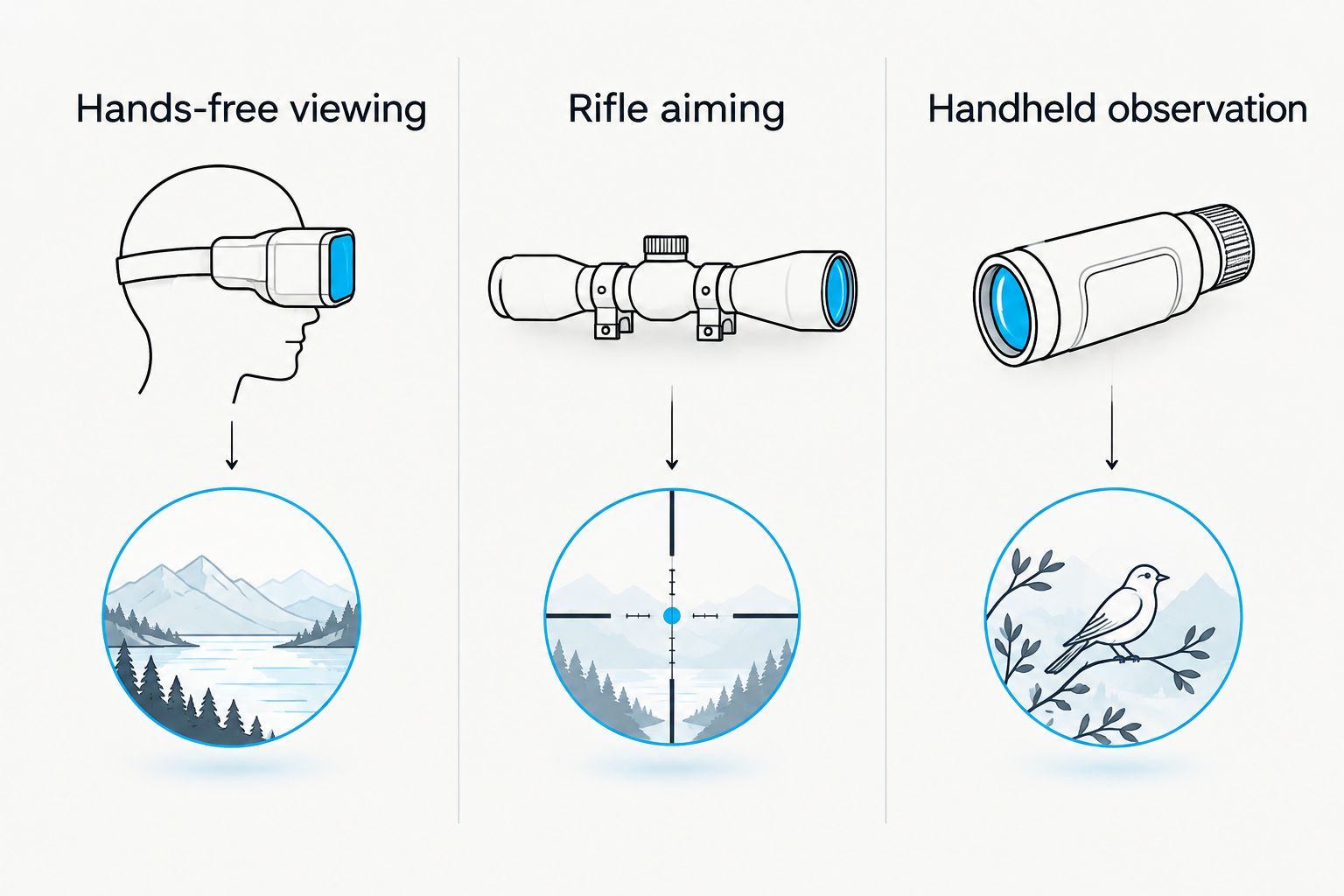
None of the ranked products above is a head-mounted goggle. If hands-free use is essential, do not buy a scope or monocular as a substitute simply because both let you see something after dark.
A head torch is different again. Visible white, red or green light illuminates your surroundings; it does not turn a headset into night vision goggles. An IR torch supplies illumination for compatible night vision equipment, not an image for your unaided eyes.
Check the complete setup before ordering
For a digital night vision purchase in 2026, write down the equipment you already own before choosing accessories. This prevents a named package from becoming a collection of duplicated or incompatible parts.
Illumination
Digital night vision needs sufficient light to form an image. In dark conditions, a compatible IR illuminator supplies light the device can use.
An 850nm illuminator and a 940nm illuminator are different wavelength options, not universal upgrades over one another. Confirm compatibility and compare the intended beam arrangement; do not assume a wavelength label proves a particular identification distance.
Mounting and controls
Confirm rail compatibility, mounting height, eye relief and room for the illuminator. You need comfortable access to focus and other controls without an awkward head position.
A QD mount describes a mounting feature, not guaranteed zero retention under every installation. Check the fitted setup and confirm zero before hunting.
Power and identification
Check the specified battery type for every powered component, including the scope, illuminator and any separate rangefinder. A spare that fits one device is not automatically compatible with another.
Detection is not identification. A heat source or distant shape is a reason to investigate further, not proof of species, orientation or what lies behind it. Neither an LRF reading nor a high-resolution label changes that distinction.
How this 2026 shortlist is ranked
This is a use-case shortlist based on the named device types, supplied package contents and stated specifications. It is not a hands-on image-quality test or a claim that one model outperforms every alternative.
The ranking puts a day/night rifle scope first, then separates illuminator and mount packages from handheld thermal observation. No budget winner is assigned: a useful comparison must account for the complete setup, not just the optic.
Which night vision setup should you choose?
Start with the HIKMICRO Alpex Lite A40EL LRF if your requirement is day/night rifle use with rangefinding. Choose the PARD Night Stalker Mini 4K combo when the named IR combination is your priority, or the PIXFRA VOLANS package when its torch and mount match your equipment.
Choose the HIKMICRO CONDOR 2.0 CQ50L for separate handheld thermal observation. If you specifically need head-mounted night vision goggles in 2026, keep that requirement intact and reject the wrong device type.
GoingDark’s role is to match the equipment to that requirement. Start with the task, then confirm the specifications and complete accessory list.
FAQ
What are the best night vision goggles for hunting in Australia?
The right night vision goggles must meet a genuine head-mounted, hands-free requirement. The products shortlisted here are rifle scopes and a handheld thermal monocular, so none is a direct goggle recommendation.
Can I use a night vision rifle scope instead of goggles?
A night vision rifle scope is not a substitute for head-mounted goggles. It serves rifle-mounted aiming rather than hands-free observation, and you should not use a rifle-mounted optic for general scanning.
Is thermal better than digital night vision for hunting?
Thermal and digital night vision serve different viewing needs. Thermal shows heat contrast, while digital night vision forms an image from available or supplied light; neither guarantees positive identification.
Does digital night vision need an IR illuminator?
Digital night vision needs sufficient light, and a compatible IR illuminator supplies it in dark conditions. Confirm the scope’s requirements and the exact package contents before selecting a separate illuminator.
Does a 4K night vision scope identify animals at its detection distance?
A 4K label does not establish identification distance. Detection, recognition and identification are different tasks, and conditions, illumination and the visible detail affect what you can establish.
Which listed option suits handheld scanning?
The HIKMICRO CONDOR 2.0 CQ50L is the handheld thermal observation option in this shortlist. It is not head-mounted and does not replace a rifle-mounted sight.
What should I check before buying a night vision scope package?
Check mounting compatibility, eye relief, illumination, power requirements and the exact included accessories. A named package does not guarantee that every component suits your existing rifle setup.
One last thing
Write your main requirement in a single sentence before comparing products: hands-free viewing, handheld observation or rifle aiming. That sentence eliminates unsuitable equipment faster than comparing resolution labels, and keeps an impressive specification from selling you the wrong device.
Share:
Best thermal monoculars for hunting in 2026
Best digital night vision scopes for hunting in 2026