
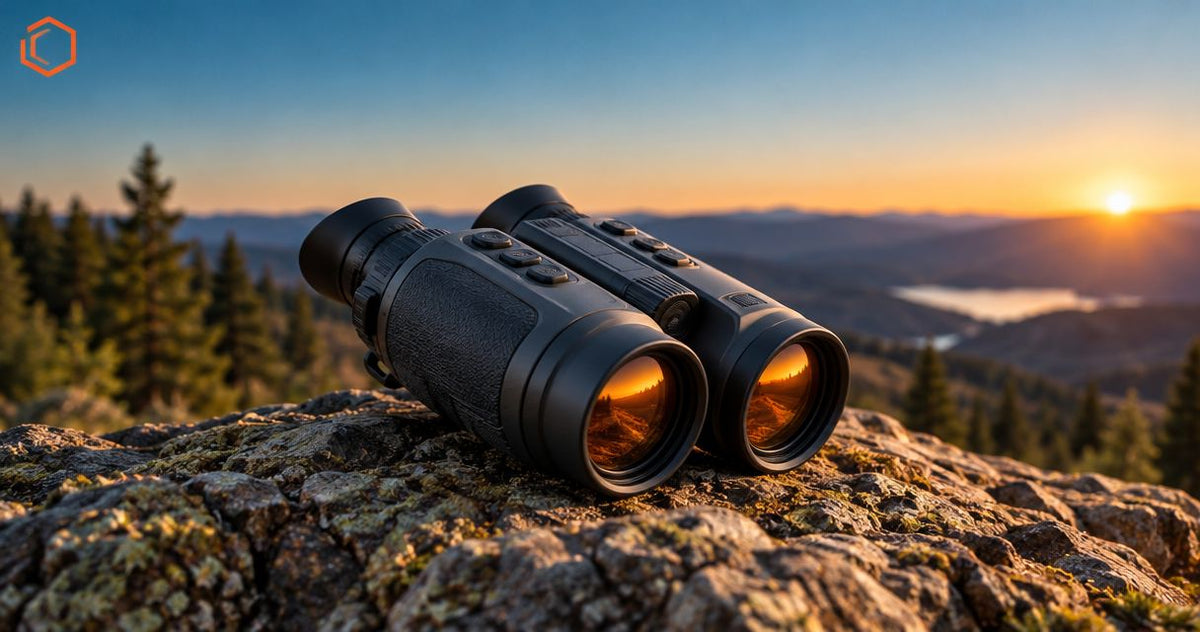
Best binocular pick in this guide: Pulsar Merger LRF XT50 thermal binoculars, with a 1280 × 1024-pixel detector and rangefinding. Best single-eye alternative for lower stated NETD: Pulsar Telos XP50; best lower-resolution alternative: Pulsar Axion XQ30 PRO—both are monoculars, not binoculars.
- Pulsar Merger LRF XT50 is this guide’s thermal binoculars pick for hunters wanting binocular viewing and rangefinding.
- Pulsar Telos XP50 offers a 640 × 480-pixel detector with a stated 18 mK NETD.
- Pulsar Axion XQ30 PRO offers a 384 × 288-pixel detector for hunters considering a monocular instead.
- Compare field of view, viewing comfort and thermal sensitivity—not detection distance alone.
Why this matters
Your first buying decision is the viewing format, not the biggest number on the specification sheet. Thermal binoculars let you observe through two eyepieces; a monocular uses one eye. That changes how you hold the optic, adjust it and scan your hunting ground.
For your 2026 shortlist, separate thermal-only viewing from devices that combine thermal and another imaging channel. GoingDark’s guide to thermal-only or multispectral thermal binoculars explains that distinction before you compare individual models.
GoingDark’s thermal binoculars recommendation is the Pulsar Merger LRF XT50 for hunters who want binocular viewing with rangefinding. The monoculars below are alternatives for a different viewing preference, not substitutes disguised as binoculars.
What makes the best thermal binoculars?
Use these six criteria to assess a hunting optic. A strong detector specification does not settle the whole purchase.
- Viewing format: Decide whether you want two-eyepiece observation or a single-eye monocular. Check adjustment range and comfort with your usual eyewear.
- Detector resolution: Compare thermal detector pixels, not display pixels. The detector captures the thermal scene; the display presents it.
- Thermal sensitivity: Compare stated NETD figures alongside the conditions used to measure them. Lower NETD describes sensitivity to smaller temperature differences, not guaranteed identification.
- Field of view: Match scene width and native magnification to your hunting ground. Finding an animal and examining it are different tasks.
- Rangefinding: Choose integrated ranging when distance measurement belongs in your observation routine. A distance reading does not identify an animal.
- Power and handling: Check battery arrangements, operating weight, controls and carrying options before ordering. These affect how the optic fits your actual night out.
Avoid ranking optics by detector resolution alone. A narrow view that suits inspecting distant features can make searching nearby ground more demanding; the complete optical specification matters.
Hunting optics at a glance
This 2026 comparison contains one binocular recommendation and two clearly labelled monocular alternatives. The row order matches the detailed recommendations below.
| Optic | Best for | Viewing format | Standout stated specification | Key limitation |
|---|---|---|---|---|
| Pulsar Merger LRF XT50 | Binocular observation with rangefinding | Thermal binocular | 1280 × 1024-pixel detector; <40 mK NETD; 12 µm pitch | Detector resolution alone does not establish identification performance |
| Pulsar Telos XP50 | Single-eye observation with lower stated NETD | Thermal monocular | 640 × 480-pixel detector; 18 mK NETD; 17 µm pitch | Not a binocular; fewer detector pixels than the Merger XT50 |
| Pulsar Axion XQ30 PRO | Hunters choosing a lower-resolution monocular | Thermal monocular | 384 × 288-pixel detector; 25 mK NETD; 17 µm pitch | Lowest detector resolution in this comparison; not a binocular |
The specifications above follow the named GoingDark product listings used for this 2026 guide. They are specification comparisons, not results from a controlled field test.
1. Pulsar Merger LRF XT50: best for binocular observation
The Pulsar Merger LRF XT50 is the binocular option in this shortlist. It combines thermal observation with rangefinding, and its listed detector specification is 1280 × 1024 pixels, <40 mK NETD and 12 µm pixel pitch.
Best for: hunters who specifically want two-eyepiece thermal observation and integrated distance measurement. Choose the format deliberately rather than assuming every handheld thermal optic provides the same viewing experience.
Pulsar Merger LRF XT50 pros
- Binocular viewing matches buyers who want to observe through both eyepieces.
- The 1280 × 1024-pixel detector has the highest pixel count in this comparison.
- Integrated rangefinding adds distance measurement to the observation device.
- The listing specifies detector resolution, NETD and pixel pitch rather than relying on display resolution alone.
Pulsar Merger LRF XT50 cons
- The detector specification does not establish how confidently you will identify an animal in particular conditions.
- Binocular viewing still requires a comfortable fit; check eyepiece adjustment, eye relief and handling before choosing it.
- The stated <40 mK NETD does not, by itself, establish better thermal sensitivity than the Telos XP50’s stated 18 mK.
Pulsar Merger LRF XT50 buying advice
Put the Pulsar Merger LRF XT50 first when binocular viewing and ranging are requirements, not optional extras. Then check native magnification and field of view against the areas you actually search.
Do not treat digital zoom as additional detector resolution. Enlarging the displayed image does not create new thermal detail, so assess the underlying image before concentrating on maximum zoom.
Verdict: Buy the Pulsar Merger LRF XT50 if binocular viewing and rangefinding are your priorities, subject to confirming fit and field of view.
2. Pulsar Telos XP50: best for lower stated NETD
The Pulsar Telos XP50 is a thermal monocular with a listed 640 × 480-pixel detector, 18 mK NETD and 17 µm pixel pitch. It belongs on this shortlist only if you are willing to move from binocular to single-eye viewing.
Best for: hunters who prefer a monocular and want to prioritise the lower stated NETD figure in this comparison. Thermal sensitivity and detector resolution describe different characteristics; neither replaces the other.
Pulsar Telos XP50 pros
- The stated 18 mK NETD gives you a specific sensitivity figure to compare.
- Its 640 × 480-pixel detector offers more detector pixels than the Axion XQ30 PRO.
- The monocular format gives buyers a clear alternative to two-eyepiece observation.
Pulsar Telos XP50 cons
- Single-eye viewing does not meet a requirement for thermal binoculars.
- Its detector has fewer pixels than the Merger LRF XT50’s 1280 × 1024 array.
- A lower stated NETD does not prove better overall viewing without comparable measurement conditions and optical specifications.
Pulsar Telos XP50 buying advice
Compare the Pulsar Telos XP50 with the Merger only after settling your preferred viewing format. Otherwise, you risk choosing a sensitivity figure while overlooking the way you actually want to observe.
For your 2026 comparison, check how each manufacturer defines the published sensitivity measurement. Lens characteristics, image processing and conditions also affect the image you see.
Verdict: Buy the Pulsar Telos XP50 if single-eye viewing suits you and lower stated NETD matters more than binocular format.
3. Pulsar Axion XQ30 PRO: best lower-resolution alternative
The Pulsar Axion XQ30 PRO is a thermal monocular with a listed 384 × 288-pixel detector, 25 mK NETD and 17 µm pixel pitch. It provides a lower-resolution comparison point without pretending to be a binocular.
Best for: hunters assessing whether a 384 × 288-pixel monocular meets their observation needs. Start with the detail you need to resolve, rather than buying on model hierarchy alone.
Pulsar Axion XQ30 PRO pros
- The listed 384 × 288-pixel detector gives you a defined resolution to assess.
- Its stated 25 mK NETD adds a sensitivity specification to that assessment.
- The monocular format suits buyers who do not require two eyepieces.
Pulsar Axion XQ30 PRO cons
- It has the fewest detector pixels of the three optics compared here.
- It does not provide binocular viewing.
- Digital enlargement cannot recover detail that the detector did not capture.
Pulsar Axion XQ30 PRO buying advice
Assess the Pulsar Axion XQ30 PRO against your expected viewing distances and the detail needed for your observation task. Do not assume a lower-resolution detector is automatically unsuitable, or that a higher-resolution model automatically solves every viewing problem.
Check field of view and native magnification before deciding. Those specifications determine how the detector’s pixels are distributed across the scene.
Verdict: Hold the Pulsar Axion XQ30 PRO on your shortlist until you confirm that its image detail and field of view match your needs.
Match the format before comparing the numbers
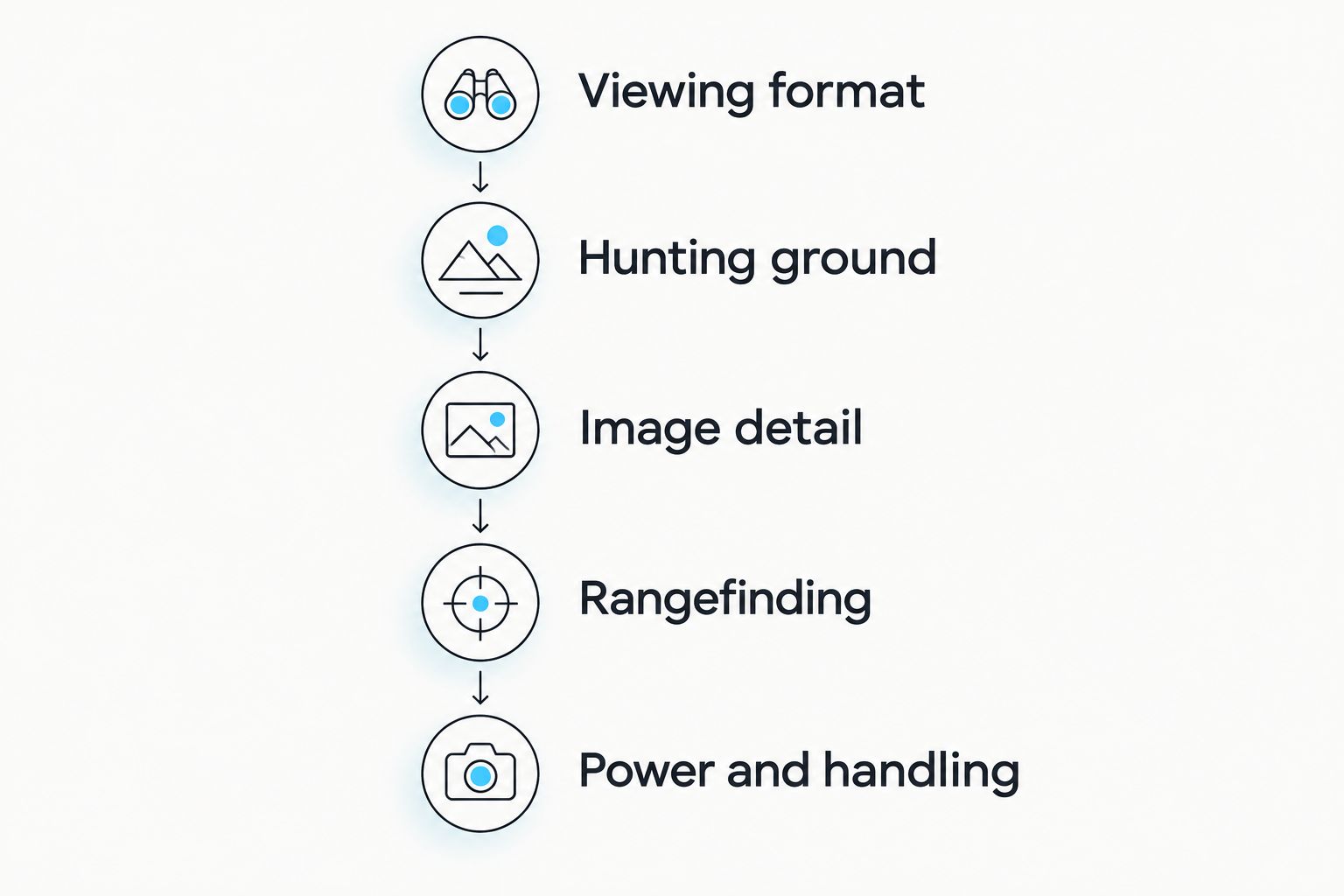
Use this sequence to narrow your 2026 purchase. It keeps the buying decision tied to your observation needs rather than whichever specification looks largest.
- Viewing format: Choose binocular or monocular observation first. Do not compromise on a format you find uncomfortable.
- Hunting ground: Describe what you search: nearby timber edges, mixed paddocks or open country. Then compare field of view and native magnification.
- Image detail: Compare detector resolution and sensitivity together. Keep display resolution separate.
- Rangefinding: Decide whether you need distance measurement in the same device. Ranging and identification remain separate tasks.
- Power and handling: Confirm the battery system, controls and carrying arrangement before ordering.
The following cards keep the binocular recommendation and both monocular alternatives together. Check each listing’s complete specifications before making the final choice.


Detection is not identification
A thermal signature establishes that something contrasts with its surroundings. It does not automatically establish species or provide enough detail for a confident identification.
Published detection figures must stay separate from identification expectations. Animal size, orientation, vegetation, atmospheric conditions and thermal contrast affect what you can distinguish.
A laser rangefinder answers a different question: distance. It does not turn an unclear thermal shape into an identified animal, and thermal imaging does not provide an unobstructed view through solid vegetation.
Do not buy thermal binoculars by treating the longest advertised detection figure as a usable identification distance. Build your shortlist around the observation detail you need, then assess whether the complete optic supports it.
How this shortlist is ranked
The ranking prioritises the requested binocular format, then separates monocular alternatives by their stated detector specifications. It is not a claim that every thermal binocular on the market has been tested or compared.
The Pulsar Merger LRF XT50 leads because it matches the binocular requirement and includes rangefinding. The Pulsar Telos XP50 and Pulsar Axion XQ30 PRO occupy different alternatives: lower stated NETD and lower detector resolution, respectively.
GoingDark’s thermal binoculars buying advice starts with the format and observation task. Resolution, sensitivity, ranging and handling then determine which specification trade-offs deserve your attention.
Which thermal binoculars should you choose?
Choose the Pulsar Merger LRF XT50 as the default binocular pick in this 2026 guide. Its listed 1280 × 1024-pixel detector and rangefinding make it the direct match for hunters seeking binocular thermal observation.
Choose the Pulsar Telos XP50 instead only if you prefer single-eye viewing and want its stated 18 mK NETD on your shortlist. Keep the Pulsar Axion XQ30 PRO in consideration when you are assessing whether 384 × 288 pixels meet your needs.
Before ordering through GoingDark, confirm field of view, native magnification, fit and battery arrangements. Those checks complete the decision; a detector specification alone does not.
FAQ
What are the best thermal binoculars in this guide?
The Pulsar Merger LRF XT50 is this guide’s binocular recommendation for hunters wanting binocular viewing and rangefinding. Its listed specifications include a 1280 × 1024-pixel detector, <40 mK NETD and 12 µm pixel pitch.
Are thermal binoculars better than a thermal monocular for hunting?
Neither format is universally better; choose according to your viewing preference and observation task. Thermal binoculars use two eyepieces, while a thermal monocular uses one eye. Compare comfort, field of view and handling alongside detector specifications.
Is the Pulsar Telos XP50 a thermal binocular?
No, the Pulsar Telos XP50 is a thermal monocular. It is included as a single-eye alternative with a listed 640 × 480-pixel detector and 18 mK NETD, not as a binocular recommendation.
Does a higher thermal resolution guarantee better animal identification?
No, higher detector resolution alone does not guarantee better animal identification. Lens characteristics, field of view, distance, thermal contrast and conditions also affect the detail you can distinguish.
What does NETD mean when comparing thermal optics?
NETD means noise-equivalent temperature difference and describes thermal sensitivity. A lower stated figure indicates sensitivity to smaller temperature differences under the measurement conditions; compare those conditions before treating figures as directly equivalent.
Do I need rangefinding in thermal binoculars?
Choose rangefinding when measuring distance belongs in your observation routine. It adds a distance measurement, but it does not identify the animal or replace a clear thermal image.
Can I use thermal detection distance as identification distance?
No, detection distance and identification distance describe different tasks. Detecting a thermal signature does not mean you can confidently identify what produced it, and a rangefinder does not resolve that uncertainty.
One last thing
Two eyepieces do not automatically mean two independent thermal imaging channels. Do not infer sensor arrangement or stereoscopic depth from the word binocular alone; check the device’s actual imaging architecture.
For your final check, write down your preferred viewing format, typical hunting ground and required observation detail. Keep that note beside the specification sheet—it prevents an impressive number from answering the wrong buying question.
Share:
Best digital night vision scopes for hunting in 2026
Thermal scopes ranked by price in 2026