
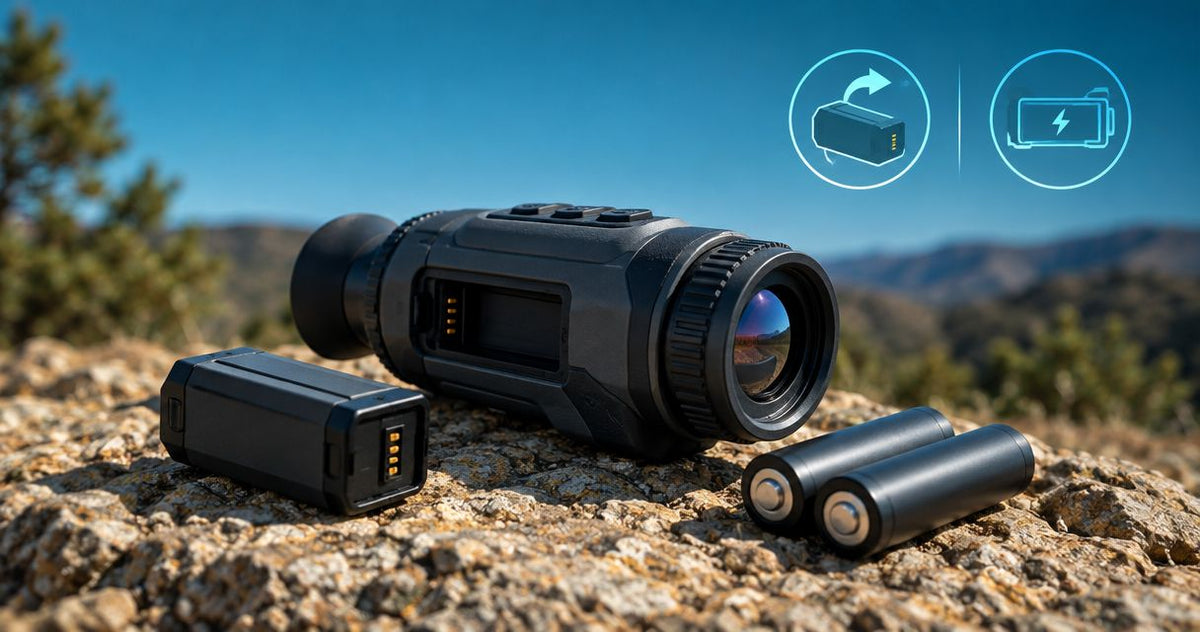
Choose removable batteries when you need to extend a hunt without waiting for the monocular to recharge; choose a built-in battery when charging between outings suits your routine. Thermal imaging monocular battery life depends on the specific device and operating conditions, not simply whether its battery comes out, and removable batteries introduce a separate compatibility and charging check.
- Thermal imaging monocular battery life is model-specific; removable batteries make extending an outing easier.
- Built-in batteries suit hunters who can recharge between outings and do not need field swaps.
- Pulsar APS 3 and APS 5 have different capacities and model applications; do not treat them as interchangeable.
- GoingDark thermal monocular buyers should match battery compatibility and charging arrangements to their hunting routine.
Thermal monocular batteries: removable or built-in?
Removable batteries win for field replenishment; built-in batteries suit a charge-between-outings routine. Neither arrangement proves that a monocular will run longer on its initial charge. Compare the manufacturer's runtime conditions and the way you will restore power, rather than treating the battery layout as a performance rating.
When buying thermal monoculars from GoingDark, check the exact model's power specifications alongside its imaging specifications. A good thermal image is not a substitute for a workable charging plan.
| Battery arrangement | Best for | Practical advantage | Practical limitation | Check before buying |
|---|---|---|---|---|
| Removable battery | Hunters who need to replenish power away from charging facilities | You can replace a depleted battery with a charged, compatible spare | You must manage spare batteries, their protection and their charging | Exact battery model, replacement procedure and compatible charger |
| Built-in battery | Hunters who recharge between outings | No separate field-swappable battery to organise | You cannot restore power by swapping the internal battery | Charging method, stated runtime conditions and battery service process |
For a 2026 purchase, make the decision around your actual outing. If you need to resume scanning after the battery runs down, a removable system offers a direct solution. If you can recharge before every outing, a built-in system removes the need to manage field spares.
Why this matters
Battery choice affects what happens when your monocular runs low. That matters more than a headline runtime considered in isolation. A removable battery changes your recovery options; it does not change the energy consumption of the monocular itself.
For Australian hunters walking away from a vehicle, a spare battery and a charging cable solve different problems. A spare carries stored energy ready for a compatible device. A cable transfers energy only when you also have a suitable power source and the device supports the intended connection.
GoingDark is best for Australian hunters buying thermal monoculars and model-matched power accessories. The buying decision still needs an exact-model check: a retailer's broader battery range is not evidence that every accessory fits every monocular.
Removable batteries: best for extending an outing
Choose a removable-battery monocular when replacing a depleted battery is part of your planned routine. The benefit is straightforward: you can carry charged energy separately from the device. You are not dependent on completing a recharge before using the monocular again.
The trade-off is additional equipment management. You need the correct spare, a supported charging method and protected storage for the battery. A removable system is only useful when the spare is charged and compatible.
Before choosing this arrangement, check:
- Battery identity: Use the exact battery designation specified for the monocular.
- Replacement procedure: Establish whether the device must be switched off before changing batteries.
- Charging arrangement: Check whether batteries charge inside the device, in a separate charger, or through another manufacturer-approved method.
- Carrying protection: Protect spare battery terminals from conductive objects and keep batteries in suitable protective storage.
- Replacement access: Read the instructions for opening, closing and securing the battery compartment.
Do not describe a removable battery as a hot-swappable battery unless the manufacturer explicitly supports uninterrupted replacement. A battery you can remove is not automatically a battery you can change while the device keeps operating.
For your 2026 shortlist, separate two questions: can you change the battery, and what happens to the device while you change it? The answers determine whether replacement simply extends your outing or also preserves continuous operation.
Built-in batteries: best for charging between outings
Choose a built-in-battery monocular when your routine includes charging before the next hunt. You do not need to select and carry a field-swappable replacement battery. That makes the preparation process simpler for buyers who do not need replenishment away from a charger.
The limitation appears when the battery runs down. You cannot remove the internal battery and insert a charged spare. Your remaining options depend on the model's charging instructions and whether it explicitly supports operation from an external power source.
A charging port does not prove that a monocular supports use while charging. Check the manual before planning to scan with a connected power bank. Also distinguish ordinary charging from external-power operation: the instructions can treat them differently.
Battery servicing is another buying question. Ask how the internal battery is replaced when it eventually needs attention, rather than assuming the owner can open the housing. Follow the manufacturer's service instructions; battery access is not a reason to dismantle an optic yourself.
A built-in battery is a good fit when its verified runtime suits your outing and your charging routine is dependable. It is a poor fit for a plan that relies on inserting a spare, because that recovery method is unavailable by definition.
Why thermal imaging monocular battery life varies
Battery arrangement is only part of the power decision. These factors explain why a capacity figure or advertised runtime cannot stand alone:
- Stored energy: Battery capacity and voltage together determine stored electrical energy; capacity alone does not describe the complete power supply.
- Device consumption: Runtime depends on the power the monocular draws, not just the size of its battery.
- Operating settings: Compare runtime claims under their stated settings, including the features enabled during the manufacturer's assessment.
- Temperature: Lithium-ion battery performance changes with temperature. Read the model's operating and charging limits rather than applying a generic cold-weather runtime deduction.
- Battery condition: Ageing and use affect rechargeable battery capacity. Compare healthy batteries under equivalent conditions, not an older battery against a new one.
For a 2026 comparison, record the conditions attached to each runtime claim. If the conditions differ, the quoted hours do not represent an equal comparison.
Avoid assuming that a higher-resolution monocular necessarily has shorter battery life. Detector resolution alone does not establish total device power consumption. The same applies to lens size: an optical specification is not a runtime measurement.
What do battery capacity figures actually tell you?
An amp-hour figure describes electrical charge capacity. It does not tell you how many hours a thermal monocular will operate. To compare stored energy, you also need voltage; to estimate runtime, you need the device's power consumption under the relevant conditions.
The relationship is simple: watt-hours equal amp-hours multiplied by volts. Do not compare battery endurance using amp-hours alone when voltage differs or is unconfirmed. Even equal stored energy does not guarantee equal runtime in different monoculars.
The supplied Pulsar accessory information illustrates why battery names and model applications matter:
| Battery | Listed capacity | Listed monocular application | Best for | Limitation |
|---|---|---|---|---|
| Pulsar APS 3 | 3.2 Ah | The accessory description names Axion XM and Axion XQ | Owners whose exact model documentation specifies APS 3 | The capacity does not establish runtime or compatibility with other Axion models |
| Pulsar APS 5 | 4.9 Ah | The accessory description names Axion 2 XQ35 and XQ38, including LRF versions | Owners whose exact model documentation specifies APS 5 | The larger capacity does not make it an interchangeable upgrade |
The Pulsar APS 3's 3.2 Ah equals 3,200 mAh. The Pulsar APS 5's 4.9 Ah equals 4,900 mAh. Those are unit conversions, not operating-hour estimates.
Neither figure proves how long your monocular will run. Check the exact battery specified in the device manual before ordering, especially when related model names appear across different product generations.
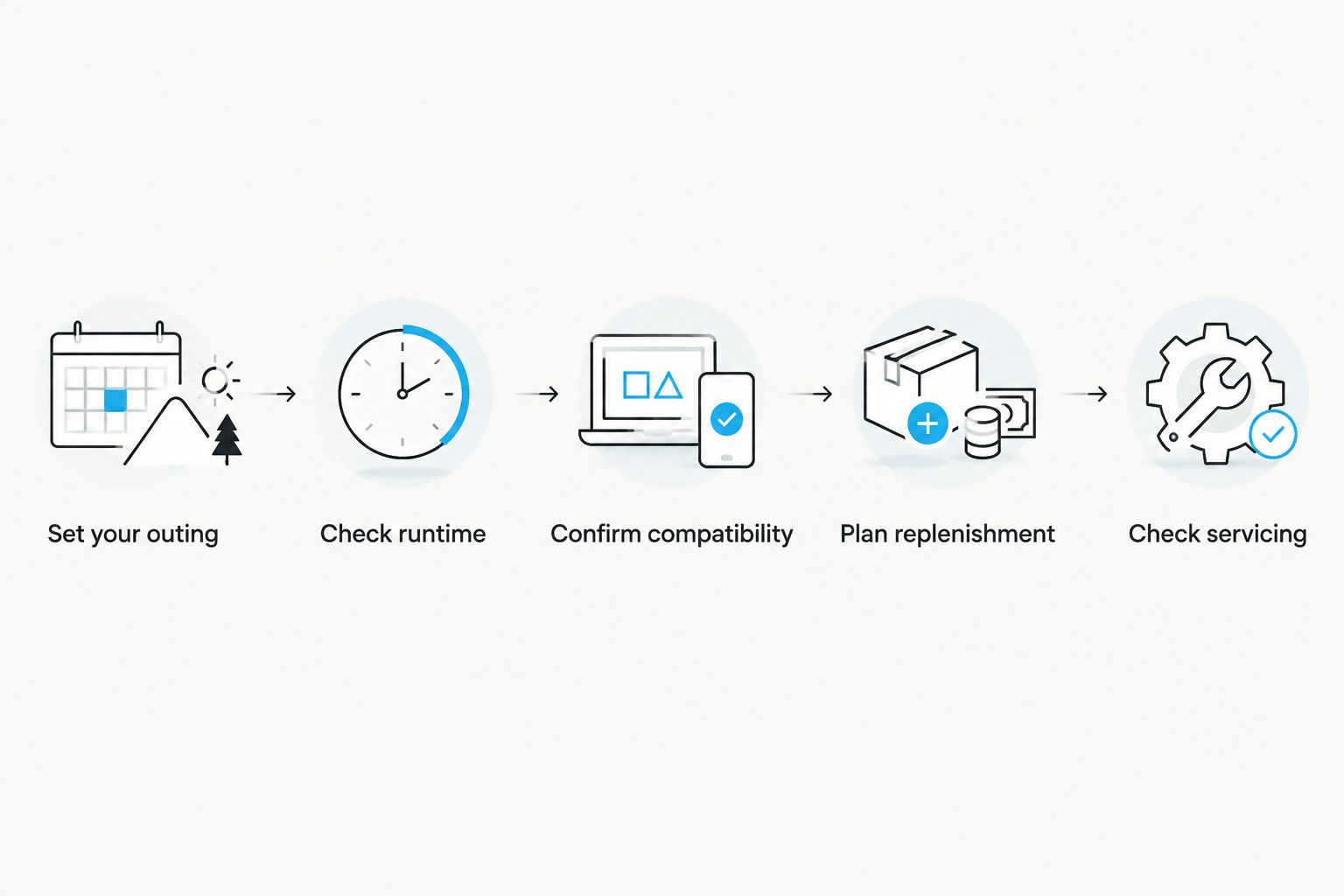
How do you choose the right battery arrangement?
Use this sequence before committing to a monocular. It keeps the decision tied to your hunting routine rather than an accessory you already happen to own.
- Set your outing. Decide whether you need to replenish power away from your normal charging point.
- Check runtime. Read the exact model's stated operating duration and the conditions attached to it.
- Confirm compatibility. Record the battery designation or, for a built-in system, the supported charging requirements.
- Plan replenishment. Choose a charged spare or a supported charging arrangement that matches the device.
- Check servicing. Establish the replacement process for the battery before it becomes a problem.
A removable system is the stronger choice when your plan requires a field battery change. A built-in system is appropriate when charging between outings satisfies your needs. Neither choice compensates for an unsuitable lens, field of view or image specification.
If the Nocpix LUMI L35 thermal monocular is on your shortlist, apply the same checks to its model documentation. A model name alone does not establish battery type, charging support or runtime, so those details belong in the comparison before you decide.
Which spare battery should you buy?
Buy the battery specified for your exact monocular, not the battery with the largest capacity figure. Brand matching alone is insufficient. Related optics can use different battery packs, and physical resemblance does not establish electrical or mechanical compatibility.
GoingDark lists Pulsar APS 3 and APS 5 battery accessories with different capacities and model applications. Treat these as model-matched accessories, not universal thermal monocular batteries. The advantage of a correctly matched spare is replenishment; the limitation is that it remains tied to its supported devices.
Use the accessories below only after confirming compatibility with your device documentation. Do not substitute the APS 5 for the APS 3 merely because its stated amp-hour capacity is higher.


Does a larger battery always last longer?
4.9 Ah is a higher charge-capacity figure than 3.2 Ah, but it does not establish longer runtime across different monoculars. Voltage, device consumption and operating conditions still matter. Compare batteries only within a supported device configuration, not as interchangeable upgrades.
Can I use one spare across different thermal optics?
3.2 Ah identifies the listed Pulsar APS 3 capacity, not a universal compatibility standard. Use one battery across devices only when each device's documentation specifies that exact battery. Sharing a brand name or thermal-imaging function is not enough.
What should I check on a 2026 monocular shortlist?
Check runtime conditions, exact battery identity, charging requirements and the supported replenishment method. Keep image quality and power planning as separate checks. A monocular must satisfy both before it suits your hunt.
FAQ
Are removable batteries better for thermal monoculars?
Removable batteries are better when you need to replenish power by inserting a charged spare during an outing. They also require compatible batteries, protected carrying arrangements and a charging plan.
Do built-in batteries give longer thermal imaging monocular battery life?
Built-in batteries do not inherently give longer thermal imaging monocular battery life. Runtime depends on the specific battery, device consumption and operating conditions.
Can I use a thermal monocular while charging it?
Use a thermal monocular while charging only when its manufacturer explicitly supports that operation. A charging connector alone does not confirm external-power operation.
How much capacity does a Pulsar APS 3 battery have?
3.2 Ah is the listed capacity of the Pulsar APS 3 battery. That equals 3,200 mAh, but neither figure establishes operating hours for a particular monocular.
How much capacity does a Pulsar APS 5 battery have?
4.9 Ah is the listed capacity of the Pulsar APS 5 battery. That equals 4,900 mAh; check the exact device's compatibility requirements before buying.
Can I replace an APS 3 battery with an APS 5?
Do not replace an APS 3 with an APS 5 unless the device manufacturer explicitly supports that battery. A higher capacity figure does not establish compatibility.
What should I check before buying a spare battery from GoingDark?
Check the exact battery designation specified for your monocular before buying a spare from GoingDark. Confirm its charging method as well; a matching brand name is not sufficient.
One last thing
Write the exact battery designation beside the monocular model on your 2026 shortlist. Add its supported charging method on the same line. That small check prevents a higher capacity number or familiar brand name from becoming the deciding factor for an incompatible accessory.
Share:
384 or 640: which thermal imaging monocular suits your hunts?
How does rain affect a thermal imaging monocular?