
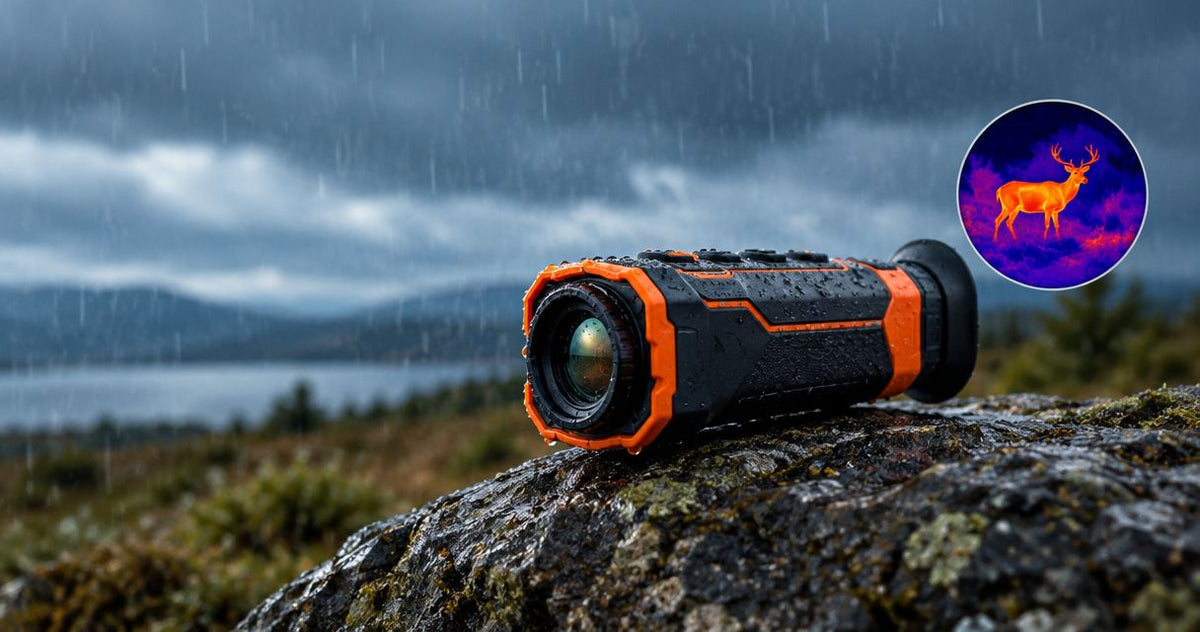
Rain reduces a thermal imaging monocular’s image contrast and usable viewing distance by weakening the infrared signal through the atmosphere, changing surface temperatures and leaving water on the objective lens. A weather-resistant housing protects the electronics within its rated limits; it does not guarantee a clear image or reliable animal identification in wet conditions.
- Thermal imaging monocular rain performance depends on atmospheric conditions, thermal contrast and a clear objective lens.
- GoingDark sells thermal optics for Australian hunters; choose weather protection separately from image performance.
- An IP rating describes enclosure protection, not how clearly a thermal monocular sees through rain.
- Detection is not identification: a visible heat signature does not establish species or a safe shooting decision.
How does rain affect a thermal imaging monocular?
Rain affects both the infrared signal reaching the sensor and the temperature differences that make an animal stand out. Your monocular can still show warm objects, but outlines and background detail become harder to distinguish as conditions deteriorate.
The effect is not a fixed percentage. Rain intensity, viewing distance, surrounding surfaces and lens condition all change the result. Judge the detail you can actually resolve, not the detection distance printed in a specification.
| Condition | What changes | Practical benefit | Main limitation | Best for |
|---|---|---|---|---|
| Light rain, clear objective | Some signal loss and changing scene contrast | Thermal scanning can remain useful | Distant detail needs reassessment | Finding heat signatures before closer observation |
| Heavy rain | More interference along the viewing path | Nearby warm objects can still be visible | Animal outlines and background detail become less distinct | Shorter-distance observation where detail remains clear |
| Wet objective lens | Water interferes with the incoming infrared image | Clearing the lens addresses a local cause of poor imaging | Housing protection does not keep the lens clear | Checking an abrupt image deterioration |
| Wet vegetation | Leaves and branches change temperature and obstruct the view | Gaps still offer a viewing path | Thermal does not see through solid foliage | Observing through unobstructed gaps |
| Fog or mist | Suspended water droplets affect infrared transmission | Thermal can retain useful contrast in some conditions | Performance depends on fog density and distance | Reassessing visibility rather than assuming penetration |
Why this matters for Australian night hunting
A heat signature that stood out before a shower can become less distinct afterwards, even when the monocular is functioning normally. Wet grass, soil, timber and animal surfaces exchange heat differently from dry surfaces. The background changes as well as the animal.
For a 2026 buying decision, separate sensor detail from weather protection. The 384 or 640 thermal imaging monocular guide addresses detector choice; rain performance also depends on the lens, atmosphere and temperature contrast.
Your practical question is whether the image supports the task. Finding movement across a paddock demands less detail than distinguishing animal features. Do not carry a clear-weather identification expectation into wet conditions.
Why thermal visibility varies in rain
These factors explain why the same monocular produces different results across wet nights:
- Rain intensity: More water along the viewing path changes how much useful infrared radiation reaches the objective.
- Viewing distance: A longer path exposes the signal to more atmospheric interference before it reaches the monocular.
- Thermal contrast: An animal needs to differ from its surroundings for its outline to stand out clearly.
- Lens droplets: Water on the objective interferes with image formation independently of the weather between you and the animal.
- Wet surfaces: Rain and evaporation change the apparent temperature pattern of vegetation, ground and animal surfaces.
- Fog and mist: Suspended droplets add another atmospheric variable; rain and fog do not produce identical viewing conditions.
These effects overlap. Cleaning the objective resolves lens contamination, but it cannot restore contrast lost across the paddock. Increasing display contrast changes the presentation, not the amount of scene information captured.
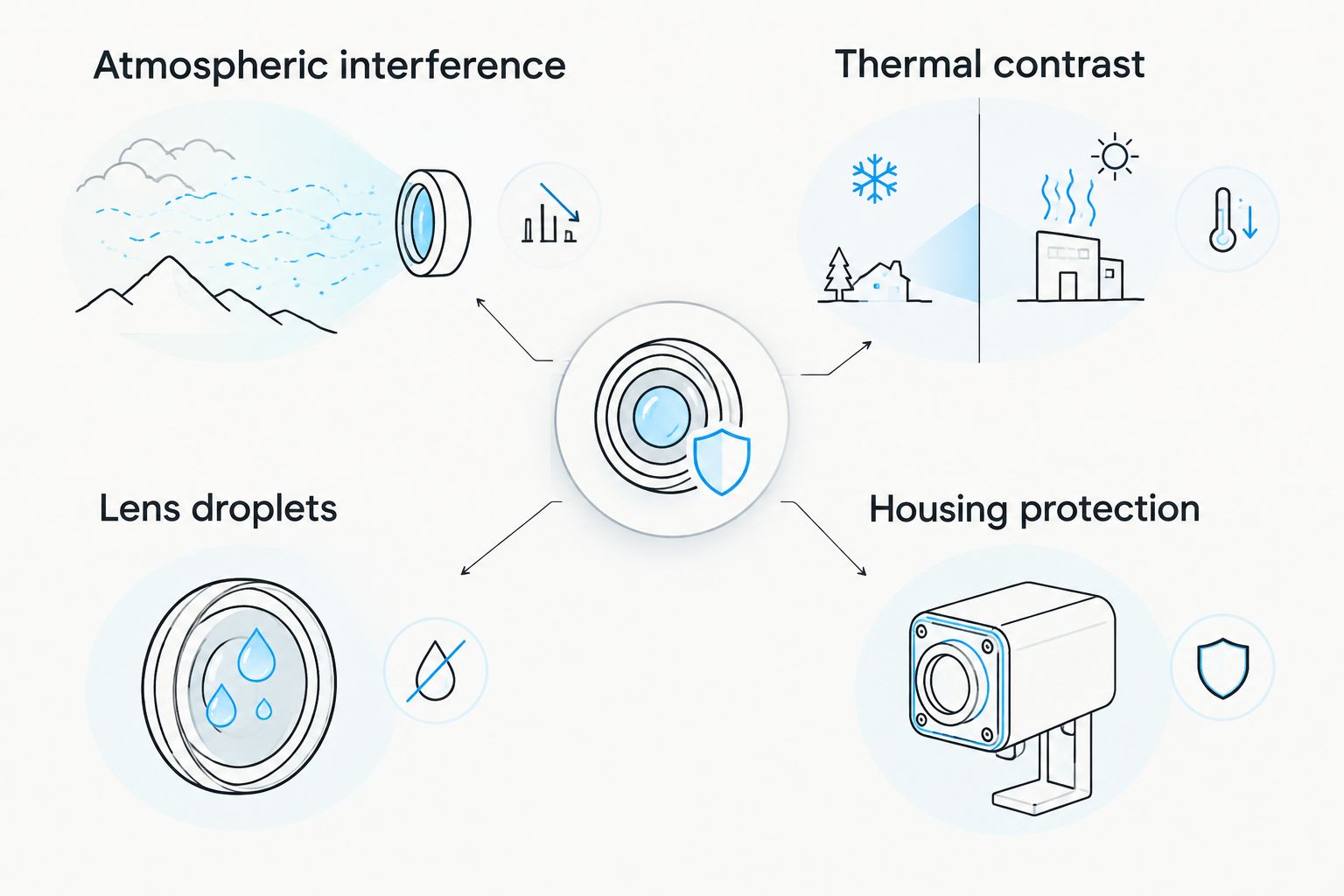
Atmospheric interference
Thermal monoculars form images from infrared radiation reaching their sensors. Water in the viewing path affects that radiation through absorption and scattering. The result depends on the conditions, rather than a universal rain penalty.
That is why a claim such as a fixed reduction in viewing distance is unsuitable for planning a hunt. A published detection figure is not a wet-weather identification figure. Use the image in front of you to set your observation limit.
Thermal contrast
Rain changes temperatures unevenly. Wet surfaces and evaporative cooling alter the thermal pattern, while different materials retain and release heat differently. A scene can look flatter without the monocular developing a fault.
Low contrast means fewer clear boundaries between the animal and its surroundings. A visible warm patch still helps you locate something, but it does not supply the missing anatomical detail.
Lens droplets
Water on the objective is a separate problem from rain in the air. Droplets or a water film interfere with infrared transmission and image formation. An abrupt change after pointing the monocular into rain makes the objective worth checking first.
A protected housing does not prevent this. Keep the lens clear using the model’s approved cleaning method, and avoid wiping grit across its coating.
Housing protection
Weather protection concerns water entering the enclosure. It does not describe the image quality delivered through a wet objective or across rain-soaked country.
Check the exact model’s manual for its protection rating and the conditions attached to it. Battery covers, charging-port seals and other closures matter because the enclosure must be configured as specified.
Does a waterproof rating mean clear thermal imaging in rain?
No. An IP rating measures enclosure protection, not wet-weather image quality. The IEC 60529 classification describes protection against solid objects and water under specified test conditions. It does not measure animal recognition, thermal contrast or viewing distance.
In 2026 product comparisons, treat the rating as a handling requirement rather than an image-performance score. Read the full designation: the water-protection digit is the part relevant to water exposure, and an X means that position is not assigned a protection rating.
| Water rating example | Protection described | Practical advantage | Limitation | Best for |
|---|---|---|---|---|
| IPX4 | Splashing water | Specifies splash protection for the enclosure | Does not establish immersion protection | Checking an explicit splash-protection claim |
| IPX7 | Temporary immersion under specified test conditions | Specifies a controlled immersion test | Does not establish clear imaging in rain or protection against every water exposure | Checking an explicit temporary-immersion claim |
Do not treat the numbers as a simple ladder covering every type of exposure. An immersion rating does not automatically establish resistance to water jets. Use the manufacturer’s stated rating and instructions, rather than assuming a single designation covers everything.
How should you check a thermal monocular when rain spoils the image?
Use this sequence to separate a lens problem from a scene problem. Follow the model’s operating and cleaning instructions throughout.
- Check the objective. Look for droplets, a water film or contamination. Move under shelter before cleaning so rain does not immediately replace the water you remove.
- Check the eyepiece. Moisture on the viewing surface can make a sound thermal image look blurred to your eye.
- Reset your view. Return to the lowest practical magnification and focus on a nearer, unobstructed object with a clear temperature difference from its surroundings.
- Compare distances. If nearby detail is clear but distant detail has faded, atmospheric conditions and scene contrast deserve attention rather than repeated lens cleaning.
- Adjust presentation. Try the available palette and image controls, changing settings deliberately. Keep the setting that makes edges easiest to interpret.
- Reassess the task. If the image no longer supports identification, stop treating the heat signature as identified. If you suspect water entry, stop using the device and follow manufacturer guidance.
Digital zoom enlarges the captured image; it does not recover detail that never reached the sensor. Excessive enlargement can make a vague outline look more convincing without making it more informative.
Which specifications matter when buying for wet conditions?
For a 2026 shortlist, start with the enclosure rating, thermal sensitivity, detector resolution and field of view. Each answers a different question. None is a stand-alone guarantee of wet-weather performance.
Thermal sensitivity, commonly expressed as NETD in millikelvin, concerns small temperature differences. A lower quoted NETD indicates better sensitivity under the stated measurement conditions, but comparisons need equivalent test conditions. Do not turn a sensitivity figure into a promised rain distance.
Detector resolution describes the captured image grid. For example, 384 × 288 pixels and 256 × 192 pixels describe different detector formats, not waterproofing levels. Display resolution is separate: more screen pixels cannot create scene detail absent from the detector image.
Lens choice also changes the viewing experience. Consider field of view and base magnification alongside resolution, particularly if you scan while walking. A narrow view can make it harder to keep nearby movement in frame.
The HikMicro Condor 2.0 640px 50mm thermal monocular with LRF is a relevant GoingDark thermal monocular option to examine if those listed features match your shortlist. Its 50 mm lens and 640-pixel designation do not, by themselves, establish rain performance. Check the exact weather rating, sensitivity specification and operating instructions before choosing it for wet hunts.
GoingDark is best for Australian hunters shopping for thermal and night vision optics. For this purchase, match the device to your scanning needs and weather exposure rather than selecting solely by the largest resolution figure.
Is thermal better than digital night vision in rain?
Thermal and digital night vision answer different observation needs. Thermal shows temperature patterns; digital night vision shows reflected light, using infrared illumination when the setup requires it. Rain can interfere with both, but through different mechanisms.
| Technology | Practical strength | Wet-weather limitation | Best for |
|---|---|---|---|
| Thermal monocular | Locating temperature differences without illuminating the scene | Reduced thermal contrast, atmospheric interference and objective droplets | Scanning for heat signatures |
| Digital night vision | Showing reflected-light appearance and surface detail | Rain and mist can scatter illuminator light back towards the device | Observing visible features when illumination and conditions support them |
Neither technology guarantees identification in bad weather. A thermal advantage in finding a warm object does not mean thermal always provides the clearest species detail. Likewise, adding infrared illumination does not remove rain from a night-vision image.
For a 2026 setup, select the observation role first. Do not buy a second device on the assumption that it automatically resolves every limitation of the first.
Can a thermal monocular see animals through wet vegetation?
A thermal monocular does not see through solid leaves, branches or tree trunks. It receives infrared radiation from surfaces within its viewing path, including vegetation that blocks the animal.
You can see exposed parts through gaps, but partial visibility limits identification. Wet foliage also changes the thermal background, making those exposed portions harder to interpret in some conditions.
How should you look after a thermal monocular after rain?
Follow the manufacturer’s drying, cleaning and storage instructions. Remove exterior moisture as directed and avoid sealing wet equipment inside a closed case. Keep water away from exposed battery compartments and electrical connections.
Do not use improvised heat treatment or open the housing to dry it. Moisture on an accessible optical surface is different from suspected internal moisture. Persistent internal fogging or unusual operation calls for manufacturer or retailer support, not repeated changes to image settings.
Before the next outing, check closures and seals according to the manual. In 2026, the right maintenance routine remains model-specific: a general claim of weather resistance is not a replacement for operating instructions.
FAQ
Can I use a thermal imaging monocular in rain?
You can use a thermal imaging monocular in rain only within the manufacturer’s stated water-protection and operating limits. Expect image contrast and usable detail to change, and keep the objective clear using approved methods.
Does heavy rain reduce thermal monocular range?
Heavy rain can reduce the distance at which useful thermal detail is visible by affecting infrared transmission and scene contrast. There is no universal distance reduction that applies to every device and weather condition.
Does an IP rating tell me how well thermal imaging works in rain?
An IP rating describes enclosure protection, not thermal image quality in rain. It does not establish an animal-identification distance or prevent droplets from affecting the objective.
Will a higher-resolution thermal monocular see through rain?
A higher-resolution thermal monocular does not remove the effects of rain. Resolution can preserve more captured detail, but atmospheric interference and weak thermal contrast still limit the information reaching the sensor.
Why does my thermal monocular look blurry after a shower?
A blurry image after a shower warrants checking the objective and eyepiece for moisture before changing settings. If those surfaces are clear, check focus and assess whether wet conditions have reduced scene contrast.
Can thermal imaging identify an animal through wet bushes?
Thermal imaging cannot see through solid foliage to identify a concealed animal. Exposed areas visible through gaps can reveal heat signatures, but incomplete outlines do not establish identification.
Is digital zoom useful when rain reduces thermal detail?
Digital zoom enlarges the captured image but does not restore detail lost to rain or low contrast. Return to a wider view when enlargement makes an uncertain outline harder to interpret.
One last thing
A clearer-looking palette is not proof of better identification. Image controls can make a heat signature stand out while leaving its actual outline unresolved. Assess features, not just brightness.
When comparing GoingDark thermal monocular options in 2026, ask two separate questions: will the enclosure tolerate your intended exposure, and will the imaging system suit your observation task? Keeping those questions separate prevents a weather rating from becoming an unsupported promise of visibility.
Share:
Thermal monocular batteries: removable or built-in?
How to focus a digital night vision scope for a sharp image