
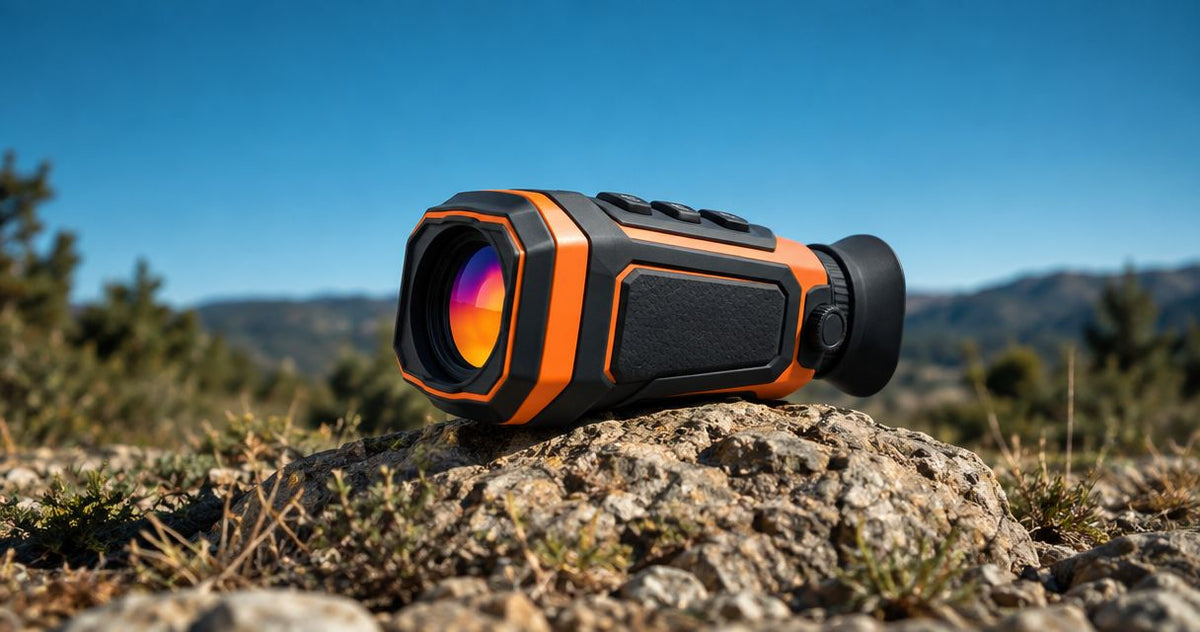
A thermal imaging monocular needs both thermal sensitivity and spatial detail: lower NETD helps separate small temperature differences, while pixel pitch only makes sense alongside detector resolution and lens focal length. For this 2026 comparison, the named thermal reference products span NETD thresholds from <18 mK to <40 mK and pixel pitches from 12 µm to 17 µm; these are specification examples, not a monocular market average.
- GoingDark thermal imaging monocular buyers should compare NETD, detector resolution and lens geometry together.
- Lower NETD means better thermal sensitivity under comparable measurement conditions, not guaranteed animal identification.
- Smaller pixel pitch changes spatial sampling; it does not automatically improve thermal sensitivity.
- Compare detector resolution separately from screen resolution and digital zoom.
Why this matters
A thermal specification sheet describes several different jobs. NETD concerns temperature contrast; detector resolution concerns spatial sampling; pixel pitch and focal length help determine how much of the scene each detector pixel covers. Treating any one number as the complete answer produces a poor shortlist.
GoingDark suits Australian hunters choosing a thermal imaging monocular by its specifications and intended use. Start with how you scan: close cover, broad paddocks or a mixture. Then compare the specifications that support that job, rather than choosing the smallest number on the page.
Use the GoingDark catalogue to separate handheld monoculars from rifle-mounted thermal scopes. The reference tables below explain the underlying detector specifications; the handheld comparison later in this guide keeps your buying shortlist in the correct product category.
NETD benchmarks: thermal sensitivity, not identification distance
NETD means noise-equivalent temperature difference. It expresses the temperature difference corresponding to detector noise under defined measurement conditions, usually in millikelvin, written as mK. Lower NETD indicates better thermal sensitivity when the measurement conditions are comparable.
The listed thresholds in this 2026 reference set run from <18 mK to <40 mK. They are upper-bound specifications, so calculating an average from them would misrepresent the data: <25 mK is not an exact measurement of 25 mK.
| Reference product | Product type | Listed NETD | What the figure tells you |
|---|---|---|---|
| Overall reference set | Three thermal rifle scopes | Thresholds from <18 mK to <40 mK | A specification range, not a monocular average |
| HIKMICRO STELLAR 3.0 SX60L | Thermal rifle scope | <18 mK | Lowest stated threshold in this reference set |
| PULSAR THERMION 2 XQ50 PRO | Thermal rifle scope | <25 mK | Lower stated threshold than the TALION XG35 |
| PULSAR TALION XG35 | Thermal rifle scope | <40 mK | Highest stated threshold in this reference set |
The HIKMICRO STELLAR 3.0 SX60L has the lowest listed NETD threshold at <18 mK; the PULSAR TALION XG35 has the highest at <40 mK. That ranking compares stated sensitivity thresholds, not complete image quality or hunting performance.
Source and scope: GoingDark product titles and descriptions form this 2026 comparison of three named thermal rifle scopes. The listings do not establish identical NETD measurement conditions, so the table cannot prove an equivalent ranking in real-world scenes.
How to use these NETD benchmarks
- Best for low-contrast scenes: prioritise a lower stated NETD, then check whether the figure describes the detector or the complete imaging system. Low temperature contrast makes sensitivity relevant, but optics and processing still affect the image.
- Best for a fair shortlist: compare equivalent specifications. Keep the less-than symbol attached to every threshold and check the measurement conditions before treating small differences as decisive.
- Best for identification decisions: assess spatial detail separately. A sensitive detector can reveal subtle thermal contrast without providing enough detail to identify an animal.
What a lower NETD does—and does not—buy you
NETD is useful when neighbouring parts of a scene have similar apparent temperatures. A lower noise-equivalent temperature difference supports the separation of smaller thermal differences under comparable conditions. That is the practical reason to examine sensitivity, rather than simply treating NETD as another badge.
The limitation is equally important. NETD does not specify field of view, the number of pixels covering an animal, focus quality or the effects of image processing. A lower threshold cannot compensate for every other part of the imaging chain.
For your shortlist, record the exact NETD wording beside each model. Do not convert a threshold into a measured result, and do not describe a percentage reduction in NETD as the same percentage improvement in visible detail.
Pixel pitch benchmarks: read micrometres with the lens
Pixel pitch is the spacing between adjacent detector pixels, expressed in micrometres, written as µm. For the same lens focal length, smaller pixels sample smaller angles of the scene; the complete field of view also depends on how many pixels span the detector.
The reference set contains pixel pitches of 12 µm and 17 µm. Neither value is a stand-alone verdict on which thermal imaging monocular produces the better image.
| Reference product | Listed pixel pitch | Listed detector resolution | Practical interpretation |
|---|---|---|---|
| Overall reference set | 12–17 µm | Different detector formats | Compare pitch with resolution and focal length |
| HIKMICRO STELLAR 3.0 SX60L | 12 µm | 1280 × 1024 pixels | Smaller pitch paired with a larger pixel array |
| PULSAR THERMION 2 XQ50 PRO | 17 µm | 384 × 288 pixels | Larger pitch paired with a smaller pixel array |
| PULSAR TALION XG35 | 12 µm | 640 × 480 pixels | Same pitch as the STELLAR, different detector format |
The HIKMICRO STELLAR 3.0 SX60L and PULSAR TALION XG35 share the smallest listed pitch at 12 µm; the PULSAR THERMION 2 XQ50 PRO lists 17 µm. Smaller is not automatically better: these products also differ in detector resolution and other specifications.
Source and scope: the pixel pitches and resolutions come from the named product listings used in this 2026 reference comparison. These figures explain detector geometry; they do not establish the handheld viewing experience or a measured identification distance.
How to use these pixel pitch benchmarks
- Best for comparing spatial sampling: hold focal length constant. Smaller pitch then corresponds to a smaller angular sample per detector pixel.
- Best for comparing scanning coverage: check detector dimensions and field of view. Pitch alone does not tell you how much country appears in the eyepiece.
- Best for assessing detail: keep NETD alongside pitch. Spatial sampling and thermal sensitivity answer different questions; neither substitutes for the other.
Why equal pixel pitch does not mean equal coverage
Two detectors can use the same pixel pitch and contain different numbers of pixels. That changes their physical dimensions. With equivalent lens geometry, a wider detector covers a wider angle of the scene.
The reference table illustrates the distinction without requiring a field-test claim. The HIKMICRO STELLAR 3.0 SX60L and PULSAR TALION XG35 both list 12 µm pitch, but their detector formats are 1280 × 1024 pixels and 640 × 480 pixels respectively. You cannot infer equal coverage simply because the pitch matches.
Likewise, the PULSAR THERMION 2 XQ50 PRO combines 17 µm pitch with a <25 mK NETD threshold. The PULSAR TALION XG35 combines 12 µm pitch with a <40 mK threshold. These examples show why smaller pixels and lower NETD must remain separate columns in your comparison.
Put the specifications in the right order
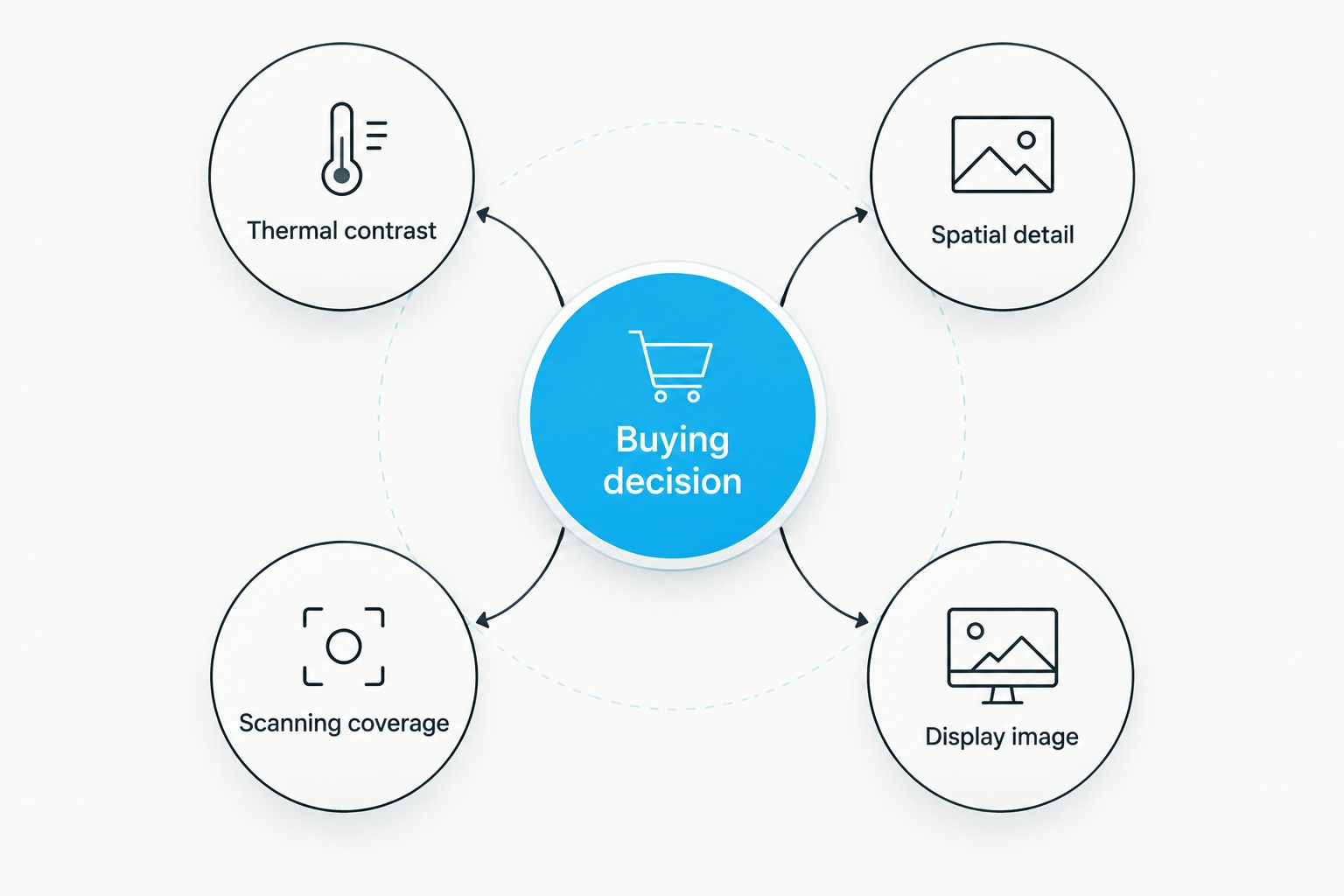
Your buying decision needs a clear separation between thermal contrast, spatial sampling and what appears in the eyepiece. Use the following checks together, rather than ranking the entire device by one specification.
- Thermal contrast: read NETD and its measurement basis.
- Spatial detail: read detector resolution, pixel pitch and lens focal length together.
- Scanning coverage: check the stated field of view and base magnification.
- Display image: distinguish screen resolution from detector resolution and examine how digital zoom is described.
A high-resolution display does not create additional detector samples. It presents the image generated from the detector and processing system. Keep the two resolutions in separate fields when comparing products.
Digital zoom also needs its own line. Enlarging the displayed image is not the same as increasing the detector's native resolution, so judge whether the enlarged view retains useful detail rather than treating a zoom figure as an identification guarantee.
Handheld monocular comparison: choose the right category
GoingDark lists handheld thermal monoculars as well as rifle scopes. For a 2026 handheld shortlist, the following product names provide directly comparable detector formats; they do not establish a NETD or pixel-pitch ranking.
| Handheld option | Detector format stated in the product name | Best for | Specification advantage | Trade-off to check |
|---|---|---|---|---|
| HIKMICRO LYNX LH25 3.0 Thermal Monocular | 384 × 288 pixels | Buyers comparing a higher native pixel count within these two LYNX listings | More native detector samples than the LE10 | Resolution alone does not establish sensitivity or scanning coverage |
| HIKMICRO LYNX LE10 3.0 Thermal Monocular | 256 × 192 pixels | Buyers assessing whether a lower-resolution detector meets their scanning needs | A clearly specified native detector format | Fewer native detector samples than the LH25; assess detail at your intended viewing distances |
The HIKMICRO LYNX LH25 3.0 has the higher listed detector resolution; neither product can be ranked for thermal sensitivity from resolution alone. Match the remaining specifications to your scanning requirements before deciding.
Detector count is a useful distinction, not a complete recommendation. The HIKMICRO LYNX LE10 3.0 needs assessment against the detail you require; the HIKMICRO LYNX LH25 3.0 still needs assessment for NETD, field of view and handling. Neither format proves that you can identify a particular animal at a particular distance.
How to use these benchmarks before buying
Start with your scanning task
For close cover, prioritise a view that lets you search without losing nearby context. For open country, examine how detector sampling and lens geometry support detail on more distant objects. These are different viewing tasks, so avoid a single specification ranking for both.
Write your intended use above the comparison table. This keeps a feature you do not need from outweighing a viewing characteristic you will use every night.
Compare the exact model
Keep each model's NETD, pitch, detector resolution, focal length and field of view on the same row. Do not transfer specifications between products because they share a series name or similar housing.
Also separate handheld requirements from rifle-scope requirements. A thermal monocular is a scanning device; rifle-scope features should not become a substitute for evaluating handheld viewing and operation.
Separate detection from identification
Detection means noticing a target's presence. Identification requires enough information to determine what the target is. A published detection distance is not an identification distance.
Do not use NETD, detector resolution or a range claim as permission to identify an animal from an indistinct heat signature. These specifications help you compare equipment, but they do not remove the need for clear identification.
Check the whole viewing chain
Before choosing a thermal imaging monocular, review focus, base magnification, field of view, display and controls alongside the detector figures. An appealing specification loses practical value if the viewing arrangement does not suit how you scan.
Use the benchmark tables to ask better questions, not to manufacture a winner. Your final shortlist should connect each claimed advantage to an actual task and retain the limitations beside it.
FAQ
What does NETD mean on a thermal imaging monocular?
NETD means noise-equivalent temperature difference and describes thermal sensitivity under defined measurement conditions. Lower NETD indicates sensitivity to smaller temperature differences when the conditions are comparable.
Is lower NETD always better for night hunting?
Lower NETD is better for thermal sensitivity under comparable conditions, but it does not guarantee better overall hunting performance. Detector resolution, optics, focus and processing also affect the usable image.
Is 12 µm pixel pitch better than 17 µm?
Neither pixel pitch is automatically better for every thermal imaging monocular. At the same focal length, 12 µm pixels sample smaller angles than 17 µm pixels, but detector dimensions and thermal sensitivity still matter.
Does a higher-resolution screen mean a higher-resolution thermal detector?
No, screen resolution and detector resolution are different specifications. A display presents the processed image; it does not add native detector samples.
Can I average NETD specifications that use a less-than symbol?
No, less-than NETD specifications are bounds rather than exact measurements. Averaging the stated thresholds would not establish the average measured NETD of those devices.
Does detection distance tell me how far away I can identify an animal?
No, detection distance is not identification distance. Seeing a thermal target does not establish that the image contains enough detail to identify it.
Which specifications should I compare before buying in 2026?
Compare NETD, pixel pitch, detector resolution, lens focal length, field of view and base magnification for the exact model. Then check the display, controls and handling against your intended scanning task.
One last thing
The useful surprise is that smaller pixels do not guarantee lower NETD. The reference products pair 12 µm with <40 mK and 17 µm with <25 mK, demonstrating why you need separate sensitivity and sampling columns.
For your 2026 shortlist, keep those columns separate and add field of view beside them. That simple comparison prevents a detector specification from standing in for the whole device.
Share:
Best IR illuminators for digital night vision in 2026
Digital night vision scopes: buying for your first setup