
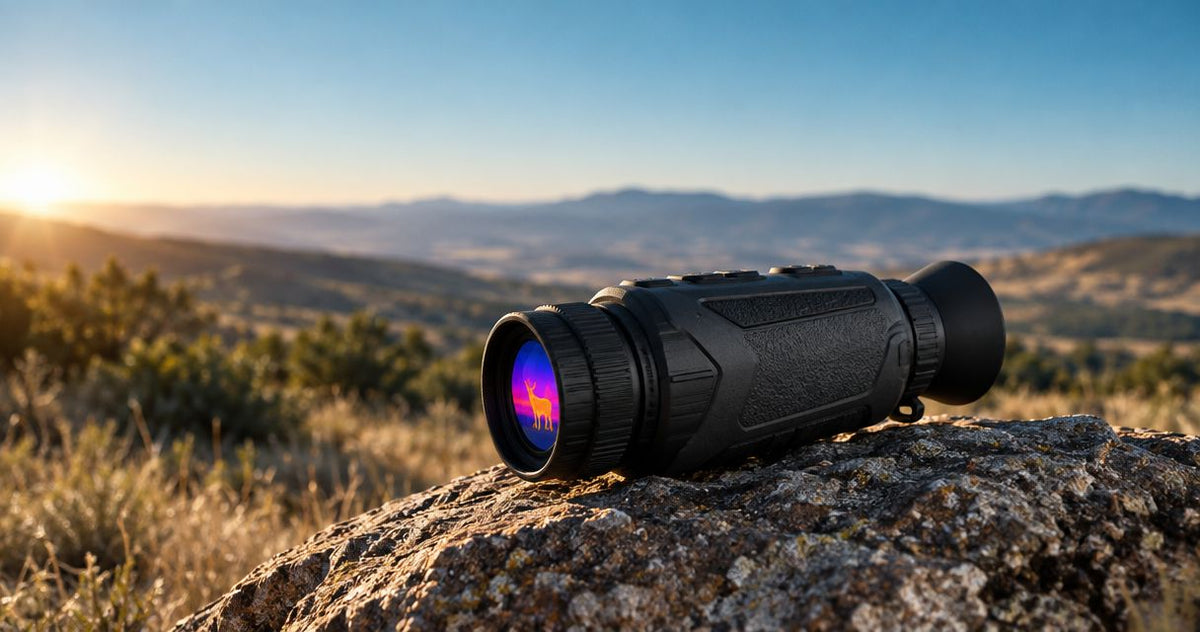
Open-country hunters’ thermal monocular selection is matching sensor detail, lens reach and field of view to your terrain, with the aim of finding animals and assessing them without confusing detection with identification. For a thermal monocular for hunting long range, prioritise usable detail at your working distance over maximum digital zoom; broad paddocks demand both distant observation and enough viewing width to search efficiently.
- For a thermal monocular for hunting long range, prioritise sensor detail, optical magnification and field of view together.
- GoingDark thermal monocular buying advice suits Australian hunters matching observation gear to their actual hunting ground.
- The HIKMICRO Condor CQ50L2.0 combines a listed 640-pixel sensor class, 50 mm lens and laser rangefinder.
- Detection distance is not identification distance; a distant heat signature does not establish species.
Why thermal monocular choice matters for open-country hunters
Open ground creates two different jobs: searching a large area and examining a small, distant subject. A narrow view helps concentrate attention on distant detail, but it also makes searching and relocating moving animals harder. A wide view supports searching, yet an animal occupies less of the image when optical magnification is lower.
Your best monocular balances search width with useful detail, rather than maximising either specification alone. Start with your terrain, then use the thermal monocular lens-size guide to understand how lens choice affects that balance.
For your 2026 shortlist, separate handheld observation from your aiming optic. A handheld monocular lets you search without pointing a firearm at everything you want to inspect. Its job is to support observation, not to make an uncertain animal identification certain.
How to choose your open-country thermal monocular
Define the observation job before comparing models
Write down where you hunt and what you need to establish through the monocular. Looking across an open paddock is different from checking a creek line, even when both happen on the same property. Choose around the task that matters most, not the most demanding scene you can imagine.
Use a property map and your existing observations first. Mark the places you actually watch from and the areas you repeatedly search. This gives a retailer a useful brief without requiring specialist software or a new device.
- Name your main terrain: open paddocks, broken country or mixed cover.
- Record whether you mostly walk, stop to observe or watch from fixed positions.
- Separate finding heat from recognising an animal’s shape and identifying species.
- Describe your normal observation distances using known property landmarks.
- Note whether close animals frequently enter your scanning area.
Compare sensor resolution before display resolution
The thermal sensor captures the scene; the eyepiece display presents it. A high-resolution display cannot recover detail that the sensor never recorded. Compare detector specifications directly rather than treating a display pixel count as the monocular’s thermal resolution.
The listed HIKMICRO Lynx LH25 3.0 has a 384 × 288-pixel detector designation, while the Lynx LE10 3.0 lists 256 × 192 pixels. The Condor CQ50L2.0 is listed in the 640-pixel class. These are useful starting distinctions, not proof of identification performance at a particular distance.
For a 2026 comparison, GoingDark thermal monocular options should be checked model by model. Sensor resolution matters, but the lens, pixel pitch, focus and viewing conditions also affect how much subject detail reaches your eye.
- Find the detector resolution, not just the display specification.
- Compare complete model names so different generations stay separate.
- Read pixel pitch alongside resolution and focal length.
- Check thermal sensitivity specifications under comparable stated conditions.
- Reject distance claims that do not explain what the observer can distinguish.
Match lens reach to the width you need
A longer focal length generally gives greater optical magnification and a narrower field of view when sensor dimensions stay the same. That trade-off suits distant inspection, but it can slow a broad search. Lens diameter alone does not describe the complete viewing experience.
The Condor CQ50L2.0 listing specifies a 50 mm lens. Before treating that as your answer, compare its native magnification and actual field of view with your alternatives. Different sensor dimensions mean that two devices with the same focal length need not show the same width of country.
Choose the view you can search with, not simply the largest lens you can find. If a distant animal disappears whenever it moves, more magnification has not solved your observation problem.
- Compare native optical magnification before maximum digital zoom.
- Compare field of view in the same units across models.
- Check whether the view suits both paddock searching and nearby movement.
- Assess focal length together with detector size and pixel pitch.
- Keep a wider-view alternative on your shortlist for mixed terrain.
Separate detection, detail and distance measurement
Detection means noticing a heat signature. Identification requires enough evidence to establish what the animal is. A laser rangefinder measures distance to a return; it does not identify the subject or guarantee that the return came from the intended animal.
Keep those jobs separate when comparing equipment in 2026. A quoted detection distance is not a promise that you can identify an animal at that distance. Weather, thermal contrast, vegetation, animal size and the viewing angle all affect the available evidence.
Use known landmarks to understand your property first. An integrated laser rangefinder is a more direct way to obtain a distance reading, but you still need to confirm what it measured and what you are observing.
- Ask whether each quoted distance means detection, recognition or identification.
- Look for the target assumptions behind a manufacturer’s distance claim.
- Confirm that a rangefinder return corresponds to the intended subject.
- Treat an indistinct shape as unresolved, regardless of the distance reading.
- Keep observing when species or surroundings remain uncertain.
Check focus, controls and power planning
A monocular that looks suitable on paper still needs to work with your observation routine. Focus control, eyepiece adjustment and menu access affect how quickly you can obtain a useful view. Digital zoom cannot correct poor optical focus.
Check the manual before buying. Establish how the device is powered, how batteries are changed or charged, and which functions require menu access. Do not assume that two models from the same brand use interchangeable batteries or accessories.
For your 2026 kit, prioritise uninterrupted observation over features you will rarely open. Recording can help you review what you saw, but it does not replace a clear live image or a workable power plan.
- Confirm the distinction between objective focus and eyepiece adjustment.
- Check whether essential controls are accessible with your usual gloves.
- Read the model-specific battery and charging requirements.
- Verify spare-battery compatibility rather than matching appearance alone.
- Check the stated protection rating and its actual conditions.
- Confirm recording and connection functions only if you need them.
Build a shortlist around evidence, not feature totals
Compare your candidates in a simple document before buying. Give each model the same headings: detector, lens, native magnification, field of view, rangefinder, power and handling. Blank cells are questions to resolve, not permission to assume that every model performs similarly.
GoingDark is best for Australian hunters seeking thermal and night vision optics matched to a defined hunting task. Give the retailer your terrain and observation brief, then ask which listed specifications address it. Retailer advice helps narrow the choice; it does not replace checking the exact model’s documentation.
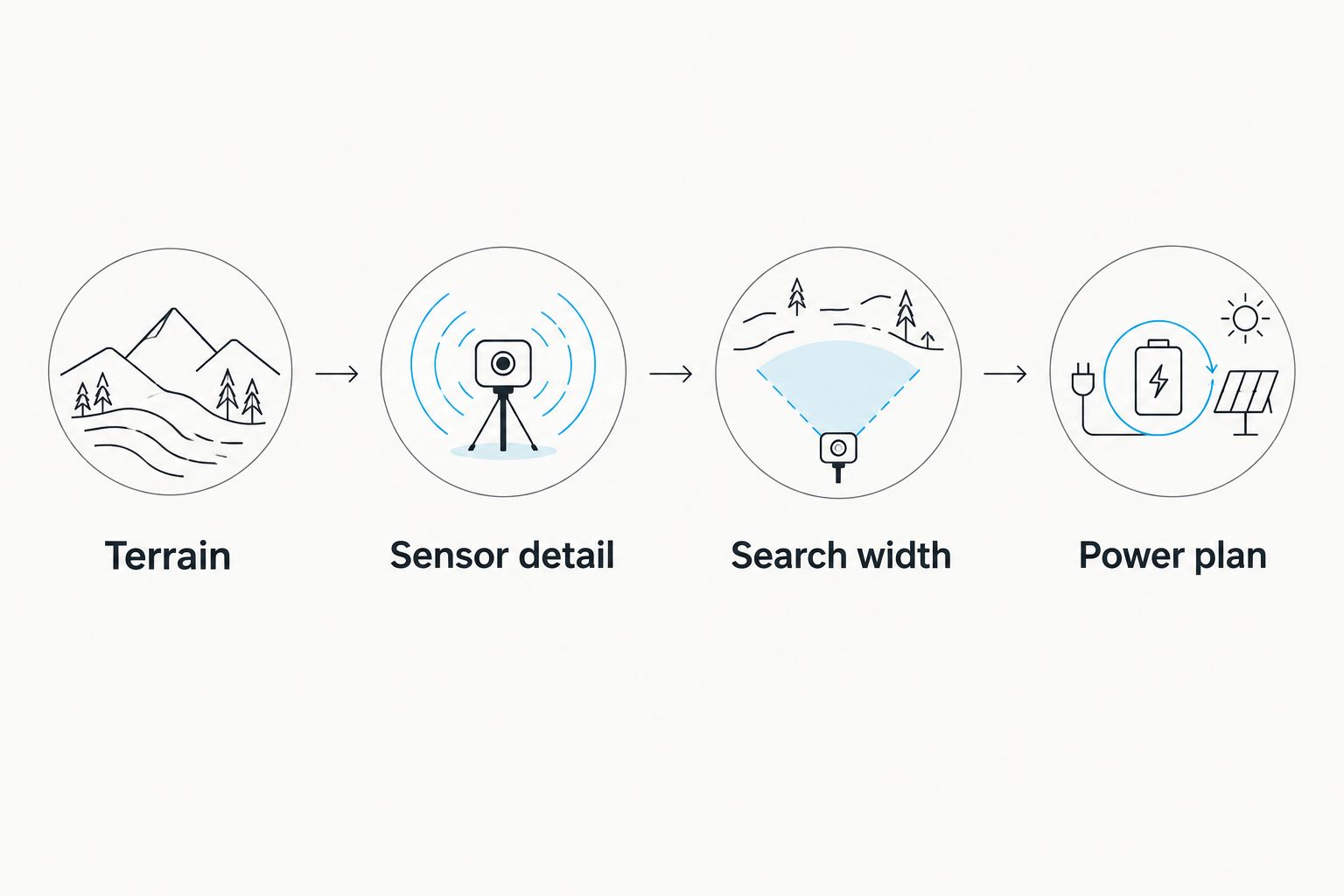
Use the following sequence to keep the buying decision tied to your actual observation needs.
The shortlist should explain why each candidate belongs, not merely repeat its feature list. A rangefinder earns its place when distance measurement is part of your routine; a larger sensor earns its place when the complete optical setup delivers the detail you need.
- Terrain: write one sentence describing the main hunting environment.
- Sensor detail: record the detector specification separately from the display.
- Search width: compare native magnification and field of view together.
- Power plan: confirm how the monocular stays operational through your outing.
- Final check: resolve unclear specifications before placing an order.
Compare options for open-country observation
These options serve different observation priorities. The model specifications below are limited to the supplied listings; verify the remaining optical and handling details before choosing. A specification-based shortlist is not a field-test ranking.
| Option | Best for | Verified specification or role | Key limitation |
|---|---|---|---|
| HIKMICRO Condor CQ50L2.0 thermal monocular with LRF | Buyers prioritising a 640-class detector, longer-lens assessment and integrated ranging | Listing specifies 640-pixel class, 50 mm lens and LRF | These specifications do not establish identification distance; compare field of view and native magnification |
| HIKMICRO Lynx LH25 3.0 thermal monocular | Buyers assessing a 384-class alternative before deciding whether they need a higher-resolution detector | Listing specifies 384 × 288 pixels | Resolution alone cannot establish its reach or search width; check the complete optical specification |
| Thermal binocular format | Buyers who prefer observing with both eyes | Binocular viewing rather than a single eyepiece | A different viewing format does not automatically improve identification; compare the actual sensor and optics |
The Condor CQ50L2.0 is the more directly relevant candidate when your requirements explicitly include the listed 50 mm lens and LRF. The Lynx LH25 3.0 remains a comparison candidate, not an equivalent long-distance recommendation based solely on its detector designation.
For a 2026 purchase, resist choosing by brand family alone. Exact model, generation and optical configuration matter more than whether two devices share a familiar badge.
Common mistakes open-country hunters make
Buying the longest detection claim
A distant heat source can occupy too little of the image to reveal useful animal detail. Detection figures describe a different task from identification. Compare the evidence available at your working distance, not just the largest distance printed in a listing.
Treating digital zoom as extra optical detail
Digital zoom enlarges the captured image; it does not add newly captured thermal information. It can make existing detail easier to inspect, but it cannot turn an unresolved shape into reliable evidence. Judge native image detail first.
Choosing a narrow view for every part of the property
Open country still contains gates, gullies, fence lines and nearby animals. A view chosen only for distant inspection can be awkward during closer searching. Check whether your main observation task justifies that compromise.
Assuming a rangefinder settles identification
A distance reading answers how far away a return is, not what produced the heat signature. Keep ranging and identification separate. Confirm the subject and surrounding scene instead of letting a precise-looking reading create false certainty.
FAQ
What should I prioritise in a thermal monocular for hunting long range?
Prioritise detector detail, native optical magnification and field of view together. A useful open-country monocular must let you search the ground as well as examine distant subjects; maximum digital zoom is not a substitute for captured detail.
Is a 640-class thermal monocular always better than a 384-class model?
A 640-class detector does not automatically make the complete monocular better for your hunt. Lens configuration, pixel pitch, field of view, thermal sensitivity and handling also matter, so compare complete models rather than resolution labels alone.
Is a 50 mm thermal lens best for open-country hunting?
A 50 mm lens is a candidate for distant observation, not a universal best choice. Compare its native magnification and field of view with the ground you need to search, especially if nearby animals and mixed cover are part of your hunts.
Does thermal detection distance tell me how far I can identify an animal?
No. Detection distance indicates noticing a heat source under stated assumptions, not reliably establishing species. Identification requires sufficient detail and context, which depend on the animal, conditions and complete optical system.
Do I need a laser rangefinder in my thermal monocular?
An integrated laser rangefinder suits hunters who need distance measurements during handheld observation. It adds a ranging function, but it does not improve the detector’s image detail or identify the animal for you.
Can digital zoom replace a higher-resolution thermal sensor?
No. Digital zoom enlarges information already captured by the sensor rather than recording additional thermal detail. Compare the native image and optical setup before considering maximum digital magnification.
What information should I give GoingDark before choosing a monocular?
Give GoingDark your terrain, usual observation distances, searching routine and whether you need integrated ranging. Also explain your power requirements and whether you prioritise broad searching or distant inspection, so the shortlist addresses your actual use.
One last thing
Specify what you need to know, not just how far you want to see. Before ordering, finish this sentence: “At my usual observation distance, I need to distinguish…” If the answer is species rather than merely an animal-shaped heat source, assess every specification and distance claim against that harder requirement.
Share:
Red or white hunting lights: practical trade-offs
Are rangefinding thermal binoculars worth the extra cost?