
The best 1280 thermal scope shortlist starts with a confirmed 1280-pixel-wide thermal detector—not the display specification. Compare the Pulsar Thermion 2 LRF XL60 as a dedicated riflescope candidate, the Pulsar Merger LRF XT50 as a confirmed 1280 × 1024-pixel observation option, and the Nocpix ACE L35 as a lower-resolution alternative; these are different buying paths, not three equivalent 1280 scopes.
- Choose a 1280 thermal scope by native detector resolution, not display resolution or a digital night vision label.
- Pulsar Merger LRF XT50 has a 1280 × 1024-pixel thermal detector; it is a binocular, not a riflescope.
- Pulsar Thermion 2 LRF XL60 belongs on a riflescope shortlist, with detector specifications checked before purchase.
- Nocpix ACE L35 is a 384-class thermal riflescope alternative, not a substitute for a confirmed 1280 detector.
Why this matters
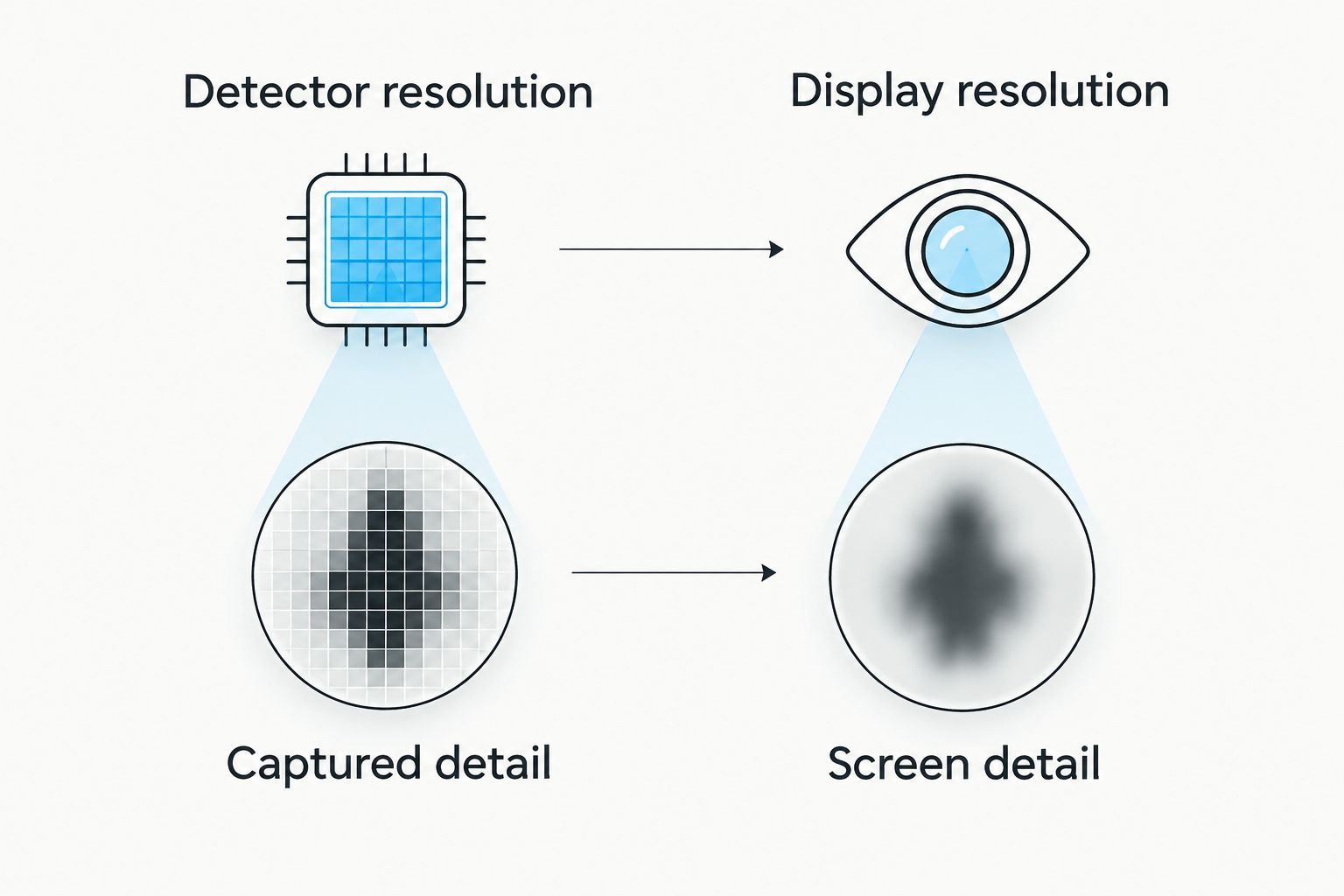
A resolution number means little until you know which component it describes. Thermal detector resolution describes the image captured from thermal radiation; display resolution describes the screen you look at. Enlarging the screen or processing the image does not add detector pixels.
For Goingdark buyers, a 1280 thermal scope should mean a 1280-pixel-wide thermal detector, not just a high-resolution display. Start with the Pulsar Thermion 2 LRF XL60 thermal rifle scope if you need a dedicated riflescope, then verify the detector specification separately rather than treating the model name as proof.
Your 2026 buying decision also needs to separate observation from aiming. A high-resolution binocular can suit your scanning requirements without replacing a riflescope. Buy the device type you need before choosing the biggest resolution number.
What makes the best 1280 thermal scope?
Use these criteria before comparing individual models:
- Detector resolution: Confirm the native thermal detector dimensions. A display specification alone does not establish a 1280-class thermal sensor.
- Field of view: Compare the width of the scene visible at base magnification. Finding an animal and inspecting an animal are different tasks.
- Useful magnification: Assess the starting magnification and what remains visible when you apply digital zoom. Enlargement does not create new captured detail.
- Thermal sensitivity: Read NETD alongside the detector and lens specifications. Resolution alone does not describe how clearly small temperature differences appear.
- Rifle compatibility: Check mounting requirements, eye relief and the manufacturer's recoil rating for the exact model. Do not transfer specifications between related products.
- Practical operation: Compare controls, focusing, battery arrangements and rangefinding requirements against how you actually hunt.
A larger detector gives you more sampling points, but the entire optical system determines the view. Lens focal length, pixel pitch, focus and atmospheric conditions all affect the image you use.
For a 2026 shortlist, record detector and display specifications in separate columns. This simple distinction prevents a sharp-looking screen from being mistaken for a higher-resolution thermal detector.
Hunting optics at a glance
The comparison below separates three useful purchase paths. It does not classify the binocular or the 384-class riflescope as a 1280 thermal scope.
| Option | Best for | Standout feature | Key limitation |
|---|---|---|---|
| Pulsar Thermion 2 LRF XL60 | Dedicated thermal riflescope shortlisting | Thermal rifle scope with LRF in its model designation | Confirm native detector resolution before treating it as a 1280 candidate |
| Pulsar Merger LRF XT50 | Confirmed 1280-pixel thermal observation | Listed 1280 × 1024-pixel thermal detector | Binocular format; not a rifle-mounted aiming optic |
| Nocpix ACE L35 384 thermal rifle scope | Comparing a lower-resolution riflescope alternative | Dedicated thermal riflescope in the 384 class | Does not meet a 1280-pixel detector requirement |
The right comparison starts with intended use, then detector resolution. Comparing unlike devices solely because they appear in a thermal optics search produces the wrong shortlist.
1. Pulsar Thermion 2 LRF XL60: best for a dedicated riflescope shortlist
The Pulsar Thermion 2 LRF XL60 is a thermal rifle scope, making it relevant when your purchase must provide a rifle-mounted aiming optic. That distinguishes it from handheld monoculars and binoculars, regardless of their detector resolution.
Keep the Pulsar Thermion 2 LRF XL60 on your comparison sheet as a riflescope candidate—not as an automatically verified 1280 model. Check the exact detector dimensions before comparing its image specifications with a confirmed 1280 × 1024-pixel device.
Pulsar Thermion 2 LRF XL60 pros:
- Its stated product type matches a dedicated thermal riflescope requirement.
- Its LRF designation makes it relevant to a rangefinding-scope comparison.
- Its exact model name lets you check specifications without confusing it with another Thermion variant.
Pulsar Thermion 2 LRF XL60 cons:
- The model designation does not establish a 1280-pixel detector specification.
- A rifle-mounted optic does not replace the separate role of a handheld observation device.
- Suitability still depends on your rifle, mounting arrangement and viewing requirements.
Best for: Hunters building a dedicated riflescope shortlist and willing to verify the complete specification before ordering.
For your 2026 comparison, ask specifically for detector dimensions, base magnification, field of view and mounting requirements. Do not accept a display-resolution answer when you asked about the detector.
Verdict: Hold until the exact detector specification and rifle compatibility match your requirements.
2. Pulsar Merger LRF XT50: best for confirmed 1280-pixel observation
The Pulsar Merger LRF XT50 is listed with a 1280 × 1024-pixel thermal detector, pixel pitch of 12 µm and NETD below 40 mK. Those are detector-related specifications, rather than a display resolution presented as thermal capture resolution.
The important trade-off is its format: the Pulsar Merger LRF XT50 is a thermal binocular. It belongs in a high-resolution observation comparison, not a list that presents every entry as a rifle scope.
Pulsar Merger LRF XT50 pros:
- Its listed 1280 × 1024-pixel detector directly addresses the resolution question.
- The listing identifies both pixel pitch and NETD, allowing a broader specification comparison.
- Binocular format gives you a dedicated observation option separate from your aiming optic.
Pulsar Merger LRF XT50 cons:
- It is not a riflescope and cannot fulfil that purchase requirement.
- A separate observation device adds another item to your hunting setup.
- Detector resolution does not establish an identification distance for your conditions.
Best for: Hunters seeking confirmed 1280-pixel thermal observation while keeping the rifle optic as a separate decision.
Goingdark’s Pulsar Merger LRF XT50 listing demonstrates why device type matters as much as the headline resolution. The 1280 × 1024-pixel specification is relevant, but it does not turn a binocular into a scope.
Verdict: Buy for a matching observation requirement; skip as a replacement for a riflescope.
3. Nocpix ACE L35: best for a lower-resolution riflescope comparison
The Nocpix ACE L35 is identified as a 384-class thermal rifle scope. It gives you a dedicated riflescope alternative to assess when you are deciding whether a strict 1280-pixel requirement actually belongs in your purchase brief.
Do not treat the Nocpix ACE L35 as an equivalent-resolution substitute. Compare its complete specification against your intended viewing conditions, then decide whether the lower-resolution category meets your needs.
Nocpix ACE L35 pros:
- Its stated device type matches a thermal riflescope purchase.
- Its 384-class designation makes the resolution category clear.
- It provides a distinct comparison point rather than another observation-only device.
Nocpix ACE L35 cons:
- It does not meet a strict 1280-pixel detector requirement.
- Digital enlargement cannot turn a 384-class detector into a native 1280 detector.
- The resolution class alone cannot establish its suitability for your hunting conditions.
Best for: Hunters comparing detector classes before committing to a high-resolution riflescope requirement.
Verdict: Hold for a full specification comparison; skip if native 1280-pixel capture is non-negotiable.
Understand what the resolution numbers actually buy
Detector resolution versus display resolution
A thermal detector with 1280 × 1024 pixels contains 1,310,720 detector pixels. That describes the captured thermal image, not the number of pixels in the eyepiece display.
A higher-resolution display can present an image clearly, but it cannot recover thermal detail the detector never captured. Ask for both specifications and keep them separate throughout your comparison.
Digital zoom versus captured detail
A central 2× digital crop of a 1280 × 1024-pixel image uses a 640 × 512-pixel region before that region is enlarged for viewing. This is image geometry, not a performance claim for a particular scope.
A larger detector therefore provides more pixels to work with when cropping. It does not guarantee that every magnification setting delivers enough detail for identification.
Detection versus identification
Detection means noticing a thermal signature. Identification means establishing what you are looking at; a distant warm shape does not answer that question by itself.
Treat a published detection distance as a detection claim only. Never convert detection distance into identification distance, and never use detector resolution alone to assign a shooting distance.
Match the optic to your hunting setup
Start with how you search, not just how far you hope to see. A detector specification cannot tell you whether the optic will be comfortable to scan with, quick to focus or suitable for your rifle.
- Open country: Compare field of view and base magnification together. You need enough scene width to search as well as enough detail to inspect.
- Timbered country: Prioritise finding openings and maintaining context. Thermal imaging does not let you see through solid trees or other opaque obstacles.
- Walking hunts: Assess the combined carry burden of your riflescope, observation device, mounts and batteries.
- Stationary observation: Consider whether a dedicated handheld or binocular better matches extended scanning than the rifle optic alone.
Before ordering in 2026, check the exact model's battery requirements and the accessories needed for your setup. Do not assume a battery, mount or adapter fits because the brand name matches.
Goingdark buyers should also separate thermal imaging from digital night vision. A 4K digital night vision label describes a different imaging system; it is not evidence of a 1280-class thermal detector.
How the shortlist is ranked
The shortlist follows device suitability first, then clearly identified detector information. The Pulsar Thermion 2 LRF XL60 occupies the dedicated-riflescope checking slot, the Pulsar Merger LRF XT50 the confirmed 1280 observation slot, and the Nocpix ACE L35 the lower-resolution comparison slot.
No field-test ranking or identification-distance claim is attached to these positions. Your final decision still rests on the criteria above: detector, viewing characteristics, sensitivity, compatibility and operation.
Which 1280 thermal scope should you choose?
If native 1280-pixel thermal capture is mandatory, choose only after the exact riflescope's detector dimensions are confirmed. Do not substitute a display figure, a binocular specification or a digital night vision resolution.
The Pulsar Merger LRF XT50 answers the confirmed-resolution observation question, not the riflescope question. Keep the Pulsar Thermion 2 LRF XL60 on a dedicated-scope comparison sheet, and consider the Nocpix ACE L35 only if you are open to a different resolution class.
For a 2026 purchase, a correctly matched optic beats a misleading resolution headline. Keep your device requirement and detector requirement explicit until both are satisfied.
FAQ
What should I look for in a 1280 thermal scope?
Look for a native thermal detector that is 1280 pixels wide, then compare field of view, base magnification, thermal sensitivity and rifle compatibility. Display resolution alone does not prove the detector meets that requirement.
Is the Pulsar Merger LRF XT50 a thermal rifle scope?
No. The Pulsar Merger LRF XT50 is a thermal binocular listed with a 1280 × 1024-pixel detector. It suits observation rather than replacing a rifle-mounted aiming optic.
Does a high-resolution display mean a scope has a 1280 thermal sensor?
No. Display resolution describes the screen, while detector resolution describes thermal capture. Check the specifications for each component separately.
Is a 1280 thermal detector always better than a 384 detector?
A 1280-pixel-wide detector has more horizontal sampling points than a 384-pixel-wide detector, but that alone does not decide which optic suits you. Lens characteristics, thermal sensitivity, field of view and intended use also matter.
Can digital zoom create more thermal detail?
Digital zoom enlarges captured image information rather than creating new detector detail. A larger detector gives you more pixels to crop, but useful identification still depends on the image and conditions.
Is 4K digital night vision the same as 1280 thermal imaging?
No. Digital night vision and thermal imaging use different imaging systems. A 4K night vision specification does not establish the resolution of a thermal detector.
Can I use a thermal scope's detection range as its identification range?
No. Detection means noticing a thermal signature, while identification requires enough information to establish what it is. A published detection distance is not an identification guarantee.
One last thing
Before placing an order, write two separate lines: device type and native thermal detector resolution. If either answer is unclear, stop the comparison there. That check prevents a binocular, a display specification or a digital night vision label from becoming the wrong purchase.
Share:
Best thermal scopes for long-range hunting in 2026