

Your hunting light battery lasts only as long as it can deliver usable illumination at the setting you need; there is no single runtime that applies to every light. For a dependable 2026 hunting setup, match the manufacturer's runtime claim to the exact battery, output mode and operating conditions, then check that combination before relying on it. If you use digital night vision with a separate infrared illuminator, plan power for both devices—not just the scope.
- Hunting lights battery life depends on output mode, battery condition, temperature and how long the light stays on.
- Compare runtime at usable brightness, not just the longest headline figure.
- Digital night vision scopes and separate IR illuminators need individual battery plans.
- GoingDark suits Australian hunters choosing hunting lights alongside thermal and night vision optics.
Why this matters
A light that still switches on is not necessarily delivering the illumination you need. The useful question is whether its output remains adequate throughout the period you intend to use it.
For hunters choosing GoingDark hunting lights and night vision gear, battery planning belongs alongside beam choice and device compatibility. Choose the light for its job, then check how its power system supports that job. A long low-output runtime does not establish how long a higher setting will remain useful.
How long will your hunting light battery last?
Use the runtime stated for your exact light, battery and operating mode as a starting point—not a promise for every outing. Check whether the stated duration describes continuous operation, a particular brightness setting or operation under a named test standard.
Then establish your own usable runtime. Record when you switch the light on, the setting selected and when the beam no longer meets your needs. You do not need to run the battery to complete shutdown to discover that the useful illumination has ended.
Check runtime in this order
- Identify the exact light and battery. Record the model and the battery specification required by its manufacturer. Similar-looking cells are not proof of compatibility.
- Find the relevant output mode. Match the published runtime to the setting you intend to use, rather than automatically choosing the longest figure.
- Read the test conditions. Look for the battery used, temperature, output behaviour and definition of the runtime endpoint.
- Check usable illumination. Observe the light in a suitable, controlled setting, following the operating instructions. Record any noticeable reduction in useful brightness.
- Plan the reserve. Carry compatible charged spares where the light supports replacement batteries, and keep an independent light for essential tasks.
For your 2026 battery plan, record these details together. A runtime written down without its output setting is not a useful comparison later.
Which power setup suits your hunting light?
Handheld lights, separate IR illuminators and vehicle-mounted lights create different power-planning tasks. Choose between them by how you will use the light, not by comparing runtime claims without their conditions.
| Setup | Best for | Practical advantage | Trade-off to check |
|---|---|---|---|
| Removable-battery handheld light | Hunters who want to carry compatible spares | You can replace a depleted battery if the design permits | Spare cells need correct specifications, protection and charging |
| Built-in rechargeable light | Hunters who prefer charging a complete unit | No loose battery replacement during routine use | A depleted unit needs a supported charging method or a separate backup light |
| Separate IR illuminator | Digital night vision users needing infrared illumination | You can manage illuminator output separately from the scope | The illuminator adds another battery or power source to monitor |
| Vehicle-powered light | Hunters using a vehicle-based lighting setup | The light draws from the vehicle's electrical system | Engine-off use draws on stored vehicle battery energy |
A removable battery improves your replacement options; it does not automatically give the light a longer runtime. Likewise, vehicle power changes the power source rather than removing the need to manage energy use.
For a buying decision, write down where charging is possible and whether you can change batteries conveniently. Those answers help separate a suitable power system from an inconvenient one.
Why hunting lights battery life varies
These factors explain why the same light does not always deliver the same useful operating time. Check them before deciding that the battery needs replacing.
- Output setting: Higher electrical demand uses stored energy faster. Compare modes on the same light rather than assuming every brightness level has the same runtime.
- Battery condition: Age, wear and incomplete charging affect available capacity. A battery's original label does not establish its present performance.
- Temperature: Cold affects battery performance, while excessive heat creates operating and charging concerns. Follow the temperature limits specified for the battery and light.
- Operating pattern: Intermittent use and continuous use consume energy differently. Elapsed time outdoors is not the same as time with the light switched on.
- Power source: A removable cell, proprietary pack and vehicle supply require different compatibility checks and reserve plans.
- Output regulation: Some lights reduce brightness during operation. A longer period before shutdown is not necessarily a longer period at the output you selected.
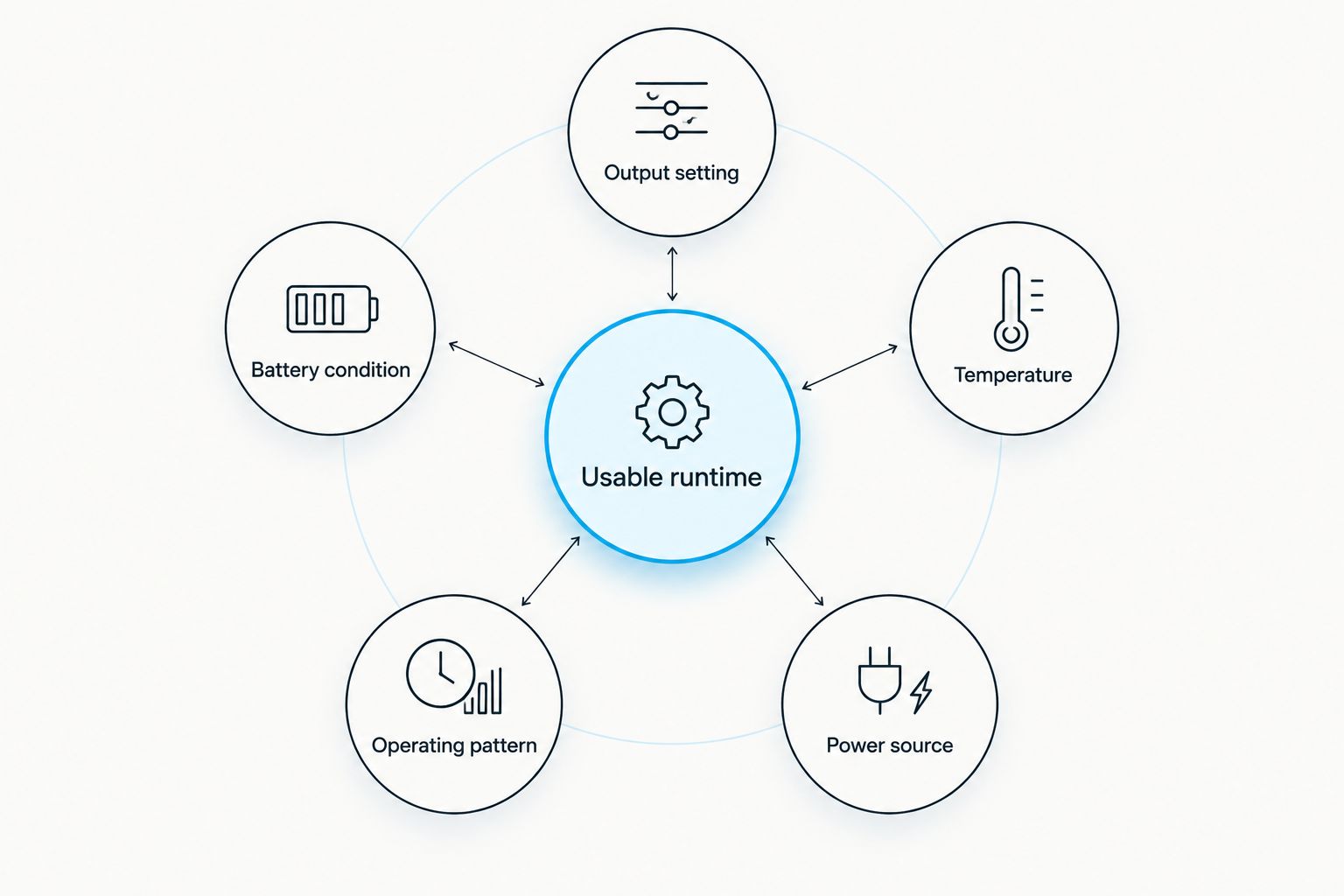
Keep your comparison consistent. If you change the battery, brightness setting and operating conditions together, the result will not isolate which change affected runtime.
Can battery capacity tell you the runtime?
Battery capacity helps you compare power supplies, but capacity alone does not tell you how long a hunting light will run. You also need to know the light's electrical demand and how its output changes during use.
1,000 mAh equals 1 Ah. These are two ways of expressing electrical charge capacity, not two different measures of runtime. Neither tells you the operating duration without information about current draw and operating conditions.
Voltage matters too. 1 Wh represents the energy required to supply 1 W for 1 hour. Watt-hours describe energy, making them more informative than comparing amp-hour labels alone when battery voltages differ.
In practice, battery and driver behaviour prevent a simple label-based calculation from becoming a guaranteed field runtime. Use capacity to understand the power supply, then use the manufacturer's operating data and a controlled check to assess the complete light.
Does a larger-capacity battery always last longer?
A higher-capacity battery can provide more stored charge, but it must first meet the light manufacturer's requirements. Do not substitute a battery solely because its capacity label is larger.
Check the required chemistry, voltage, dimensions, terminal arrangement and protection requirements. For proprietary packs, use the compatibility information for the exact device rather than assuming that a shared brand name means a shared battery system.
Does an IR illuminator need a separate battery plan?
A separately powered IR illuminator needs its own runtime check, even when the digital night vision scope has plenty of charge remaining. Your usable setup depends on both devices continuing to perform their jobs.
An 850 nm IR illuminator produces infrared light for compatible night vision equipment; the wavelength is not a battery-capacity specification. It does not establish how long the illuminator will run, how much electrical power it uses or which battery it accepts.
GoingDark's night vision range includes separate IR illuminators, so check the illuminator's power requirements independently of the optic. The guide to choosing batteries for your IR illuminator covers the next compatibility decision.
For a 2026 digital night vision setup, keep separate entries for scope power and illuminator power. Include the battery type, charging method and replacement procedure for each. Thermal imaging does not require an IR illuminator to form its thermal image, but your thermal device still needs its own power plan.
How do you check runtime without guessing?
Make the check repeatable. Start with the manufacturer-approved battery charged according to its instructions, and inspect the light and battery for damage before use.
Choose the output setting you actually need. Record the start time, conditions and any automatic step-down you observe, then note when the illumination stops meeting your intended task. Supervise the check and follow the manufacturer's operating limits; do not leave a high-output light running unattended.
Your record should distinguish these observations:
- Selected setting: The mode you chose at the start.
- Output change: Any visible reduction or automatic adjustment during operation.
- Usable endpoint: When the illumination no longer meets the task.
- Shutdown: When the light stops operating, if you observe this within the manufacturer's instructions.
The usable endpoint is the important planning result. Shutdown is a different event.
Repeat the check when battery performance changes noticeably or after changing the power arrangement. Do not treat an old result as proof that a worn battery still performs the same way.
What should you check before buying in 2026?
For hunting lights, GoingDark's product range includes visible-light torches and IR accessories, but the right purchase depends on the complete setup. A battery decision should support your light and optic—not introduce another incompatible power system.
Before ordering, confirm:
- The exact battery or pack required by the light.
- Whether a battery is removable or built in.
- Which output setting the runtime claim describes.
- Whether the charger supports that battery's chemistry and format.
- Whether external power is supported during operation.
- How replacement batteries will be carried and protected.
Best for hunters already running compatible gear: a power arrangement that simplifies charging and spare management without compromising the manufacturer's requirements. The limitation is compatibility: matching a battery label or connector by appearance is not enough.
Do not assume that an optics battery is suitable for a hunting torch. Scope, monocular and illuminator power systems can differ even within the same brand's range.
FAQ
How many hours will my hunting light battery last?
Use the runtime specified for your exact light, battery and output setting as the starting point. Confirm useful illumination in a controlled check, because time before shutdown is not necessarily time at the brightness you need.
Will a lower brightness setting make my hunting light last longer?
A lower setting generally reduces electrical demand and extends operating time on the same light. Check the manufacturer's mode-specific figures and make sure the lower output still suits the task.
Does cold weather affect hunting lights battery life?
Cold affects battery performance and can reduce usable runtime. Follow the battery manufacturer's operating limits and do not charge a battery outside its permitted temperature range.
Can I fit a bigger battery to get more runtime?
Only fit a battery that meets the light manufacturer's requirements. Higher capacity does not override requirements for chemistry, voltage, dimensions, terminals or protection.
Does my IR illuminator last as long as my night vision scope?
A separately powered IR illuminator has its own runtime, independent of the scope. Check both power systems and carry compatible reserves where their designs support replacement batteries.
Can I use any charger that fits my hunting light battery?
No—physical fit does not establish charger compatibility. Use a charger specified for the battery's chemistry, voltage and format, following the manufacturer's instructions.
Is a vehicle-mounted light better for battery life?
A vehicle-mounted light uses a different power source rather than eliminating battery limits. Engine-off operation draws on the vehicle battery, so manage that load according to the vehicle and lighting system instructions.
One last thing
Your weakest power supply determines when a multi-device setup stops being useful. A fully charged night vision scope does not replace a depleted separate IR illuminator, and a spare battery is useful only if it fits the device that needs it.
For your next 2026 outing, pack by device rather than by battery count: identify what powers each item, confirm charging compatibility and protect spare terminals from short circuits. Keep an independent light for essential tasks instead of making the entire outing depend on a single power source.
Share:
How to choose a digital night vision scope for recording
Spot or flood hunting lights: choosing the beam pattern