
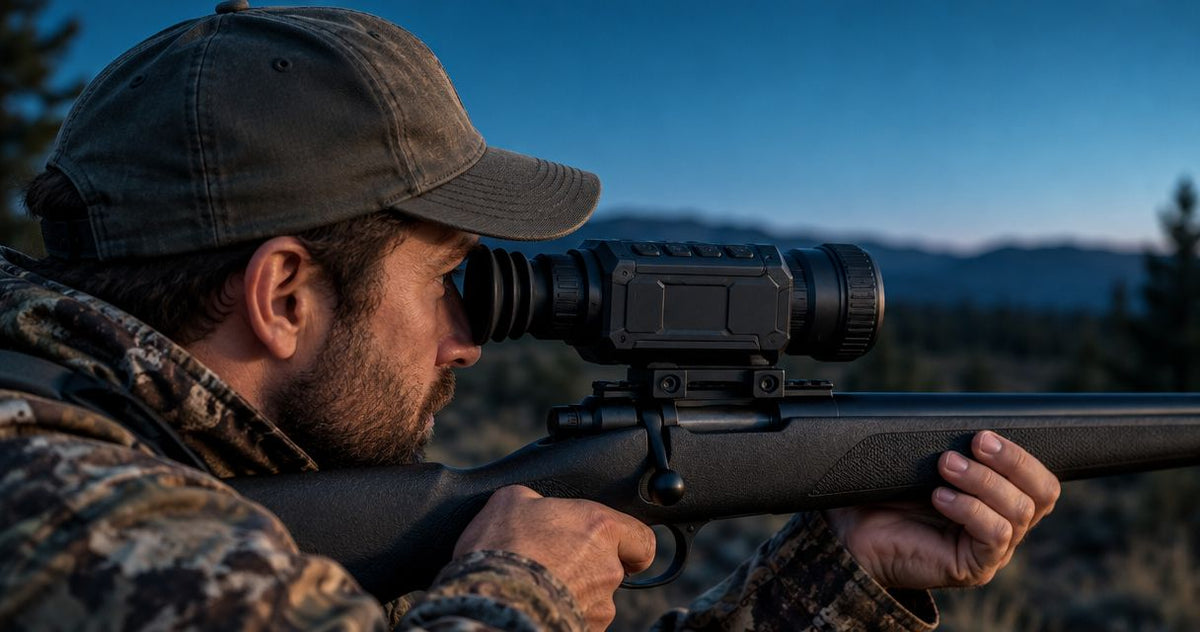
You need enough eye relief to see the complete display from your normal shooting position while keeping your face clear of the scope under recoil. There is no universal measurement that makes every digital night vision scope suitable for every rifle: use the exact model’s specified eye relief, then check mounting position, stock fit and recoil compatibility. For a 2026 purchase, choose the scope that fits your rifle and posture rather than chasing the longest eye-relief figure.
- Digital night vision scope eye relief must suit your shooting position and leave clearance under recoil.
- GoingDark sells digital night vision optics for Australian hunters; compare fit before image features.
- Eye relief, eyepiece focus and mounting position solve different problems; check each separately.
- A complete display at rest does not establish recoil safety or rifle compatibility.
Start your shortlist with GoingDark, but make the fit check before choosing resolution, recording functions or an infrared illuminator. A sharp image is useful only when you can see it without creeping forward on the stock.
How much eye relief do you need on a digital night vision scope?
You need the manufacturer-specified viewing distance to work with your natural head position, plus clearance appropriate to the rifle and its recoil. Treat the published eye-relief measurement as a fitting specification, not a guarantee that the assembled setup is safe.
Eye relief is the distance between your viewing eye and the eyepiece at which you see the intended image. On a digital night vision scope, you are viewing an electronic display through the eyepiece. Moving your eye closer is not a substitute for mounting the scope correctly.
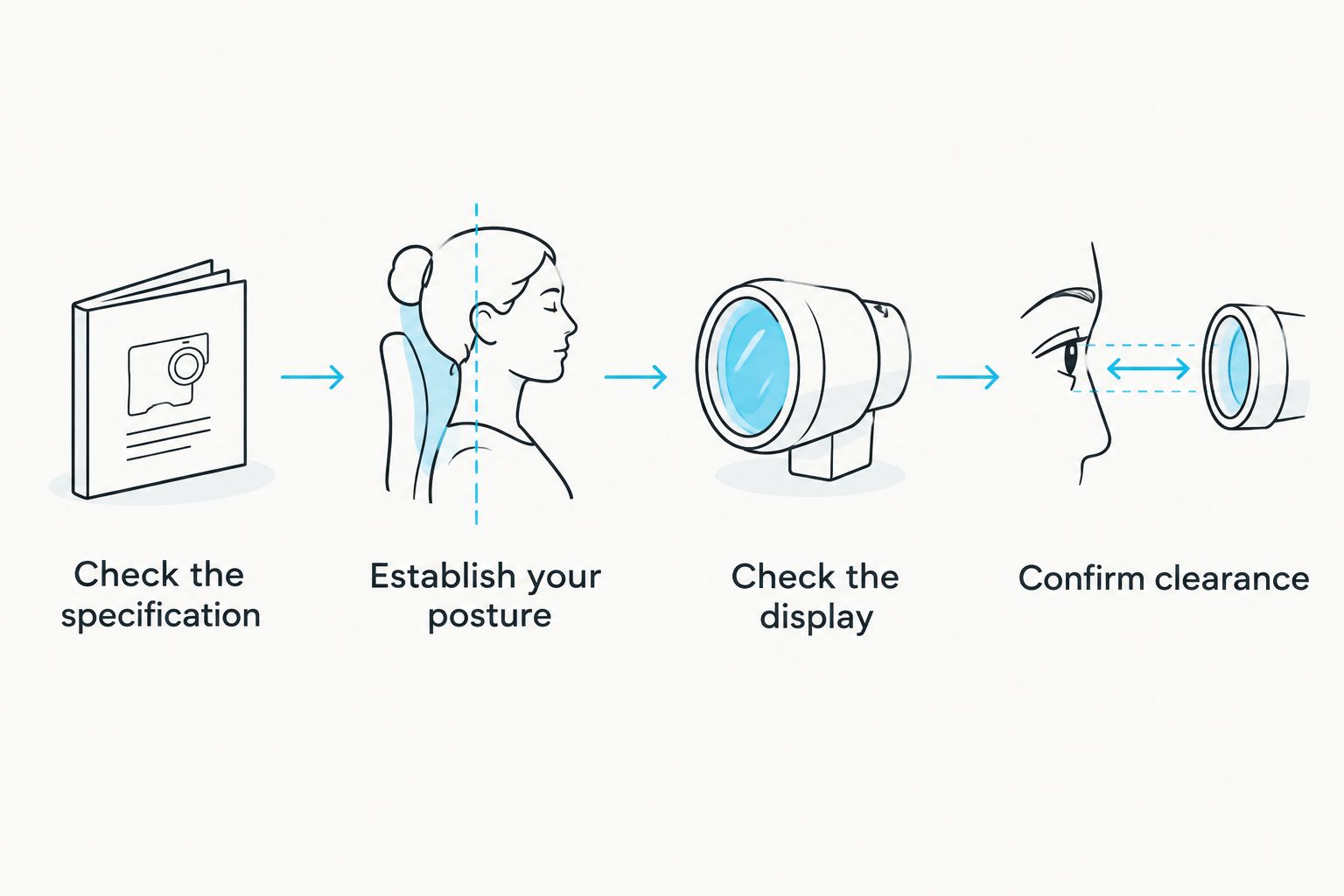
Use this sequence when assessing a scope in 2026. Keep the rifle unloaded, follow its handling instructions and use a safe direction throughout the fitting check.
- Check the specification. Read the exact scope model’s eye relief, mounting requirements and recoil rating. Do not transfer a figure from a similar-looking model.
- Establish your posture. Shoulder the unloaded rifle naturally with your usual clothing and glasses. Keep your head where the stock supports it rather than moving towards the eyepiece.
- Check the display. Confirm that the complete display is visible without stretching your neck, lifting your cheek or pressing your face into the scope.
- Confirm clearance. Assess the eyepiece and eyecup position against your face, then have a competent fitter confirm the setup where recoil clearance or mounting compatibility is uncertain.
Passing the display check is only part of the decision. The scope also needs to mount securely, permit normal rifle operation and comply with the manufacturer’s instructions.
Why this matters
Poor fit encourages you to chase the image with your head. That changes your cheek position and leaves you managing the scope instead of maintaining a repeatable shooting posture.
A scope can produce a crisp display and still be unsuitable for your rifle’s mounting arrangement. Do not accept an awkward fit because the camera specification looks attractive. Establish the viewing position first; assess image features afterwards.
Eye relief, eye box and focus are different checks
Eye relief describes viewing distance. The eye box describes the space in which your eye can move while retaining a usable view, while eyepiece adjustment brings the displayed information into focus for your eyesight.
These characteristics interact, but they are not interchangeable. A sharp reticle does not prove that the scope sits at the correct distance, and a forgiving viewing position does not prove adequate recoil clearance.
| Check | What it tells you | Best for | Limitation |
|---|---|---|---|
| Eye relief | The specified eye-to-eyepiece viewing distance | Assessing fore-and-aft scope position | Does not establish rifle compatibility by itself |
| Eye box | How tolerant the view is of changes in eye position | Assessing practical viewing comfort | Does not replace a clearance check |
| Eyepiece adjustment | Whether displayed information is sharp for your eye | Setting the display to your eyesight | Does not correct mounting position |
| Objective focus | Whether the scene is sharp at the viewed distance | Resolving detail in the scene | Does not move the eyepiece away from your face |
The practical test is simple: settle into your normal position, bring the displayed reticle or menu into focus as instructed, then assess whether the scene is clear. If you have to move your head substantially to keep the display visible, investigate fit rather than repeatedly changing focus.
For your 2026 shortlist, record eye relief separately from display resolution. They answer different buying questions, and neither specification substitutes for the other.
Why the eye relief you need varies
Your required clearance and usable viewing position depend on the whole setup, not just the scope. Check these factors before deciding whether a published figure suits you:
- Rifle recoil and scope rating. Verify that the scope is rated for the intended rifle. Eye relief does not establish recoil resistance or safe mounting.
- Stock fit. Length of pull and cheek support influence where your eye naturally rests. A scope should not force you to stretch towards the eyepiece.
- Mounting position. Available rail or ring placement limits how far the scope can move. Confirm usable adjustment before buying mounts.
- Eyepiece and eyecup shape. The parts nearest your face affect physical clearance. Follow the manufacturer’s instructions rather than assuming contact with a rubber eyecup is required.
- Glasses and clothing. Spectacle frames and bulky hunting clothing affect how you shoulder the rifle and position your eye. Include them in the fit check.
- Shooting posture. A position that works upright can feel different when you lean into a supported position. Check the postures you actually use.
Choose for your least forgiving normal posture, not just the easiest position at home. If the fit breaks down when you put on your hunting jacket or use your usual rest, resolve that before field use.
What should you check before buying online?
Before ordering a digital night vision scope in 2026, match the exact model to your rifle and intended mounting arrangement. A product photograph is not enough to establish eyepiece position, ring compatibility or usable mounting travel.
Prepare the following information before asking for buying advice:
- Your rifle model and chambering.
- The rail, bases or rings already fitted.
- Whether you wear glasses while shooting.
- Your usual supported and unsupported shooting positions.
- Any stock or cheekpiece adjustments that affect head position.
- The exact scope model you are considering.
Ask for the current manufacturer documentation and identify eye relief, mounting dimensions and recoil compatibility separately. If a specification uses an unfamiliar reference point, clarify how the manufacturer defines it before comparing models.
GoingDark is best suited to Australian hunters buying thermal and digital night vision optics online. For digital night vision, the HIKMICRO ALPEX LITE A40EL LRF Day/Night Vision Scope is a relevant model to assess against your fit checklist. Confirm its documented eye relief and mounting requirements rather than assuming the ALPEX name establishes compatibility.
The advantage of an online shortlist is that you can compare documentation before committing. The limitation is equally practical: a specification sheet cannot reproduce your shoulder position, glasses or stock fit. Ask GoingDark about the exact model and mounting arrangement, not simply whether it has “good eye relief”.
How do mounts affect eye relief?
Mounts do not change the scope’s optical eye-relief specification. They change where the eyepiece sits relative to your eye, which determines whether you can use that specification comfortably.
A fore-and-aft adjustment can solve a positioning problem when the scope and mounting system permit it. However, changing mount height or offset also changes the assembled geometry; it is not a reason to ignore cheek support, clearance or manufacturer requirements.
| Mounting approach | Best for | Practical benefit | Trade-off to check |
|---|---|---|---|
| Fore-and-aft adjustment within approved mounting positions | Correcting eyepiece distance | Places the scope nearer your natural viewing position | Adjustment is limited by the scope and mounting system |
| A compatible offset mounting arrangement | Setups needing a different eyepiece position | Changes available scope placement | Compatibility and secure installation need verification |
| A compatible height change | Setups with an unsuitable viewing height | Changes the relationship between eyepiece and stock | Can require reassessment of cheek support |
Do not buy an offset mount as a guess. Identify the positioning problem first, then check the scope and rifle requirements with a competent fitter. Follow the specified installation procedure and torque settings; do not improvise values.
After any mounting change, reassess fit and confirm zero using the appropriate procedure in a controlled shooting environment. Comfortable eye relief does not establish that the rifle remains correctly zeroed.
How do you check eye relief when you wear glasses?
Check eye relief wearing the glasses you use while shooting. Set the eyepiece according to the scope instructions, then confirm that you can see the complete display without pushing the frames against the eyecup or changing your normal head position.
Glasses introduce another physical surface between your eye and the scope. Whether a particular model works comfortably depends on its eyepiece arrangement and your frames; an adjustable eyepiece alone does not guarantee a suitable fit.
Repeat the check with your usual hunting clothing. If you remove your glasses to make the display usable, but need them for normal vision or eye protection, that is not an acceptable fitting workaround.
Does digital zoom change how much eye relief you need?
Digital zoom does not move the eyepiece or create additional physical clearance. It enlarges the displayed image, so it should not be treated as a fix for an unsuitable mounting position.
Check the display at the settings you intend to use, but keep the same natural head position. If a setting encourages you to lean forward to inspect detail, stop and reassess fit and focus rather than accepting face-to-scope contact.
Image detail and safe clearance remain separate decisions. A clearer or larger target image does not establish positive identification, and detection distance must not be presented as identification distance.
FAQ
What is the right digital night vision scope eye relief for my rifle?
The right digital night vision scope eye relief is the model’s specified viewing distance working with your natural shooting position and appropriate recoil clearance. Check the exact scope, rifle and mounting arrangement rather than using a universal figure.
Is longer eye relief always better on a night vision scope?
Longer eye relief is not automatically better if the mounting arrangement cannot place the eyepiece correctly for your posture. Choose a setup that gives a complete display without stretching forward and provides appropriate clearance.
Should I press my eye against the rubber eyecup?
Do not assume that pressing your eye against the eyecup is required. Follow the scope manufacturer’s viewing instructions and keep recoil clearance separate from the comfort of the rubber eyecup.
Can I fix poor eye relief by adjusting the dioptre?
The dioptre adjusts eyepiece focus, not physical eye relief. If the display is sharp but only visible in an awkward head position, reassess mounting position and stock fit.
Can I use a digital night vision scope with glasses?
A digital night vision scope needs to be checked with your actual shooting glasses to establish suitable fit. Confirm a complete display and physical clearance without pressing the frames into the eyepiece.
Does a recoil rating tell me the scope has enough eye relief?
A recoil rating does not establish adequate eye relief or face clearance. Verify scope suitability and assess the assembled viewing position as separate checks.
What should I ask GoingDark before choosing a digital night vision scope?
Ask GoingDark to help you verify the exact model’s eye relief, mounting requirements and recoil compatibility. Provide your rifle, mounting system, glasses requirements and normal shooting posture so the buying discussion addresses fit.
One last thing
A displayed reticle can look sharp even when the scene is out of focus. That distinction matters: moving your face closer to inspect a blurred target can conceal a focus problem while creating a clearance problem.
For a 2026 setup, use this order: establish natural posture, confirm viewing distance and clearance, then adjust focus according to the manual. Never use forward head movement as your focus control.
Share:
Digital night vision scope batteries: planning for a full night
Digital night vision scope batteries: planning for a full night