
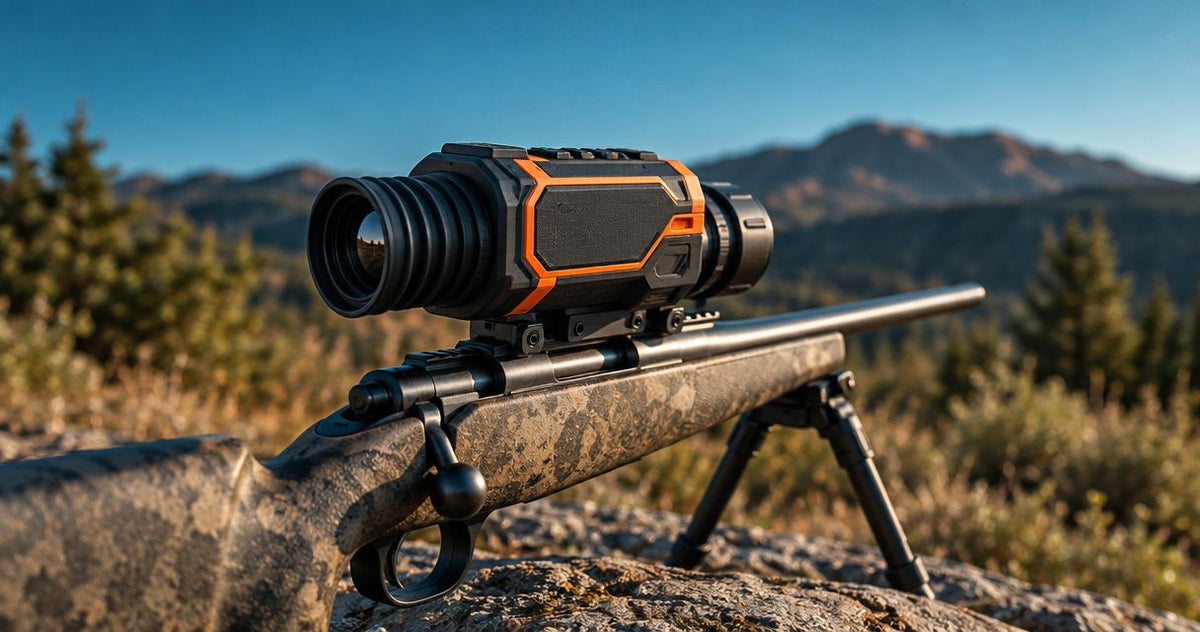
Best overall shortlist: Pulsar Krypton 2 XG50 for higher detector resolution. Best lower-resolution alternative: Pulsar Krypton 2 XQ35. Your best thermal clip on in 2026 is the model that works with your day scope, adapter and rifle—not simply the one with the largest specification figures.
- Pulsar Krypton 2 XG50 leads this thermal clip on shortlist on detector resolution: 640 × 480 pixels.
- Pulsar Krypton 2 XQ35 offers a 384 × 288-pixel alternative; compare the complete setup before choosing.
- GoingDark lists both Krypton models as monoculars; confirm the front-attachment configuration and required adapter before ordering.
- Check day-scope compatibility, recoil suitability and zero before using any thermal clip-on setup.
Why this matters
A thermal clip-on adds thermal imaging to a compatible day scope. That makes it a different buying decision from a dedicated thermal riflescope: you are choosing a complete optical and mounting system, not just a detector.
GoingDark suits Australian hunters comparing thermal clip on options against their existing day-scope setup. Start with your rifle, scope model and intended use when comparing the optics at GoingDark. A familiar daytime sight picture does not remove the need to check the thermal attachment's fit and alignment.
The Pulsar Krypton models below are listed as thermal monoculars. Treat them as candidates for a confirmed front-attachment configuration, not as a promise that every listed package includes everything needed for clip-on use.
What makes the best thermal clip on?
For a 2026 purchase, compatibility comes before a headline detection figure. Judge each candidate against these criteria before comparing the table.
- Confirmed configuration: Establish whether the exact package supports front attachment, handheld observation, or both, and which components each configuration needs.
- Day-scope compatibility: Check the attachment manufacturer's supported magnification and mounting requirements against your actual scope.
- Detector detail: Compare detector resolution separately from display resolution. Enlarging a display does not add captured thermal detail.
- Mechanical fit: Confirm objective-housing measurements, adapter compatibility and clearance around the barrel and other equipment.
- Rifle suitability: Check the exact device and mounting system against the manufacturer's recoil guidance. A secure-looking clamp is not a recoil rating.
- Repeatable setup: Understand the fitting, alignment and zero-check procedure before deciding whether regular removal suits your hunting routine.
Do not award a model the budget slot without comparing the complete required configuration. An attachment, adapter and any necessary conversion components belong in the same buying decision.
Thermal clip on shortlist at a glance
This 2026 shortlist separates the two Krypton candidates by detector resolution. It does not rank identification distance, mounting repeatability or field performance that has not been established for your setup.
| Model | Best for | Verified detector specifications | Standout feature | Key limitation |
|---|---|---|---|---|
| Pulsar Krypton 2 XG50 | Hunters prioritising higher detector resolution | 640 × 480 pixels; 12 µm pixel pitch | Higher detector pixel count of these two candidates | Listed as a monocular; confirm attachment configuration and adapter requirements |
| Pulsar Krypton 2 XQ35 | Hunters considering a lower-resolution alternative | 384 × 288 pixels; 17 µm pixel pitch | A distinct lower-resolution option within the Krypton family | Fewer detector pixels; confirm whether the image suits your intended scope magnification |
The XG50's resolution advantage is a specification comparison, not a guarantee of better results in every condition. Lens characteristics, thermal contrast, focus and the magnification of the day scope also affect what you see.
1. Pulsar Krypton 2 XG50: best thermal clip on candidate for resolution
The Pulsar Krypton 2 XG50 is listed as a thermal monocular with a 640 × 480-pixel detector and 12 µm pixel pitch. It takes the first position because it has the higher detector resolution of the two Krypton candidates here—not because of an invented field-test result.
Best for: hunters who prioritise detector resolution and intend to confirm a compatible front-attachment setup. Choose the XG50 as your first comparison when retained image detail matters more than simply selecting the smaller detector format.
Pulsar Krypton 2 XG50 pros
- Its 640 × 480-pixel detector provides more captured image pixels than the XQ35's 384 × 288-pixel detector.
- The specified 12 µm pixel pitch gives you a concrete detector characteristic to compare alongside lens and field-of-view information.
- The monocular listing gives handheld observation a place in the buying discussion; confirm the components needed for each intended configuration.
Pulsar Krypton 2 XG50 cons
- The monocular listing alone does not establish a complete, ready-to-fit clip-on package for your day scope.
- Higher detector resolution does not establish a usable magnification limit, identification distance or return-to-zero performance.
- The adapter and forward-mounted assembly introduce fit and clearance checks that a detector specification cannot answer.
What to confirm before choosing the XG50
Ask for confirmation against your exact scope model and objective housing, rather than ordering by the scope's advertised lens diameter. Also establish whether switching between handheld and front-attachment use requires changing components.
For your 2026 shortlist, the XG50 is the resolution-led default. Verdict: Hold until the front-attachment configuration, adapter and rifle suitability are confirmed; then choose the XG50 if detector resolution is your priority.
2. Pulsar Krypton 2 XQ35: best thermal clip on candidate for a lower-resolution setup
The Pulsar Krypton 2 XQ35 is listed with a 384 × 288-pixel detector and 17 µm pixel pitch. It gives you a lower-resolution alternative to the XG50 without treating a different sensor format as automatically unsuitable.
Best for: hunters willing to assess a 384 × 288-pixel image against their actual viewing needs and supported day-scope magnification. The decision is whether that complete setup meets your needs, not whether a specification sheet contains the biggest number.
Pulsar Krypton 2 XQ35 pros
- The stated 384 × 288-pixel resolution makes the detector trade-off clear before you commit.
- The specified 17 µm pixel pitch supports a direct technical comparison with the XG50.
- The monocular listing lets you include handheld observation in your configuration questions rather than considering mounted use alone.
Pulsar Krypton 2 XQ35 cons
- The detector contains fewer pixels than the XG50, so the models should not be treated as equivalent on resolution.
- The product listing does not, by itself, confirm the adapter or attachment components required for your scope.
- Lower detector resolution does not prove lower total setup expense; compare the complete configuration rather than assuming a budget winner.
What to confirm before choosing the XQ35
Ask how the XQ35 image works with the day-scope magnification you actually intend to use. Do not substitute a general recommendation for the manufacturer's guidance on the exact attachment configuration.
Choose on the image and fit requirements together. Verdict: Hold until compatibility is confirmed; choose the XQ35 only when its lower-resolution image meets your needs.
Compare the exact Krypton listings
GoingDark lists these Krypton products as monoculars. Use the exact listings below to discuss the required front-attachment configuration, rather than assuming the product title describes a complete clip-on kit.


Check the complete setup before ordering
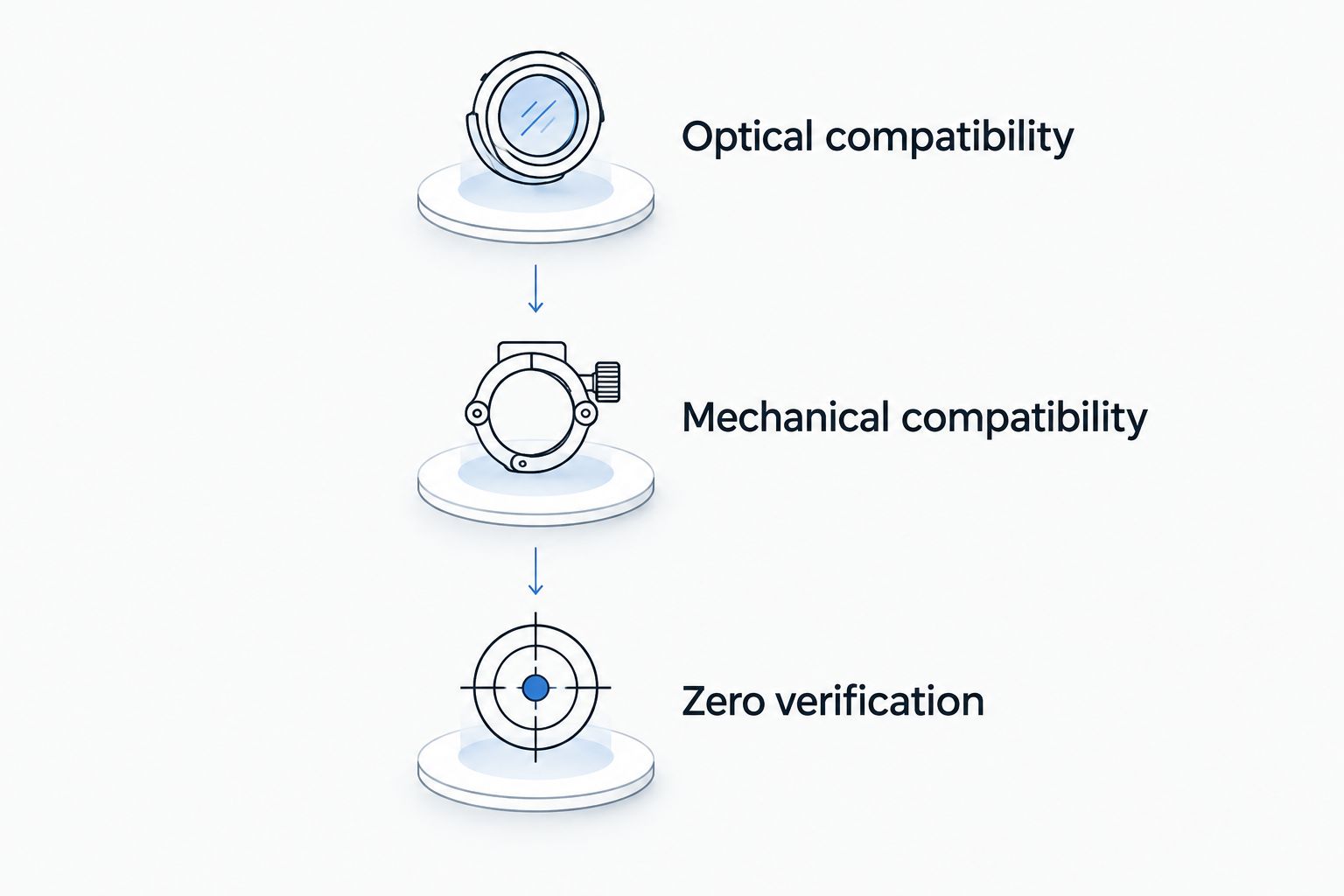
A thermal clip-on decision has three separate gates: optical compatibility, mechanical compatibility and verified operation after fitting. Passing one does not establish the others.
Optical compatibility
Record your day scope's make, model and intended magnification setting. Then check the attachment manufacturer's guidance for that combination, including how the thermal image is presented through the day scope.
Increasing day-scope magnification enlarges the thermal image you are viewing; it does not increase the detector's captured resolution. That distinction matters when comparing the XG50 and XQ35 for the same rifle.
Mechanical compatibility
Measure the actual objective housing where the adapter clamps, using the adapter manufacturer's instructions. The objective lens designation describes the lens, not necessarily the outside diameter of the housing.
Check the adapter's exact device compatibility as well. For example, the Rusan QR one-piece adapter for HIKMICRO Thunder is named for HIKMICRO Thunder; that name does not establish compatibility with a Pulsar Krypton. An adapter is not interchangeable simply because both devices are thermal optics.
Zero verification
Follow the manufacturer's fitting and alignment procedure, then verify the rifle's point of impact in a controlled range setting. If your routine includes removing and refitting the attachment, include that operation in the verification process.
Do not interpret an unchanged day-scope adjustment as proof that the complete assembly needs no checking. Your purchase decision should include whether you can fit, inspect and verify the setup consistently.
Read thermal specifications without buying the wrong thing
For a 2026 comparison, start by separating detector specifications from display specifications. They describe different parts of the imaging chain.
Detector resolution describes the captured thermal image. The XG50's 640 × 480 pixels and the XQ35's 384 × 288 pixels are therefore directly relevant to this comparison. A higher-resolution display cannot recreate detail the detector did not capture.
Pixel pitch describes the spacing of detector pixels, expressed in micrometres. The XG50 lists 12 µm and the XQ35 lists 17 µm. Neither figure, on its own, proves which complete optic gives you the better field of view or usable image.
Thermal sensitivity concerns the ability to distinguish small temperature differences. Compare sensitivity figures with their measurement conditions rather than treating one number as a complete verdict on image quality.
Detection distance is not identification distance. A thermal signature at a stated detection distance does not establish species, a clear foreground or a safe background. Do not use a detection claim as your shooting-distance recommendation.
Finally, distinguish a thermal monocular, a dedicated thermal riflescope and a confirmed thermal front attachment. A familiar product-family name does not make every configuration interchangeable.
How the shortlist is ranked
The ranking uses the stated detector specifications and the requirements of a day-scope attachment setup. It places the Pulsar Krypton 2 XG50 first for higher detector resolution and the Pulsar Krypton 2 XQ35 second as the lower-resolution alternative.
No score is assigned for unverified runtime, weight, recoil tolerance, identification distance or mounting repeatability. Those checks remain purchase conditions, not assumed advantages.
Which thermal clip on should you choose?
Start with the Pulsar Krypton 2 XG50 if you want the higher-resolution candidate. Compare the Pulsar Krypton 2 XQ35 when you are prepared to assess the lower-resolution image against your actual scope settings.
For your 2026 purchase, ask GoingDark to confirm the complete thermal clip on configuration against your day scope and rifle. If the fit, supported magnification or required components remain unresolved, wait rather than ordering on the detector specification alone.
FAQ
What's the best thermal clip on to shortlist in 2026?
The Pulsar Krypton 2 XG50 leads this shortlist for detector resolution, with 640 × 480 pixels. Confirm the front-attachment configuration, adapter and day-scope compatibility before ordering; the listed product is described as a monocular.
Is the Pulsar Krypton 2 XG50 better than the XQ35?
The Pulsar Krypton 2 XG50 has higher detector resolution than the XQ35: 640 × 480 pixels versus 384 × 288 pixels. That advantage does not establish better compatibility, mounting repeatability or identification distance for your rifle.
Can I use any thermal monocular as a clip-on?
No, a thermal monocular is not automatically suitable for use in front of a day scope. The exact device must support that configuration, with the correct optical components, adapter and manufacturer guidance.
Does a thermal clip-on need its zero checked?
Yes, verify the complete fitted setup according to the manufacturer's instructions. If you plan to remove and refit the attachment, include that operation in your point-of-impact checks.
How much day-scope magnification can I use with a thermal clip-on?
Use the magnification range supported by the exact attachment manufacturer. Increasing day-scope magnification enlarges the displayed thermal image without adding captured detector detail.
Is the objective lens size enough to choose a clip-on adapter?
No, the objective lens designation is not the same measurement as the outside of the scope housing. Measure the clamping area as instructed and confirm compatibility with both the scope and thermal device.
Does a thermal detection distance tell me how far I can identify an animal?
No, detection distance does not establish identification distance. Confirming an animal and assessing the surrounding scene require more information than detecting a heat signature.
What should I send GoingDark before choosing a thermal clip on?
Send your day-scope make and model, intended magnification, rifle details and relevant objective-housing measurements. Ask for confirmation of the attachment configuration, required adapter and manufacturer recoil guidance.
One last thing
Write down the complete parts list before choosing the detector. Include the thermal unit, the required viewing or attachment components and the exact adapter. A clear parts list turns a promising optic into a setup you can actually assess—and prevents a monocular listing from being mistaken for a complete clip-on package.
Share:
Best rangefinding thermal scopes for hunting in 2026
Best thermal scopes for long-range hunting in 2026