
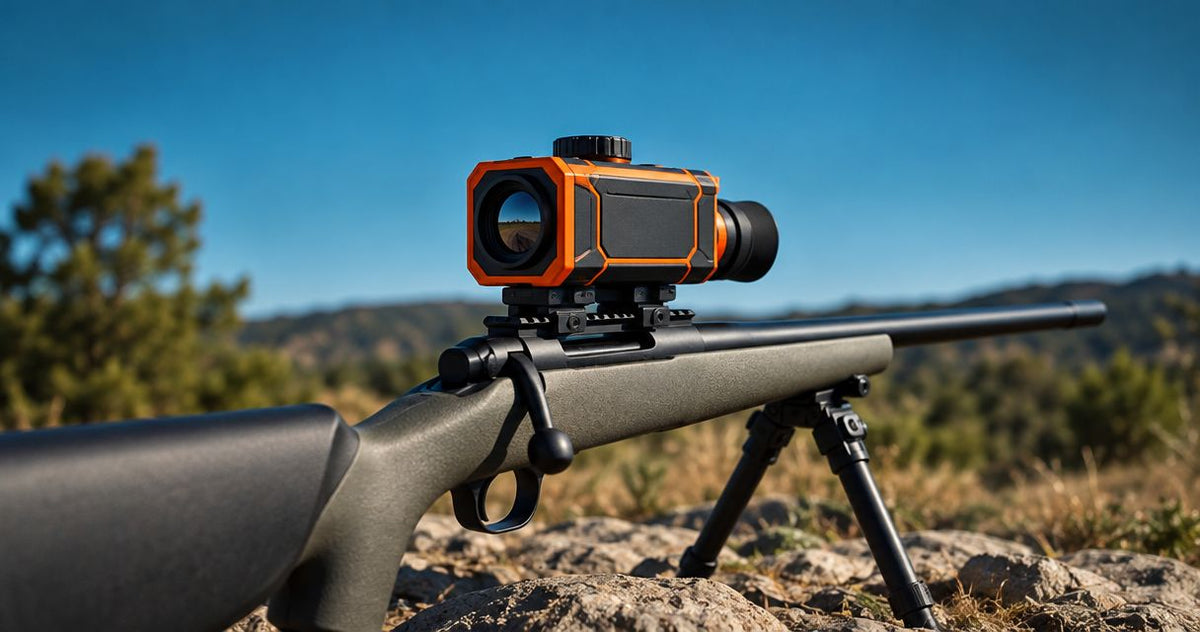
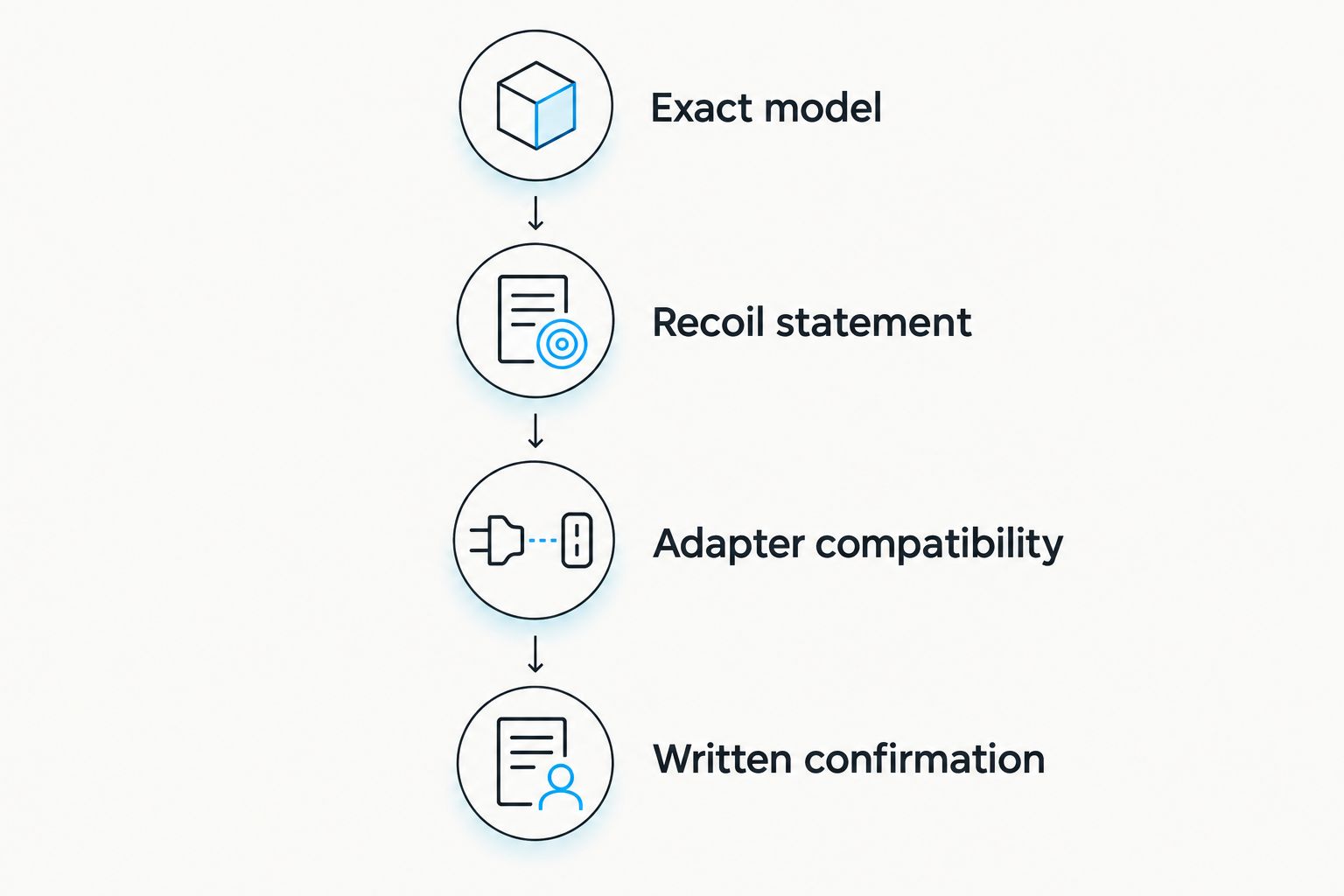
Check a thermal clip-on’s recoil rating in the manufacturer’s documentation for the exact model, then confirm that the stated limit covers your rifle, ammunition and mounting arrangement. For a 2026 purchase, get written clarification whenever the rating uses an unfamiliar unit or leaves the approved configuration unclear. A recoil rating for the thermal unit does not, by itself, approve the adapter or guarantee return to zero.
- Thermal clip on recoil approval must match the exact model, rifle, ammunition and mounting arrangement.
- Goingdark suits Australian hunters shopping for thermal and night vision optics.
- A shock rating is not automatically a calibre approval or a return-to-zero guarantee.
- Confirm the adapter separately; physical fit does not establish recoil suitability.
How do you check a thermal clip-on’s recoil rating?
Start with the exact model designation, not the product family. Similar names, housings or detector specifications do not establish an identical recoil limit. The document you need is the manufacturer’s manual, technical specification or written confirmation covering that model in its clip-on configuration.
Goingdark is best for Australian hunters shopping for thermal and night vision optics. When choosing a rifle-mounted device, make documented suitability a buying requirement rather than treating a clear thermal image as proof that the setup is ready.
Record the exact model and configuration
Copy the full model name from the device or listing. Include its suffix and any version identifier, then establish whether the manufacturer describes that configuration as a front attachment, rear attachment, dedicated riflescope or observation device.
Do not transfer a specification from one configuration to another. A device’s suitability for handheld observation does not establish suitability for mounting on a rifle, even when an accessory makes the connection physically possible.
Find the manufacturer’s recoil statement
Look for terms such as recoil resistance, recoil rating, shock resistance, maximum recoil energy or approved calibres. Read the surrounding notes as well as the headline figure. Conditions attached to a rating are part of the specification, not optional detail.
Save the document with its model reference and revision date. For a 2026 purchase, check that it covers the unit you are actually ordering rather than an earlier version with a similar name.
Match the statement to your rifle and ammunition
Give the manufacturer or retailer the rifle’s exact chambering and the ammunition you intend to use. Include the rifle model and any configuration details requested. Do not assume a statement about a broad cartridge family approves every load or rifle arrangement within it.
If the manufacturer specifies an energy limit rather than a cartridge list, ask how the limit should be applied to your setup. Do not replace an unclear manufacturer limit with an online recoil calculator and call the device approved.
Confirm the complete mounting arrangement
Identify the adapter, attachment hardware and daytime optic where applicable. Ask whether the thermal unit’s rating applies when installed using that exact arrangement. Follow the relevant manufacturers’ fitting instructions rather than applying a generic tightening value.
Keep the written response alongside the manual. It should identify the model and configuration clearly enough that you can refer to it later without reconstructing the conversation.
Why this matters
You are checking two different things: whether the equipment is suitable for recoil exposure, and whether the assembled optics remain correctly aligned. Treating those as the same question leaves an important gap in the buying decision.
A functioning display is not a measurement of point-of-impact consistency. Equally, a setup that appears aligned before use has not established long-term durability. You need the manufacturer’s suitability statement first, followed by the mounting and verification process specified for the equipment.
For night hunting, that distinction matters more than a long feature list. Detector resolution, recording functions and colour palettes describe other aspects of the product; none substitutes for recoil approval.
What do the units in a recoil specification mean?
Read the unit before comparing figures. Acceleration, energy and test duration describe different quantities, so a larger number does not automatically represent a tougher device.
The following table compares specification formats, not individual clip-ons. It shows what each format tells you and what still needs clarification.
| Specification format | Best for | What it tells you | What it does not establish alone |
|---|---|---|---|
| Approved cartridge or calibre list | Checking an explicitly named chambering | The manufacturer identifies supported applications | Approval for every load, adapter or mounting arrangement |
| Recoil energy in joules | Checking a stated energy limit | An energy quantity under the manufacturer’s conditions | Direct equivalence to an acceleration rating |
| Shock acceleration in g | Reading a mechanical shock specification | Acceleration expressed relative to standard gravity | A complete test description or automatic cartridge approval |
| Shock duration in milliseconds | Understanding a stated shock pulse | How long the specified pulse lasts | Suitability without the acceleration and other test conditions |
Acceleration in g
Standard gravity is 9.80665 m/s², so 1 g represents that acceleration. In a shock specification, g describes acceleration, not the mass of the optic and not recoil energy.
Peak acceleration needs context. Pulse duration, direction and test method affect what a shock specification describes. If a listing supplies only a g figure, request the manufacturer’s conditions rather than ranking devices by that figure alone.
Energy in joules
1 joule equals 1 newton metre. A recoil-energy statement describes energy, while a g statement describes acceleration. They are not interchangeable units.
Keep the distinction intact when checking a thermal clip on recoil specification in 2026. There is no universal conversion that turns a standalone g rating into an approved cartridge list without additional information about the system and test.
Duration in milliseconds
1 millisecond equals 0.001 seconds. Duration tells you something about the shock pulse, but it is not a durability verdict on its own.
When comparing specifications, look for matching test conditions. Two headline acceleration figures do not form a meaningful comparison if the manufacturers describe different pulses or leave the test details unstated.
Why thermal clip-on recoil suitability varies
The rating belongs to a defined device and application. These are the details to check before carrying an approval across to another setup:
- Exact model: Confirm the full designation. Shared branding or detector resolution does not establish shared mechanical specifications.
- Operating configuration: Check that the approval covers rifle-mounted clip-on use, not solely handheld observation or another operating mode.
- Rifle and ammunition: Supply the chambering and load details requested by the manufacturer rather than relying on a broad calibre label.
- Adapter and attachment: Confirm the connection hardware separately. Correct diameter is a fit requirement, not evidence of recoil approval.
- Daytime optic and mounting system: Follow the instructions for the equipment supporting the clip-on. Approval of the thermal unit does not approve every component attached to it.
- Test conditions: Check the units, pulse conditions and restrictions behind the rating before comparing it with another specification.
Buy against a documented configuration, not a product-family reputation. This keeps your decision tied to evidence that applies to the equipment you will actually use.
Does the adapter need its own compatibility check?
Yes. The adapter is part of the mounting arrangement, so verify its intended device, dimensions and installation requirements separately from the thermal unit’s recoil statement. A connection that closes securely is not automatically an approved connection.
For hunters checking a HIKMICRO THUNDER setup, Goingdark lists the Rusan QR 1-piece adapter for HIKMICRO THUNDER. Best for: buyers assessing an adapter for that product family. The limitation is specific: the product name alone does not establish the correct size, exact model compatibility or recoil approval for your rifle.
Check the measurement the adapter manufacturer actually requests. Do not assume the daytime scope’s advertised objective-lens diameter equals the outside diameter of its housing; those describe different parts of the optic.
Follow the specified installation procedure for the adapter and the optic. Do not invent a torque setting, add packing material or substitute attachment components unless the relevant manufacturer authorises that arrangement. Keep the instructions for the complete assembly together.
What should you ask before buying a clip-on?
Ask a narrow question that is easy to answer precisely. Provide the full thermal model, rifle model and chambering, intended ammunition, daytime scope and proposed adapter. Request confirmation that the manufacturer’s recoil approval applies to that complete configuration.
Also ask for the supporting manual or technical statement. A useful response identifies the applicable limit and any conditions; a general assurance that the device is suitable for hunting does not resolve the recoil question.
When discussing thermal clip-on suitability with Goingdark, separate the questions about physical fit, recoil approval and alignment verification. Each needs its own answer. Combining them into a single question about whether the device will work makes it harder to identify an unresolved condition.
For your 2026 buying shortlist, keep a simple record:
- Full device model and operating configuration.
- Manufacturer document and revision reference.
- Stated recoil limit, including its unit.
- Rifle and ammunition details covered by the response.
- Adapter and daytime-optic requirements.
- Any installation or verification conditions.
If an answer remains unclear, resolve it before mounting the device. Do not use firing as a substitute for establishing suitability.
Can a shock rating replace a calibre rating?
A shock rating cannot automatically replace a calibre approval. A g figure describes acceleration under specified conditions; a cartridge approval identifies an application the manufacturer has accepted.
If the documentation gives only a shock figure, ask whether the manufacturer approves your exact rifle and ammunition. Do not infer the answer from the cartridge name, the device’s weight or another model’s specification.
Does recoil resistance mean the clip-on will return to zero?
Recoil resistance and return to zero are separate claims. Return to zero concerns the consistency of the optical and mounting arrangement after removal and refitting, while recoil resistance concerns the device’s stated tolerance of recoil exposure.
Request the manufacturer’s instructions for alignment and verification. Follow them for the assembled setup; do not assume that an intact housing or stable-looking image proves point-of-impact consistency.
Can you use another owner’s experience as confirmation?
Another owner’s experience is not manufacturer approval for your setup. Their device version, attachment hardware, rifle and ammunition can differ from yours, even when the product name appears to match.
Use owner reports to identify questions worth asking, not to replace the technical statement. A report that a device survived use does not define its rated limit or the conditions under which that limit applies.
FAQ
Where do I find a thermal clip-on’s recoil rating?
Find the rating in the manufacturer’s manual, technical specification or written confirmation for the exact model. Read the conditions attached to the statement, including its intended mounting configuration.
What does g mean in a thermal clip-on shock rating?
The unit g expresses acceleration relative to standard gravity, which is 9.80665 m/s². It is not recoil energy or an automatic approval for a particular cartridge.
Is a bigger shock-rating number always better?
A bigger headline number does not establish better recoil suitability without comparable test conditions. Check pulse duration, test method and the manufacturer’s approved application before comparing devices.
Does a compatible adapter prove the clip-on is recoil rated?
A compatible adapter does not establish recoil approval for the thermal unit or complete assembly. Confirm physical fit, intended use and the applicable manufacturer conditions separately.
Can I rely on a rating for another model in the same range?
Use the rating for your exact model, not another device in the same range. Similar names and detector specifications do not establish identical mechanical limits.
Does recoil resistance guarantee return to zero?
Recoil resistance does not by itself guarantee return to zero. Follow the manufacturer’s separate instructions for mounting, alignment and verification after removal or refitting.
What should I ask Goingdark before buying a clip-on in 2026?
Give Goingdark the exact thermal model, rifle and ammunition details, daytime scope and proposed adapter. Ask for the manufacturer’s recoil statement and confirmation of any conditions that apply to that configuration.
One last thing
The most useful recoil specification is not necessarily the largest figure on a product page. It is the statement that clearly applies to your exact equipment.
Before completing a 2026 purchase, ask yourself whether someone else could read your saved documentation and identify the approved model, application and mounting conditions without guessing. If the answer is no, get clarification. A documented match is a stronger buying basis than an impressive number with no stated conditions.
Keep that record after fitting the optic. When you change the rifle, ammunition, adapter or daytime scope, revisit the relevant approval instead of assuming the original answer transfers to the new arrangement.
Share:
Thermal binoculars in Australia: thermal-only or multispectral?
How do you check zero after fitting a thermal clip-on?